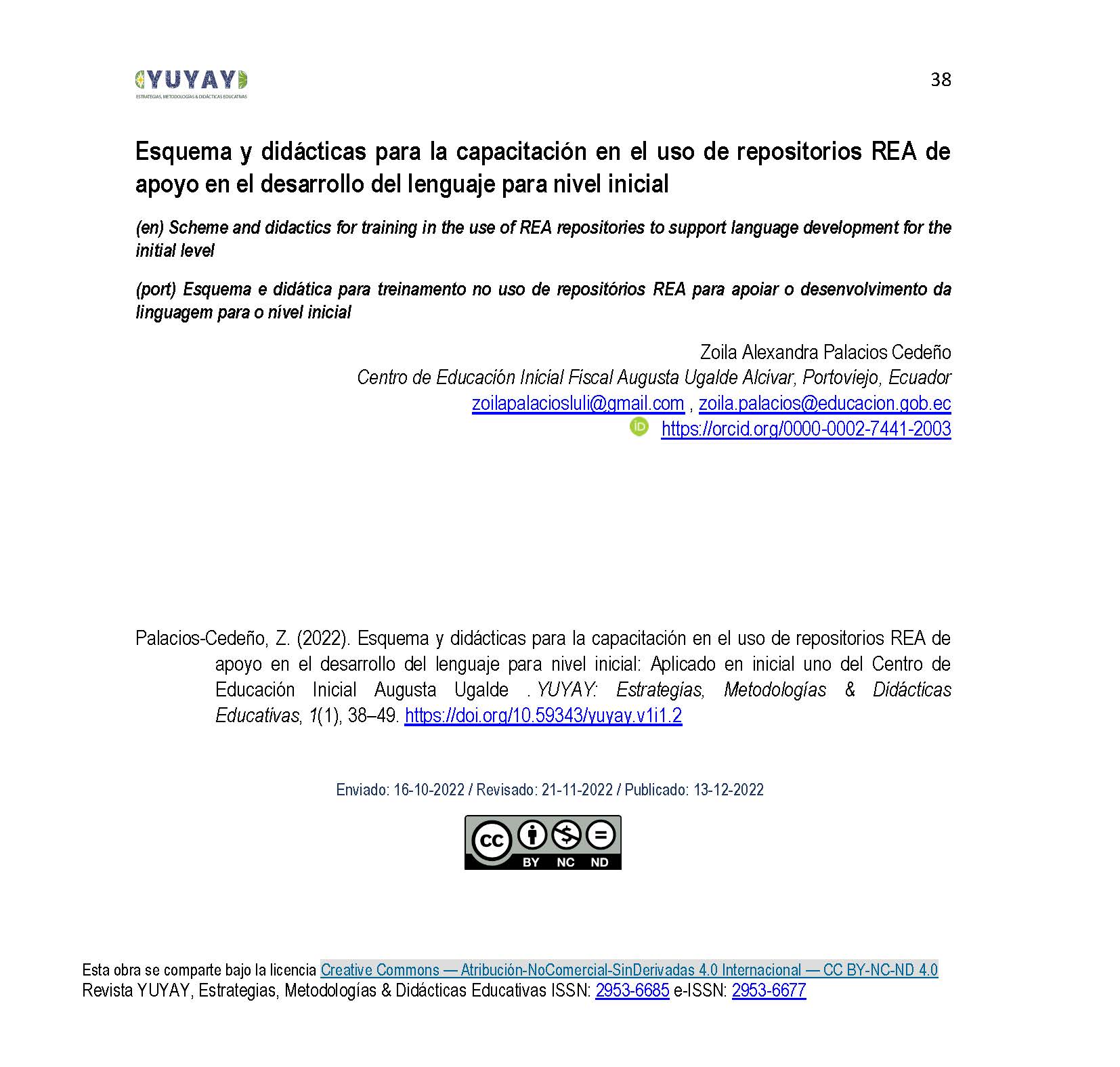
Scheme and didactics for training in the use of RLO repositories to support language development for the initial level
Applied on inicial uno of Centro de Educación Inicial Augusta Ugalde
DOI:
https://doi.org/10.59343/yuyay.v1i1.2Keywords:
multimedia, interactiva, autonomous, quality, sinewsAbstract
The development of this project aimed at the investigation, construction and presentation of a training plan that can be implemented in an LMS aimed at teachers and parents of children of initial 1 of the Centro de Educación Inicial Fiscal Augusta Ugalde Alcívar (CEIAUA), is in the urban parish Portoviejo, in the canton Portoviejo, province of Manabí.
The execution of this project seeks to contribute to the resolution of the problem in the development of language in children of 4 years taking reference to the methodological events of other contexts, including in the Latin American region and that shows that it is a current problem. The absence of parental focus on the actions or routines of infants makes imperative an application of alternatives that dialogue with the resources they already have and that have a use more of leisure than didactic.
Downloads
References
Cabrera-Amaiquema, J (2020) La escritura como Tecnología. Universidad de las Artes. https://dspace.uartes.edu.ec/handle/123456789/660
Cobo, C., & Moravec, J. (2011). Aprendizaje invisible. Hacia una nueva ecología de la educación. Laboratori de mitjans interactius/Publicacions i Edicions de la Universitat de Barcelona. https://prep-digital.fundacionceibal.edu.uy/jspui/handle/123456789/170
Fernández March, A. (2006). Metodologías activas para la formación de competencias. Education siglo XXI, 24(1), 35-56. https://revistas.um.es/educatio/article/view/152
Gabelas, J. A., & Marta-Lazo, C. (2016). Comunicación digital: Un modelo basado en el Factor R-elacional. Comunicación digital, 1-191. http://contenidosdigitales.uned.es/fez/view/intecca:VideoCMAV-5a6f82f0b1111fb6438b45f1
McKenna, M., Labbo, L., Reinking, D., & Zucker, T. (2003). Effective use of technology in literacy instruction. Best practices in literacy instruction, 2, 307-331. https://books.google.es/books?hl=es&lr=&id=THqYbGvItWUC&oi=fnd&pg=PA361&dq=use+of+technology+for+the+development+of+literacy&ots=b5el_pRII9&sig=uMpMeB5y3MlvffNZf4W96gC8UO8
Mineduc, (2016). Instructivo Metodológico para el docente de la I Etapa de Componente Post-alfabetización. Módulo 3. Dirección Nacional de educación para personas con escolaridad inconclusa. P. 26. https://educacion.gob.ec/wp-content/uploads/downloads/2016/06/MODULO4.pdf
Punín, P. (2021) Proyecto de nivelación de la lectoescritura mediante estrategias metodológicas virtuales: una propuesta para tercer año de Educación General Básica Ecuatoriana. Universidad del Azuay. http://dspace.uazuay.edu.ec/handle/datos/11365
Quevedo, M. (2015) Aplicación del método de escuelas lectoras con el uso de herramientas interactivas en segundo año de básica de la unidad educativa San Vicente de Paúl de Riobamba. Universidad Católica del Ecuador. P. 21. http://repositorio.puce.edu.ec/handle/22000/7963
Sepulveda, J. (2020). Enfoques multidisciplinares, en Ingeniería, Tecnología e Innovación. Corporación Americana, Medellín. https://americana.edu.co/medellin/wp-content/uploads/2020/09/Enfoques-multidisciplinares-en-ingenier%C3%ADa-tecnolog%C3%ADa-e-innovaci%C3%B3n.pdf DOI: https://doi.org/10.52441/ing202002
Sevilla-Villanueva, B. (2020). Neuroeducación en Ciclos Formativos: guía para el profesorado (Master's thesis, Universitat Politècnica de Catalunya). https://upcommons.upc.edu/handle/2117/339593
Siemens, G. (2014). Digital Learning Research Network. Learnspace, November. http://www.elearnspace.org/blog/2014/11/18/digital- learning-research-network-dlrn/ Valery, O. (2000). Reflexiones sobre la escritura a partir de Vygotsky. Educere, vol. 3, pp. 38-43.
Downloads
Published
Versions
- 2022-12-13 (2)
- 2022-12-13 (1)
Issue
Section
Categories
License
Copyright (c) 2022 YUYAY: Estrategias, Metodologías & Didácticas Educativas

This work is licensed under a Creative Commons Attribution-NonCommercial-NoDerivatives 4.0 International License.
You are free to:
Share — copy and redistribute material in any medium or format.
- Licensor cannot revoke these freedoms if you follow the terms of the license.
Attribution — You must give credit appropriately, provide a link to the license, and indicate if any changes have been made. You may do so in any reasonable way, but not in a manner that suggests that you or your use are supported by the licensor.
NonCommercial — You may not use the material for commercial purposes.
NonDerivatives — If you remix, transform, or create from the material , you may not distribute the modified material.
No additional restrictions — You may not apply legal terms or technological measures that legally restrict others from making any use permitted by the license.
How to Cite