
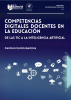
Digital Teaching Competencies in Education From ICT to Artificial Intelligence
Keywords:
Artificial Intelligence, Digital Skills, Digital Society, Digital TechnologySynopsis
The book Digital Teaching Competences in Education: from ICT to Artificial Intelligence provides a rigorous overview of how education is being reshaped by digital technologies, tracing the shift from the Industrial Society to the Knowledge Society and finally to today’s Digital Society. In Part I, it establishes the conceptual foundations: it defines and classifies ICT, examines their epistemological bases, and presents Educational Technology as an interdisciplinary field that systematically designs, implements and evaluates technology-enhanced teaching–learning processes. Classic and contemporary instructional design models (ADDIE, Dick & Carey, constructivist and connectivist approaches) are reviewed, highlighting their evolution toward flexible and personalized digital learning environments.
The book then develops the notion of digital competence and more specifically teachers’ digital competence, drawing on international standards and frameworks. It analyses pedagogical approaches for integrating digital tools into classroom practice, the role of open educational resources, and strategies and instruments to assess teachers’ digital competence, including a case study at upper-secondary level.
Part II focuses on Artificial Intelligence in education. After discussing digital education, digital learning and learning ecosystems, it introduces key concepts of AI and maps its main educational applications: personalized learning, intelligent tutoring systems, adaptive platforms, automated assessment and intelligent feedback, learning analytics for dropout prediction and instructional design optimization, conversational agents and chatbots, as well as tools that enhance inclusion and accessibility. Ethical issues—responsible use, bias, data protection, equity and the digital divide—are treated as a cross-cutting axis. Overall, the book offers a solid theoretical and practical framework to help teachers build critical, ethical digital competences in technology-rich and AI-mediated learning environments.
References
Su, S., Shooter, W., Brough, A. & Mackay, D. (2023). Evaluation of Panorama Platform Use and Perceptions of Effectiveness. Utah State Board of Education.
Subosa, M., & West, M. (2018). Re-orienting education management information systems (EMIS) towards inclusive and equitable quality education and lifelong learning Working papers on education policy, No. 5. UNESCO. https://unesdoc.unesco.org/ark:/48223/pf0000261943
Tu, CH., Sujo-Montes, L., Yen, CJ. et al. The Integration of Personal Learning Environments & Open Network Learning Environments. TECHTRENDS TECH TRENDS 56, 13–19 (2012). https://doi.org/10.1007/s11528-012-0571-7
Van Laar, E., van Deursen, A. J. A. M., van Dijk, J. A. G. M., & de Haan, J. (2020). Measuring the levels of 21st-century digital skills: A critical analysis of instruments and their psychometric qualities. Poetics, 81, 101434. https://doi.org/10.1016/j.poetic.2020.101434
Vorobyeva, K. I., Belous, S., Savchenko, N. V., Smirnova, L. M., Nikitina, S. A., & Zhdanov, S. P. (2025). Personalized learning through AI: Pedagogical approaches and critical insights. Contemporary Educational Technology, 17(2), ep574. https://doi.org/10.30935/cedtech/16108
Voskoglou, MG (2022). Conectivismo vs. Teorías tradicionales del aprendizaje. Revista Americana de Investigación Educativa , 10 (4), 257-261.
Vygotsky, L. S. (1978). El desarrollo de los procesos psicológicos superiores. Editorial Crítica.
Wolf, R., Armstrong, C. & Ross, S. M. (2018). Study of Knewton Online Courses for Un
dergraduate Students: Examining the Relationships Among Usage, Assignment Completion, and Course Success. Johns Hopkins University Center for Research and Reform in Education.
Yang, M., & Wen, F. (2023). AI-Powered Personalized Learning Journeys: Revolutionizing Information Management for College Students in Online Platforms. Journal of Information Systems Engineering and Management, 8(1), 23196. https://doi.org/10.55267/iadt.07.14079
Yeh, P. L., Kuo, W. C., Tseng, B. L. & Sung, Y. H. (2025). Does the AI-driven Chatbot Work? Effectiveness of the Woebot app in reducing
anxiety and depression in group counseling courses and student acceptance of technological aids. Current Psychology 44, 8133–
https://doi.org/10.1007/s12144-025-07359-0
Yuan, L., & Powell, S. (2013). MOOCs and open education: Implications for higher education. JISC CETIS
Zawacki-Richter, O., Marín, V. I., Bond, M. & Gouverneur, F. (2019). Systematic review of research on artificial intelligence applications
in higher education – where are the educators? International Journal of Educational Technology in Higher Education, 16(1), 39. https://doi.org/10.1186/s41239-019-0171-0
Zou, Y., Kuek, F., Feng, W. & Cheng, X. (2025). Digital learning in the 21st century: Trends, challenges, and innovations in technology
integration. Frontiers in Education, 10, 1562391. https://doi.org/10.3389/feduc.2025.1562391
Downloads
Published
November 17, 2025
Series
Categories
Copyright (c) 2025 Carmen Cerón-Garnica
License

This work is licensed under a Creative Commons Attribution-ShareAlike 4.0 International License.
Details about this monograph
ISBN-13 (15)
978-9942-791-07-8
Physical Dimensions
How to Cite
Digital Teaching Competencies in Education From ICT to Artificial Intelligence: Vol. Libro 2. (2025). JLA Ediciones. https://doi.org/10.59343/jlaed.4