General diagnostic
The
Lautaro Aspiazu Sedeño Educational Unit (UELAS), which is located in the
Palenque parish of the Palenque Canton of the province of Los Ríos, detected
the lack of innovative methodological evaluation strategies for its students
due to the lack of knowledge about the management of these, and the lack of
training provided by the Ministry of Education and institutional authorities on
the use of different platforms that allow to develop simple, practical, and fun
evaluations.
The scarce use of digital
tools in the evaluation process causes the student to show a total disinterest
in the preparation for them, it should be emphasized that it is important that
teachers change strategy in order to prepare students for the tests to be a
student which are applied by INEVAL in order to check the applicability of the
standards of institutional educational quality as well as to The transform
tests that are applied for admission to fiscal universities.
It is necessary to make a
change in the applicability of evaluations, whether they are diagnostic,
formative or summative, through innovative strategies that include the use of
technological tools such as Google Forms, Educaplay, Genially, YouTube, Socrative,
among others that allow the creation of structured base questionnaires in
accordance with the guidelines issued by the Ministry of Education for the
application of evaluations at the national level in all institutions.
Educational.
Technology has been
gradually incorporated into teaching-learning processes, and intrinsically in
evaluation, contributing to the generation of current dynamics and in some
cases disruptive or unimaginable in education, for this reason its use and
integration is perceived as necessary and beneficent as mentioned by Olvera et
al., (2011).
It is necessary to emphasize
that within the existing problem in educational institutions is the lack of one
of the most important educational components within the teaching-learning
process such as evaluation that requires greater attention due to the great
advances in technology, so it constitutes a challenge and frames greater effort
on the part of teachers to generate significant changes and transformations
within its application within the classroom.
Methodology
The
teaching-learning methodology to be applied in this proposal is Flipped
Classroom since it focuses on the learning of the participants and not on the
teaching of the teacher, being a didactic strategy that focuses mostly on
practice that is to say this pedagogical model consists of inverting the order
of traditional education since the student takes an active role in his learning
process through an interactive environment in which the teacher becomes a guide
and facilitator of learning, a process in which students are involved and
actively participate in the classroom building their learning.
In
flipped learning, the student can obtain and have information without the need
for the physical presence of the teacher, since the aim is for the student to
increase their commitment and responsibility in the learning process, allowing
them to self-train in an integral way, discovering and developing skills
according to their requirements (Prieto et al., 2021) and that four fundamental
aspects are needed to consider to apply flipped learning.
It
begins with "Flexible environments" which he mentions (Mancero, 2022)
by expressing that these helps provide students with spaces so that they have
the option to choose when and where they can learn. The culture of learning
according to Mayea-Carpio (2022) Create in students the culture in which they
are the protagonists of their learning, and the teacher becomes a guide who
will support and deepen knowledge and expose or present different alternatives,
options, and opportunities, giving them a clearer vision for the acquisition
and construction of their knowledge. Totally transforming the traditional
methodology.
Again
Mancero (2022) recognizes that there is a type of intentional content which
must be thoroughly analyzed the content to be presented and made available to
students should allow students to develop their potential and acquire
educational skills becoming critical people. Mayea-Carpio (2022) and Serrano
(2022) refer to the "professional teacher" as the main gear of
inverted learning the teacher must organize the time in the best way so that
students can interact and participate actively distributing activities, tasks
and evaluations among others that can be developed inside the classroom and
outside it (Mayea-Carpio, 2022).
A
Fidalgo-Blanco and ML Sein-Echaluce. (2020) comment
that the flipped classroom is a methodology that is part of the new modalities
of study due to technological progress and online learning, through this
information can be presented in different formats which causes interest and
motivation in students, encouraging effective and timely participation, they
also opt for personalized and autonomous learning.
Development
of the plan
To
structure an adequate training for the educational environment, the use of
Moodle as a digital tool was selected with an integrated system that allows
creating personalized learning environments according to needs and requirements
is a means to develop and manage online training spaces, it is designed for
educators, administrators, and students (Rodríguez, 2018).
Among
the features of the Moodle platform is the one that is updated to its versions
with improvements to meet the needs of teachers and students. Its versatility
features multiple template options to customize the environment, even within
its most standard version. Its interface is very intuitive and easy to handle
according to the type of server on which it is being installed.
As
an LMS, it offers different activities and collaborative tools while allowing
access to reports of activities or student performance. The LMS includes an
academic calendar in which activities can be organized according to the
instructional schedule thanks to its simple and intuitive text editing.
Resources:
Genially:
It allows you to create interactive content (individually or collaboratively)
attractive and effective. It allows the creation of multiple formats such as
presentations, flipped classrooms, infographics, interactive images, guides,
etc. It has a paid subscription, but its free version is very complete
(Mayea-Carpio, 2019).
Canva:
It is a platform to create images and graphic designs more visual, but not
interactive. It is simpler than Genially so it offers a good alternative for
teachers with less digital knowledge / skills and for the students themselves
to create visual content.
Liveworksheets:
Serrano (2022) that liveworksheets allows you to transform any traditional
worksheet in doc, PDF, jpeg format. into an interactive sheet with
auto-correction. Students can take the activity online and send their answers
directly to their teacher or see the answers at the end of the activity. The
exercises can incorporate audio and video and offer several types of questions.
EducaPlay:
It is a web tool that allows teachers to create different types of multimedia
educational activities, through various scenarios or activities such as
crosswords, word search, riddles, dictations, among others.
Wordwall:
It is a digital resource that allows you to create and edit activities for the
classroom in a simple way. With Wordwall you can create different types of
games for students (Mancero, 2022).
Following the data collected during the
analysis phase of this project, it has been considered that the learning
outcomes can be distributed in five units with their respective sub-themes and
learning achievements for a virtual training plan with 40 hours of learning in which asynchronous and synchronous
learning has been considered from the ARCS structure.
Table 1
Categories, definitions, and motivational
strategies of the ARCS Model
|
Category
|
Definition
|
Motivational
strategies
|
|
Attention
|
Capture
students' interest and stimulate their curiosity to learn.
|
Incongruity
and conflict
Concretion
Variability
Humor
Research
Participation
|
|
Relevance
|
Consider
the personal needs or goals of the student to generate a positive attitude.
|
Experience
Current
value
Future
utility
Need
for play
Modelling
Election
|
|
Confidence
|
Help
students believe they will succeed and know how to control it.
|
Learning
Requirements
Difficulty
Expectations
Powers
Self-confidence
|
|
Satisfaction
|
Reinforce
achievements with internal and/or external rewards
|
Natural
consequences
Unexpected
rewards
Positive
results
Negative
influences
Programming
|
Source: Martha
Cervantes (2022)
Table 2
Detail of work units
|
Learning
achievement:
At
the end of the course participants will be able to:
Identify
the fundamentals of ICT, apply the knowledge acquired on digital resources in
the educational process, having the necessary skills to create content and
implement in their classrooms.
|
|
Learning
outcomes by unit
|
Detail
of units
|
|
|
Obtain
knowledge about the fundamentals of ICT, for the proper use of technologies
and the improvement of different activities of the teacher.
|
Unit
1:
ICT
Fundamentals
|
|
|
Use
the different tools available on the Internet to acquire truthful and usable
information in the teaching-learning process.
|
Unit
2
Internet
and Education
|
|
|
Know
different digital educational resources that are used in the pedagogical
field to innovate teaching practices.
|
Unit
3
Digital
Educational Resources
|
|
|
Apply
Workspace tools in pedagogical management according to requirements and
context.
|
Unit
4
Workspace
Tools
|
|
|
Use
technological tools for the creation of digital pedagogical content, with
multimedia and interactive information.
|
Unit
5
Tools
for the Creation of
Digital
Educational Content
|
|
Source: Martha
Cervantes (2022)
We can access
Google Sites through the following link https://sites.google.com/mgs.ecotec.edu.ec/tic-para-docentes
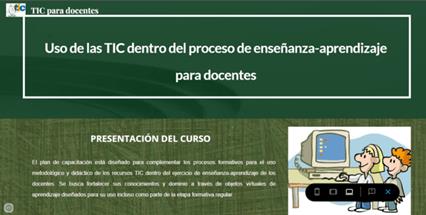
Figure 1
Course presentation on SITE
Source: Martha
Cervantes (2022)
The
presentation has been prepared under a minimalist concept (regarding tones) so
as not to generate visual noise with the resources (images) that can accompany
the text. Also, the detail of the course proposes a very brief but concrete
explanation of the general objective of the training plan.
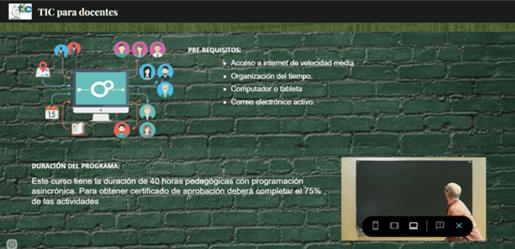
Figure 2
Pre-requisites and duration of the program
(SITE detail)
Source: Martha
Cervantes (2022)
Analysis.
An essential point to design a learning environment is the analysis of the
students, the content, and the environment, that is, an assessment of needs
that allows identifying both the profile of the students and the contextual
conditions, which may affect the teaching-learning process, which reveals the
nature of a certain problem to be addressed and its possible solution
alternatives (Morales-Gonzalez, 2014).
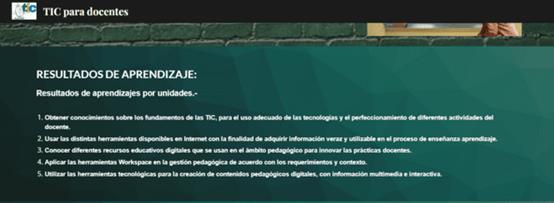
Figure 3
Learning Outcomes at SITE
Source: Martha
Cervantes (2022)
The
curriculum process of the training plan envisages the completion of five
instructional objectives designed as "learning outcomes". The
fulfillment of this is aligned with the forty-hour training proposal and its
respective certification weighted in figure four.
Figure 4
Methodology and detail of the units in SITE
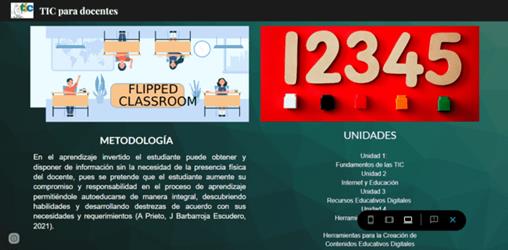
Source: Martha
Cervantes (2022)
When
developing their proposal, the methodological proposal proposed by Lage et al.
(2000) has been based on the need to match the different types of learning of
the multiple students gathered in a group and the teaching style of the
teacher. With this premise, the use of multimedia is considered as an
instrument that allows the student to choose the best method and space to
acquire declarative knowledge at their own pace (Coufal, 2014; Lage et al.,
2000; Talbert, 2012), especially if the material is web-based or easily
accessible; transferring responsibility for the apprehension of content to the
learner; and to the teacher, the organization of his practice in order to guide
the activities towards the goal set (Bristol, 2014, Lage et al., 2000).
Figure 5
Detail of the rubrics within the training plan
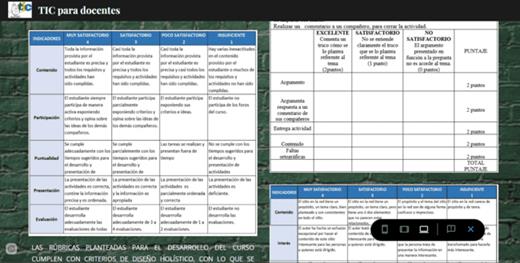
Source: Martha
Cervantes (2022)
According to Hernández et al (2016) the
processes of improvement of teaching performance and comprehensive training
that students require in a changing context dominated by technology has been
left aside (Tobón, 2012b). Although the competency approach is one of the
proposals that emerges internationally with great force to achieve authentic
training that responds to the demands of the twenty-first century, and even
promoted through international organizations.
Figure 6
Technical data on the teacher
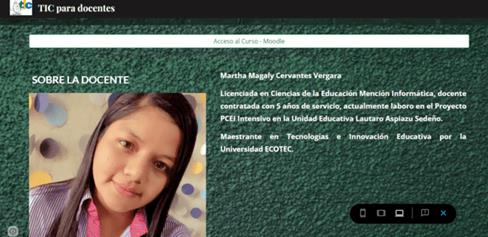
Source: Martha
Cervantes (2022)
Recommendations
The functionalities and use of the
components or internal tools of the Moodle platform were analyzed and known and
with this the training plan was carried out in a very satisfactory way, using
and applying several resources such as forums for presentation and presentation
of criteria, glossaries of terms referring to the subject, labels for titles,
pages to enter different information such as videos, resources of Genially,
Canva, Url, files in pdf format and images and questionnaires, with this he
could present the information in a dynamic and varied way.
As teachers we must take advantage
of the information collected regarding the technological educational resources
that can be used and implemented for the teaching-learning process to improve
teaching practices, looking for alternatives that allow creating digital
educational content. All the information was organized to handle the subject in
order, having a correct and appropriate advance for the acquisition of
knowledge.
It is necessary that we preserve
the methodology of organization by "study units" since in this way
each of the units may have up to three sessions and an evaluation in each unit,
in addition the training plan has a final questionnaire that encompasses and
evaluates in a general way all the contents of the course, making the learning
process more dynamic.
The information presented in this
type of planning must make use of multimedia resources and interactive
activities that are permanently available to the participant, that is, that can
be reviewed at the time desired; With this, users will maintain interest and
motivation, they will also be able to acquire skills and build their knowledge
autonomously and according to their time availability.
Both formative and summative
assessment activities to measure knowledge and skills acquired in the course by
the participants, with which the scope of the learning outcomes can also be
known. It is recommended that the evaluations are carried out using Moodle
resources, as well as external tools such as Liveworksheets, Quizizz,
EducaPlay, Genially, among others, with this the evaluations are presented in
different ways and dynamics.
References:
Coufal,
K. (2014). Flipped learning instructional model: perceptions of video delivery
to support engagement in eighth grade math. (Tesis doctoral).
de
Guayaquil–Guayas-Ecuador, S. ANTECEDENTES, CUESTIONAMIENTO Y PROPUESTAS PARA EL
AULA REGULAR 2016-2017.
Hernández-Mosqueda, J. S., Tobón-Tobón, S., &
Guerrero-Rosas, G. (2016). Hacia una evaluación integral del desempeño: las
rúbricas socioformativas. Ra Ximhai, 12(6), 359-376. http://www.redalyc.org/articulo.oa?id=46148194025
Lage, M., Platt, G., y Treglia, M. (2000). Inverting
the classroom: A gateway to creating an inclusive learning environment. The Journal of
Economic Education, 31(1), 30-43.
Mancero, R. E.
(2022). Análisis de viabilidad para el desarrollo de un proyecto de aplicación
sobre fracciones mediante el uso de recursos digitales en Moodle Cloud, caso:
9no Año de Educación Básica de La Unidad Educativa Vinces. YUYAY:
Estrategias, Metodologías & Didácticas Educativas, 1(1),
91-117. https://jlacolectivo.com/revistas/index.php/YUYAY/article/view/7
Mayea-Carpio, R. I.
(2022). Estudio para la aplicación de LMS como apoyo pedagógico para
estudiantes de educación básica superior: caso Escuela de Educación Básica José
María Barona de Vinces. YUYAY: Estrategias, Metodologías &
Didácticas Educativas, 1(1), 118-143. https://jlacolectivo.com/revistas/index.php/YUYAY/article/view/11
T. Malveira de Araujo y A. Rossi, (2005) “Virtual
design studio: Vygostky and virtual interaction”, presented at Proc. 9th
Iberoamerican Congress of Digital Graphics, Lima - Peru 21-24 november, vol. 1,
pp. 310- 314
Olvera,
W., Gámez, I. E., & Castillo, J. M. (2014). Aula o modelo invertidos de
aprendizaje: Origen, sustento e implicaciones. Los modelos tecno-educativos,
revolucionando aprendizaje del siglo XXI, 143-160. http://tebaevmartinez.com/documentos/Aula_Invertida_o_Modelo_Invertido_de_Aprendizaje.pdf
Rivadeneira,
E. (2017). Competencias didácticas-pedagógicas del docente, en la
transformación del estudiante universitario. Orbis, Revista Científica de
Ciencias Humanas, 41-55.
Salazar,
S. (2018). La familia asume el uso de las TIC como apoyo al aprendizaje. En M.
Gallegos Navas, La inclusión de las TIC en la educación de personas con
discapacidad. 147-155. UPS Quito.
Serrano,
J (2022) Propuesta metodológica para la elaboración de un guion instruccional
que fortalezca las actividades de vinculación comunitaria a través de la
práctica artística en estudiantes de Educación General Básica subnivel
Superior. http://201.159.223.180/bitstream/3317/19226/1/T-UCSG-PRE-FIL-CE-32.pdf
Serrano-Macias, J. H. (2022). De lo experimental a lo
creativo:: Metodología Didáctica para aprender jugando. YUYAY: Estrategias, Metodologías &
Didácticas Educativas, 1(1),
51-70. https://jlacolectivo.com/revistas/index.php/YUYAY/article/view/5
Siemens, G. (2005). Connectivism: A Learning Theory for the
Digital Age. Connectivism: A Learning Theory for the Digital Age. Retrieved.
Tigse Parreño, C. M. (2019). El constructivismo, según
bases teóricas de César Coll. Revista Andina de Educación, 2(1), 25-28. https://revistas.uasb.edu.ec/index.php/ree/article/download/659/635/
Triglia,
A. (2018). Las 4 etapas del desarrollo cognitivo de Jean Piaget. Universidad de
Guadalajara. http://biblioteca.udgvirtual.udg.mx/jspui/handle/123456789/2942
 https://orcid.org/0009-0008-8584-6342