Literary Narratives in Teacher Education: A Pedagogical Approach for Developing Critical and Reflective Competencies in Basic Education
(esp) Narrativas literarias en la formación docente: Un enfoque pedagógico para desarrollar la capacidad crítica y reflexiva en la educación básica
(port) Narrativas Literárias na Formação de Professores: Uma Abordagem Pedagógica para o Desenvolvimento de Competências Críticas e Reflexivas na Educação Básica
Universidad Estatal de Milagro
 https://orcid.org/0009-0002-0416-1517
Alban-Vera, C. G. (2025). Narrativas literarias en la formación docente: Un enfoque pedagógico para desarrollar la capacidad crítica y reflexiva en la educación básica. YUYAY: Estrategias, Metodologías & Didácticas Educativas, 4(2), 50–61. https://doi.org/10.59343/yuyay.v4i2.98
Recepción: 28-10-2024 / Aceptación: 12-12-2024 / Publicación: 31-01-2025

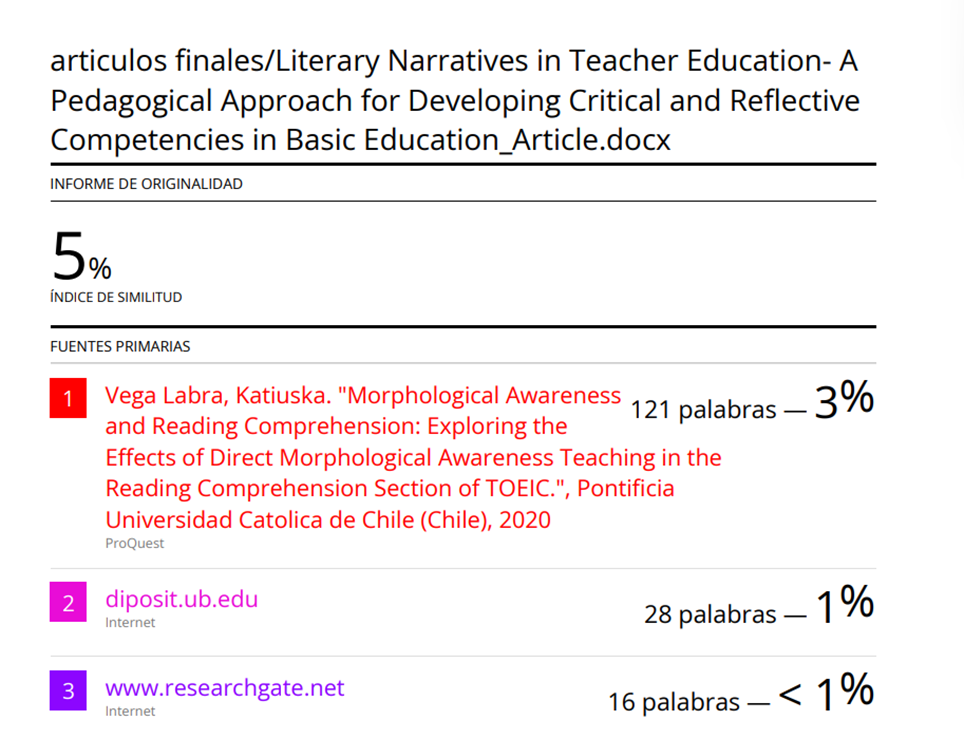
Turnitin IA Similarity
Abstract
This research explores the role of literary narratives in teacher education, emphasizing their significance in shaping professional identity and pedagogical practices. Through storytelling, pre-service teachers engage in self-reflection, gaining a deeper understanding of their experiences, beliefs, and ethical dilemmas. Literary narratives serve as a bridge between theory and practice, allowing educators to critically analyze their roles and interactions in the classroom. The study examines theoretical frameworks that support narrative methodologies, highlighting their potential to foster empathy, self-awareness, and critical thinking. Additionally, case studies and practical examples illustrate how literature can be effectively integrated into teacher training programs to enhance learning and professional growth. By engaging with diverse narratives, teachers develop a broader perspective on cultural, social, and educational contexts, enriching their teaching approaches. The findings suggest that incorporating literary narratives in teacher education not only strengthens instructional strategies but also promotes meaningful reflection and dialogue among educators. Ultimately, this approach contributes to the development of more reflective, ethical, and adaptive teachers prepared to navigate complex educational environments.
Keywords: Educational experience; Narrative pedagogy; Teaching; Knowledge; Innovative teaching.
Resumen
Esta investigación explora el papel de las narraciones literarias en la formación del profesorado, destacando su importancia en la formación de la identidad profesional y las prácticas pedagógicas. A través de la narración de historias, los profesores en formación reflexionan sobre sí mismos y adquieren una comprensión más profunda de sus experiencias, creencias y dilemas éticos. Las narraciones literarias sirven de puente entre la teoría y la práctica, permitiendo a los educadores analizar críticamente sus funciones e interacciones en el aula. El estudio examina los marcos teóricos que sustentan las metodologías narrativas, destacando su potencial para fomentar la empatía, la autoconciencia y el pensamiento crítico. Además, estudios de casos y ejemplos prácticos ilustran cómo la literatura puede integrarse eficazmente en los programas de formación del profesorado para mejorar el aprendizaje y el crecimiento profesional. Al relacionarse con diversas narrativas, los profesores adquieren una perspectiva más amplia de los contextos culturales, sociales y educativos, lo que enriquece sus enfoques pedagógicos. Los resultados sugieren que la incorporación de narraciones literarias en la formación del profesorado no sólo refuerza las estrategias de instrucción, sino que también promueve una reflexión y un diálogo significativos entre los educadores. En última instancia, este enfoque contribuye al desarrollo de profesores más reflexivos, éticos y adaptables, preparados para desenvolverse en entornos educativos complejos.
Palabras clave: Experiencia educativa; Pedagogía narrativa; Docencia; Conocimiento; Enseñanza innovadora.
Resumo:
Esta pesquisa explora o papel das narrativas literárias na formação de professores, enfatizando sua importância na formação da identidade profissional e das práticas pedagógicas. Por meio da narração de histórias, os professores em formação se envolvem em autorreflexão, obtendo uma compreensão mais profunda de suas experiências, crenças e dilemas éticos. As narrativas literárias servem como uma ponte entre a teoria e a prática, permitindo que os educadores analisem criticamente suas funções e interações em sala de aula. O estudo examina as estruturas teóricas que apoiam as metodologias narrativas, destacando seu potencial para promover a empatia, a autoconsciência e o pensamento crítico. Além disso, estudos de caso e exemplos práticos ilustram como a literatura pode ser integrada de forma eficaz aos programas de treinamento de professores para aprimorar o aprendizado e o crescimento profissional. Ao se envolverem com diversas narrativas, os professores desenvolvem uma perspectiva mais ampla sobre os contextos culturais, sociais e educacionais, enriquecendo suas abordagens de ensino. Os resultados sugerem que a incorporação de narrativas literárias na formação de professores não apenas fortalece as estratégias de instrução, mas também promove a reflexão e o diálogo significativos entre os educadores. Em última análise, essa abordagem contribui para o desenvolvimento de professores mais reflexivos, éticos e adaptáveis, preparados para navegar em ambientes educacionais complexos.
Palavras-chave:
Experiência educacional; Pedagogia narrativa; Ensino;
Conhecimento; Ensino inovador.
Teacher training for basic education faces the challenge of developing critical and reflective thinking skills in future teachers that enable them to analyse and improve their pedagogical practice. In this context, the use of literary narratives - understood as stories, histories and narrated experiences - has gained relevance as a pedagogical approach in teacher training. Many educational theorists argue that narrative is a privileged way of constructing meaningful knowledge in education. Indeed, narrative discourse is considered essential in our attempts to understand teaching and learning processes. Through stories and narratives, trainee teachers can connect theory with experience, make sense of complex classroom situations and develop a deeper understanding of their role.
The central thesis of this essay is that incorporating literary narratives in basic education teacher education contributes significantly to the development of critical thinking and pedagogical reflection. This narrative approach not only enriches the training experience of teachers but also prepares educators capable of fostering these same critical and reflective skills in their students. The theoretical foundations that support this claim, concrete examples of the application of narratives in teacher education contexts, their relationship with the development of critical- reflective thinking, as well as the challenges and limitations of this pedagogical strategy will be presented below.
Development
The use of narratives in education is underpinned by a rich theoretical base. Influential authors such as Paulo Freire have advocated dialogical and contextual pedagogical approaches where the life stories and experiences of teachers and students become learning texts for critical consciousness-raising. Freire's critical pedagogy stresses the importance of educators and learners jointly analysing reality from their own narratives, thus developing a critical consciousness about their world. In line with this view, much contemporary research has explored narrative rationality in educational practice, noting that people make sense of our experience of the world through narratives. "Narrating a pedagogical experience can account for the individual process of organising, knowing and learning from that experience", says Ruiz Juri in highlighting the formative value of first-person writing by trainee teachers.
In other words, by recounting and writing down their experiences, the future teacher not only reconstructs what happened but also reflects on their actions, decisions and emotions, integrating theory and practice into situated knowledge.
From educational psychology and epistemology, Jerome Bruner already distinguished narrative thinking as complementary to logical thinking, highlighting that narratives facilitate the understanding of human intentionality and the context of actions. Following this line, Edith Litwin (2008) argues that narratives are a way of approaching knowledge and a strategy for approaching teaching. This means that presenting educational content through stories or concrete cases can make pedagogical knowledge more comprehensible and accessible, connecting it to real situations. Donald Schön (1983) introduced the idea of the reflective practitioner, emphasising the importance of teachers analysing their practice in and about action. Narrative becomes a key tool to foster such reflection, as by narrating their practices, teachers can identify theories in use (Argyris & Schön) - that is, the implicit beliefs that guide their actions - and critically examine them.
In Latin America, specific approaches that integrate narrative and teacher reflection have been developed. For example, Suárez, Ochoa and colleagues propose the narrative documentation of teaching experiences as a professional development strategy. In their work they refer to collecting and writing detailed accounts of classroom experiences for collective analysis, considering it an effective approach to teacher training and professional growth.
Similarly, Caporossi (2012) points out that narrative works as a device for the construction of professional knowledge, since the stories that teachers produce reveal their conceptions about teaching, science, art, etc., making tacit knowledge explicit. Thus, the pedagogical narrative connects with the idea of reflective practice developed by authors such as Perrenoud (2004), for whom training reflective teachers involves providing opportunities to analyse one's own practice systematically. Classroom stories - be they personal experiences narrated by the trainee teachers themselves, accounts of experienced teachers or even literary works dealing with educational issues - constitute such valuable material for reflection. In short, the theoretical underpinning argues that by articulating experiences in the form of narratives, trainee teachers develop a more critical understanding of their practice, questioning assumptions, contextualising problems and envisioning alternatives for action informed by values and evidence.
Literary narrative as a pedagogical methodology in teacher training
Translating these foundations into training practice involves designing pedagogical activities based on narratives. An illustrative case is the experience of initial teacher training at the University of the Basque Country described by Gutiérrez Cuenca et al. (2009). These authors implemented a reflective model in the Practicum (supervised teaching practice) based on the use of narrative as an educational method, with emphasis on introspection, collaboration, critical thinking and the will to transform the school. In the Practicum II course, student teachers were invited to develop ethnographic accounts of their classroom experiences during the practicum.
Each prospective teacher narrated first-person accounts of situations experienced, describing contexts, interactions, difficulties and achievements. These accounts were then shared and discussed in community (including online forums), so that the individual experience of one became the collective learning of all. In the case analysed, the detailed narration made by a student (pseudonym "Leire") about a pedagogical dilemma she faced in her class, generated in her classmates the motivation for knowledge within the group and motivated a collaborative process of enquiry and knowledge construction in a telematic forum.
In other words, Leire's story acted as a trigger for the whole group of trainees to critically analyse the situation, contribute ideas and provide feedback, creating situated and shared learning. This example shows how narratives can be used in teacher training to promote communities of reflection among peers, where critical thinking is constructed collectively on the basis of real cases.
Another modality of application is through autobiographical reflective writing. For example, in teacher training programmes in Argentina and Uruguay, it has been proposed that trainee teachers keep reflective diaries or autobiographical narratives about their teacher learning process. Rodríguez Morena and Arbelo (2016) conclude, after several years of working with narratives in teacher training institutes, the importance of generating collaborative spaces where pedagogical experiences can be exchanged, reflected upon and examined. These spaces, where we attend to the perspectives of those who are a fundamental part of the experience, allow future teachers to articulate their experience with theoretical frameworks through narrative and thus build professional knowledge in a situated way (Rodríguez Morena & Arbelo, 2016). Similarly, María Ruiz Juri (2022) describes two didactic proposals in university teacher training that revolve around narratives: the interview and the narrative essay.
In the first, student teachers interviewed practising teachers about their professional experiences, collecting first-person accounts of what teachers do, think and feel at school. This activity confronted future teachers with reality narrated by others, allowing them to integrate theoretical knowledge with their own and others' perspectives in a genuine way. In the second proposal, students wrote autobiographical narrative essays, recounting a significant educational experience. Both exercises - both the narrative collected from others through interviews and the written narrative itself - enabled students to connect theoretical knowledge with diverse perspectives, including their own, thus fostering authentic and learning.
These experiences confirm the high formative value of narrative: by narrating (or listening to narratives), the trainee teacher connects theory with practice, develops empathy for the experiences of other educators and explores his or her own teacher identity under construction.
Likewise, the use of literary works and fictional stories with educational themes can be a pedagogical resource in teacher training. For example, analysing a short novel that deals with conflicts in the classroom, or children's stories from a pedagogical point of view, can be used to discuss teaching approaches, values and ethical dilemmas. Literary narrative, by presenting characters, contexts and conflicts, offers richly nuanced simulated situations for the future teacher to practise critical analysis.
Some programmes have incorporated the reading of literary texts (short stories, chronicles, poetry) followed by written reflections or discussions, in order for trainee teachers to expand their capacity for critical interpretation and learn to mediate reflective conversations with their own students. For example, Lipman (1998) - creator of the Philosophy for Children programme - proposed philosophical novels as triggers for Socratic dialogue in the classroom, an idea that can be transferred to teacher training: teachers can be trained to formulate questions and guide analytical discussions on the basis of literary narratives. In short, narrative methodology in teacher training takes various forms (autobiographical accounts, case studies, interviews, literature analysis, digital narrative, etc.), but in all cases it seeks to place the trainee teacher as an active protagonist in the construction of knowledge through the narrated experience.
Relationship to the development of critical and reflective thinking
The link between narratives and the development of critical-reflective thinking in teachers (and by extension in their students) is profound. First of all, when writing or recounting an experience, the trainee teacher pauses to reflect he or she must order the facts, assign meaning to them, look for causes and consequences, and possibly confront what happened with his or her theoretical references. This act of reinterpreting experience is a highly cognitive reflective practice. Studies in teacher education have observed that narrative facilitates introspection and critical analysis of one's own practice.
When a prospective teacher narrates how they handled, for example, a problem of indiscipline in class, they are simultaneously evaluating their decisions (where they effective? what could they have done differently?), examining their assumptions (why did I define this as indiscipline? what beliefs do I have about discipline?) and considering the context (what factors in the environment were influential?). In this way, the narrative acts as a mirror in which the teacher sees him/herself in action and learns to think about his/her own thinking (metacognition), a key to reflective thinking.
Secondly, narratives especially foster critical thinking when they are shared and subjected to discussion. The narrative of a pedagogical experience then functions as a case that invites scrutiny: colleagues and trainers can question, contrast, offer other perspectives or related theories. This dialogue around the narrative forces deepen analysis, to substantiate opinions and to consider alternative angles, all of which are critical thinking skills. In the example cited from the Basque Country, the collective discussion in forums around Leire's story led to the emergence of critical questions and the joint construction of meanings.
Similarly, in other contexts it has been seen that by socialising classroom narratives in practice seminars, future teachers develop an investigative attitude: they learn to problematise the educational reality instead of assuming it uncritically. This coincides with the observation that the pedagogical narrative questions teachers on the basis of their concerns, contradictions and ethical dilemmas, providing valuable information to systematically analyse their pedagogical practices. That is, the stories - even those with open endings or unresolved difficulties - challenge teachers to confront uncomfortable or complex aspects of teaching, stimulating deeper reflection that transcends easy answers.
Moreover, the emotional identification that a narrative often generates enhances critical thinking in a broad sense: by connecting personally with a story, the trainee teacher develops empathy and a more humanised understanding of educational problems. This is fundamental to critical thinking that is not merely technical, but also critical in the humanistic sense, aware of social and cultural contexts. For example, a vivid account of the difficulty of a student with certain needs can make the future teacher question prejudices or traditional practices and think about inclusive solutions, a reflection of critical thinking with ethical sensitivity. In this way, narrative not only sharpens the capacity for logical analysis, but also engages teachers' values and reflective attitudes.
It is worth noting that the impact is not limited to the teacher trainer, but reaches the basic education classroom. A teacher who has been trained in narrative strategies is more likely to use narratives in his or her own teaching, replicating the virtuous cycle with his or her students. For example, he or she may use stories, historical anecdotes or simulated situations to develop children's critical thinking, getting them to argue, reflect and draw lessons from the stories as well.
Likewise, a teacher who is accustomed to narrative reflection will tend to model an inquiring attitude to her students: she will openly acknowledge when something does not go well, reflect with her students on what they might do differently next time, i.e. she will turn the classroom into a narrative learning community. In this way, critical and reflective competences are transferred: the teacher trained in this perspective exercises them and passes them on to his or her students, fostering more dialogical, conscious and critical classrooms in basic education.
Challenges and limitations of the narrative approach
While the evidence for the benefits of narratives in teacher education is strong, it is important to recognise the challenges and limitations of this pedagogical approach. Firstly, not all trainee teachers are comfortable narrating or writing about their experiences. Reflective writing is a skill that may require development; some trainees may offer very descriptive but not very analytical accounts, or conversely, feel self-conscious about sharing failures or doubts in their stories. This requires trainers to create a climate of trust and guidance to deepen reflection. Related to this is the challenge of avoiding superficiality: a narrative does not automatically guarantee critical thinking. Without adequate guidance, there is a risk that the story remains a personal anecdote without drawing general lessons. For this reason, several authors emphasise the need for analytical frameworks for narratives (e.g. question guides, theoretical references to contrast, feedback tutorials) that ensure reflective quality. The narrative should be a starting point for enquiry, not an end in itself.
Another aspect to consider is the "dangers and abuses" that can occur in the use of accounts of teaching experiences. Gutiérrez Cuenca et al. warn, for example, about ethical care when narrating true stories: protecting the identity of third parties (students, colleagues) and handling sensitive situations with respect. They also point out the possibility that some teachers may fall into an excessively personalistic or biased view of reality if they only rely on their own narratives without checking them against other sources. Narrative, being subjective, needs to be balanced with critical analysis to avoid drawing erroneous conclusions from particular cases. Similarly, an abuse of narrative may occur if it is used as a simple catharsis or complaint, losing sight of the constructive construction of knowledge. Therefore, the role of the trainer is key in channelling narratives towards rigorous reflection, asking questions, challenging assumptions and incorporating multiple perspectives.
In addition, there are practical limitations: integrating narrative methodologies into the curriculum requires time and curricular space. Narrating and reflecting takes more time than traditional expository methods, which can put a strain on busy curricula. However, this time investment is justified by the depth of learning achieved; even so, curriculum designs need to be adapted to include narrative reflection seminars, personalized tutorials, etc. Training of teacher educators in the use of these strategies is also needed. Not all teacher educators themselves have been trained in narrative approaches, so there may be resistance or lack of initial expertise to implement them. Overcoming this barrier involves professional development and communities of practice among trainers, where they themselves experience and value narrative as a teaching tool.
Finally, a potential challenge is the assessment of learning gained through narratives. Traditionally, teacher education has assessed theoretical knowledge through written examinations; how, however, does one assess growth in critical-reflective thinking as evidenced in a narrative? Here, qualitative forms of assessment are called for: for example, rubrics that assess depth of analysis in reflective journals, the ability to connect theory and practice in a narrative, or substantive participation in case discussions. Such assessments require time and professional judgement but are necessary to recognize and provide feedback on the trainee teachers' progress in these competences.
Despite these challenges, none is insurmountable. Experience from multiple institutions shows that, with the right conditions, narratives can be successfully integrated into teacher education and bring about positive change. The challenges mentioned above call for refining the methodology rather than discarding it: for example, incorporating reflective writing workshops to improve students' narrative skills, establishing confidentiality and respectful agreements on the use of real stories, combining narrative with other pedagogical strategies (it is not necessary to completely abandon traditional instruction, but to complement it), and promoting research that continues to shed light on how to optimize this approach.
Conclusions
In conclusion, the use of literary narratives in basic education teacher education proves to be a powerful pedagogical strategy for cultivating critical and reflective educators. Through the construction and analysis of narratives, future teachers learn to see teaching not as a set of techniques to be applied uncritically, but as a situated practice that requires deep understanding, contextual judgement and continuous learning. Narrative provides them with a language for talking about education in terms of human experiences, enabling them to connect theory to real classroom life and to develop an analytical view of their work.
Various examples - from reflective practice programmers with ethnographic narratives to the incorporation of autobiographical diaries and literature into the training curriculum - demonstrate that this approach enriches teacher education and has a tangible impact on the way in which these teachers, once in practice, will approach teaching.
The importance of this strategy lies in the fact that critical and reflective competences are not effectively taught through abstract discourses but are built in reflective practice. By experiencing first-hand (and analyzing in community) narrative processes, trainee teachers develop habits of enquiry, self-evaluation and dialogue that will be fundamental in their professional development. In an educational world that demands teachers capable of adapting, innovating and facing complex problems, training narrative reflective teachers is a commitment to more autonomous professionals committed to the continuous improvement of education. Looking ahead, the narrative approach can be broadened and deepened.
On the one hand, it could be incorporated more systematically into the initial teacher education curricula and in-service teacher training. On the other hand, digital narratives open new possibilities: the use of reflective blogs, electronic portfolios, narrative videos or podcasts produced by teachers could enhance the exchange of experiences beyond the training classroom, creating virtual communities of practice. It would also be valuable to extend this strategy to the training of managers and teacher trainers, thus creating a multiplier effect throughout the education system.
Ultimately, promoting literary storytelling as a pedagogical approach in teacher education contributes to higher quality basic education. A teacher who has learned to think critically about his or her own professional history will be better prepared to guide students in constructing their own critical and reflective voices. As the literature points out, narratives allow teachers to reassert control over their own practices and to optimize teaching and learning processes, resulting in more reflective, democratic and innovative schools. Therefore, the integration of narratives in teacher training is not only a pedagogical methodology among others, but an essential component for the development of educators capable of positively transforming basic education from a critical and conscious praxis.
References
Balseca Chusin, V. L. (2025). Aportes de la Campaña "Yo Leo" en el comportamiento lector de los estudiantes de segundo de básico (Master's thesis). Universidad Andina Simón Bolívar, Quito, Ecuador.
Baioni, G. (2024). La práctica reflexiva en la formación docente de los/as estudiantes del PUEF. SaDe-REVISTA DE CIENCIAS DE LA SALUD Y EL DEPORTE, (4), 15-28.
Castillo Chavarro, Y. A. (2024). Subjectivity in an active participatory exercise in learning: pedagogical proposal "strengthening minds, building subjectivities".
Freire, P. (1970/2005). Pedagogy of the oppressed (Ed. in Spanish). Montevideo, Uruguay: Tierra Nueva.
Gutiérrez Cuenca, L., Correa Gorospe, J. M., Jiménez de Aberasturi, E., & Ibáñez Etxeberria, A. (2009). The reflective model in teacher training and narrative thinking: a case study of educational innovation in the Teacher Training Practicum. Revista de Educación, 350, 119- 142.
Litwin, E. (2008). Teaching, its conception and narrative strategies. [Reference cited in Ruiz Juri, 2022].
Mádelen, P. C., Milena, P. C. A., & Paola, R. C. J. (2022). The Magic of Questions. Strategies for the Development of Critical Thinking. Revista de la Facultad de Ciencias Universidad Nacional de Colombia, 4(2), 17-42.
Perrenoud, P. (2004). Developing reflective practice in the teaching profession: Professionalisation and pedagogical reason. Barcelona, Spain: Graó.
Rodríguez Martín, S. L. (2014). Narratives as a teacher education strategy. Inter-American Journal of Research in Education and Pedagogy (RIIEP), 7(2), 11-22.
Rodríguez Morena, S., & Arbelo Hernández, S. (2016). Narratives in the training of future teachers? Revista ConVocación, 6, 77-89.
Ruiz Juri, M. (2022). The value of narrative in teacher training. Pedagogía [Blog of the Blas Pascal University]. Retrieved from https://pedagogia.ubp.edu.ar/2022/08/04/el-valor-de-la- narrativa-en-la-formacion-docente/
Suárez, D. H., Ochoa, L., & Dávila, P. (2005). Narrative documentation of pedagogical experiences. Nodos y Nudos, 2(17), 16-31.
Suárez, D. H., Ochoa, L., & Vallone, M. (2005). La documentación narrativa de experiencias pedagógicas: Una estrategia para la formación de docentes. Buenos Aires, Argentina: MECyT/OEA.
Villamil, N. L. S. (2022). Strengthening critical thinking based on the scientific method. Rastros y Rostros