Barriers Preventing Quality Virtual Learning for
Students of the Facultad de Transporte y Vialidad
(FATV)
(en) Barreras que imposibilitan un aprendizaje virtual de
calidad, en los estudiantes de la Facultad de Transporte y Vialidad (FATV)
(port) Barreiras que
impossibilitam a aprendizagem virtual de qualidade para os alunos da Faculdade
de Transportes e Estradas (FATV)
Instituto
Superior Tecnol gico Bolivariano de Tecnolog a
 https://orcid.org/0009-0008-6442-7827
Jhonny Fabián Jiménez-Simbaña
Instituto Ecuatoriano de Seguridad Social
https://orcid.org/0009-0008-9196-2614
Karen Andrea
Cabrera-Rodr guez
Instituto Superior Tecnol gico Bolivariano de
Tecnolog a
https://orcid.org/0009-0000-6653-1849
Instituto Superior Tecnol gico Bolivariano de
Tecnolog a
https://orcid.org/0009-0007-5833-7123
Macias-Anchundia,
J. P., Jiménez-Simbaña J. F.,
Cabrera-Rodr guez, K. A., & Cabrera-Loja, D. K. (2025). Barreras que
imposibilitan un aprendizaje virtual de calidad, en los estudiantes de la
Facultad de Transporte y Vialidad (FATV). YUYAY: Estrategias,
Metodolog as & Did cticas Educativas, 4(2), 39 49. https://doi.org/10.59343/yuyay.v4i2.95
Recepci n: 18-08-2024
/ Aceptaci n: 30-10-2024 / Publicaci n: 31-01-2025
%20(1)_archivos/image012.jpg)
Turnitin IA Similarity
Report
%20(1)_archivos/image013.png)
Abstract
The article, entitled barriers that prevent quality virtual learning
in students of the virtual modality of the Bolivian Higher Institute of
Technology (ITB), for the realization of this article, it was allowed to work
with the students of the Faculty of Transportation and Roads (FATV), in order
to determine the main barriers that prevent meaningful learning in students of
generation X, Y & Z. Students of these generations are the ones with the
highest number of conglomerations in the total student population, which is why
andragogical approaches are used that promote the direct appropriation of the
knowledge shared in the key ideas of each unit, in order to determine which of
these barriers are the ones that prevent their good performance and learning. A
descriptive research was carried out on a sample group of 70 Transportation
students, which consisted of a 20-question form, which when adding the
information obtained based on direct observation identified 4 essential
barriers that make meaningful learning impossible in virtual modalities:
technological barriers, lack of availability of time, lack of motivation
generated by not receiving feedback from the teaching staff and lack of
commitment to exploring explicit content for their professional training; This
allowed us to obtain a more precise overview of what must be worked on so that
virtual education processes are effective in the learning process.
Keywords: Barriers;
learning; virtual education; limitations; FATV.
Resumen
El art culo, titulado barreras que imposibilitan el aprendizaje
virtual de calidad, en los estudiantes de la modalidad virtual del Instituto
Superior Boliviano de Tecnolog a (ITB) en la Facultad de Transporte y Vialidad
(FATV), con la finalidad poder determinar las principales barreras que
imposibilitan el aprendizaje significativo en los estudiantes de la generaci n
X, Y & Z. Los estudiantes de estas generaciones son las que tienen mayor
n mero de conglomeraci n en la poblaci n total de alumnos, por lo cual se
utiliza enfoques andrag gicos que impulsen a la apropiaci n directa de los
conocimientos compartidos en las ideas claves de cada unidad, para llegar a
determinar cu les de estas barreras son las que imposibilitan su buen desempe o
y aprendizaje. Se realiz una investigaci n descriptiva a un grupo muestral de
70 estudiantes de la Transporte. Esta investigaci n consisti en un formulario
de 20 preguntas, las cuales al ir sumando la informaci n obtenida en base a la
observaci n directa de los autores de este articulo cient fico, se pudo
determinar qu existen 4 barreras esenciales que imposibilitan el aprendizaje
significativo en las modalidades virtuales. Una de estas barreras es la
tecnolog a, otra es la falta disponibilidad de tiempo, la falta de motivaci n
generada al no receptar retroalimentaciones por el cuerpo docente y la falta de
compromiso a la exploraci n de los contenidos expl citos para su formaci n
profesional, esto permitir obtener un panorama con mayor precisi n en la cual
se debe de trabajar para que los procesos de educaci n virtual sean eficaces en
el proceso de aprendizaje.
Palabras claves: Barreras; aprendizaje; educaci n
virtual; limitaciones; FATV.
Resumo
O artigo, intitulado barreiras que impossibilitam a aprendizagem virtual de
qualidade, em estudantes da modalidade virtual de Instituto Superior Boliviano
de Tecnologia (ITB com os alunos da Faculdade Acad mica de Transportes e
Estradas (FATV). a fim de determinar as principais barreiras que impossibilitam
a aprendizagem significativa em alunos da gera o X, Y & Z. Os alunos
destas gera es s o os que apresentam o maior n mero de conglomera o na
popula o total de alunos, raz o pela qual s o utilizadas abordagens
andragogias que promovem a apropria o direta do conhecimento partilhado nas
ideias-chave de cada unidade, para determinar quais destas barreiras s o as que
os impossibilitam de ter um bom desempenho e aprender. Foi realizada uma
pesquisa descritiva em um grupo amostral de 70 alunos do Departamento de
Transportes. Esta pesquisa consistiu em um formul rio de 20 quest es, que
somando as informa es obtidas com base na observa o direta dos autores deste
artigo cient fico, foi poss vel determinar que existem 4 barreiras essenciais
que impossibilitam a aprendizagem significativa em modalidades virtuais. Uma
dessas barreiras a tecnologia, outra a falta de disponibilidade de tempo, a
falta de motiva o gerada por n o receber feedback do corpo docente e a falta
de compromisso com a explora o de conte dos expl citos para a sua forma o
profissional, isso permitir obter um panorama mais preciso no qual trabalhar
para que os processos de educa o virtual sejam eficazes no processo de
aprendizagem.
Palavras-chave: Barreiras; aprendizagem; educa o virtual; limita es; FATV.
Introduction
With the increase in information technologies in education, the Faculty
of Transport and Roads (FATV) has provided a background of possibilities to the
population to opt for specialized or university training,
this gap in possibilities has allowed many students to enter the
educational system to acquire university degrees, technicians, and
specializations.
This has led to teaching processes and methodologies being transformed
towards the new trends demanded by the current market. For this reason, the
main purpose of this presentation was born, which focuses on determining the
barriers that FATV students have within virtual learning platforms; This is how
it becomes one of the main challenges as described by which he states that
these processes can generate different difficulties in the learning of
students, because students have had to adapt to a new way of studying and many
of them are unable to keep up with this new methodology (Santana et al., 2020) (Fardoun et al., 2020).
The population of students at the driving school in its entirety average
and exceed 18 years of age, therefore, we are facing an andragogical learning
process, which consists of the active intervention of students for the
appropriate purpose of the contents (Bravo et al., 2024), because the student
is the main interested in acquiring knowledge and more so when it is being
studied in a virtual learning process (Aguilar et al., 2024) where Paretto's law
can be applied and the commitment to learning depends on 80% of the students
and 20% of the institutions, teachers and content (Guayasamin
et al., 2024).
For this, it should be mentioned that percentage-wise there is a
population that predominates in demographic distribution to students between
the ages of 18 30 years, which represent 58% of the total student body
enrolled, followed by the range of 31 40 years old with 28% of the total
number of students, it should be noted that a large part of these students
belong to generation X, Y & Z.
It is important to define the essential concepts of the group of people
who are called generation as mentioned when explaining the so-called generation
X, it is indicated that they are people born between the years 1965 to 1981,
known as the lost generation. Generation
Y, also known as Millennials, is understood to be people born between 1982 and
1994 (Galdames et al., 2022). This generation is so called because they grew up
in an era of rapid technological advancements and are attributed to having an
entrepreneurial mindset and valuing between work and personal life (V squez et
al., 2021). And finally, generation Z born specifically between 1995 and 2010,
their main characteristic is that they have grown up in an overwhelming digital
environment and are considered to show advanced technological skills and above
all to have greater cultural diversity (R squez
Navarro, 2023).
Given these definitions, it is essential to analyze behavior
individually, that is, to study the groups of people where they are more likely
to adapt to technological changes, the same who belong to generation Z,
followed by the students who represent generation Y (Clarin, 2024), to find
homogeneous information that can affect all students.It
should be taken into account that a large part of those mentioned are heads of
households, for this you can see image 1, where the INEC mentions that the
average age of marriages at the national level is 31 years, therefore they are
of limited economic resources, with these observations it is sought to
determine the barriers that arise in their educational learning process under
the virtual scheme. (Instituto Nacional de Estadisticas
y Censos-INEC, 2023)
Figure 1
Average ages of marriages in Ecuador.
%20(1)_archivos/image014.jpg)
Fountain:
Students, due to the accumulation of activities, usually have problems
in the learning process that makes it impossible for them to learn, among these
causes is the lack of availability of time for synchronous learning when using
a virtual platform, it causes a deterrence of the message, because at the time
they are receiving a keynote talk, conference, they are doing other activities
at the same time, in the Bailey" (2020)
mentions that the dispersion of attention can become a relevant problem in this
educational context" (p.26), therefore virtual learning processes must be
promoted through changes in order for the contents to generate interest in
students and generate that they voluntarily appropriate the knowledge
established in the virtual learning platform (EVA).
In summary, information technologies in learning processes have
revolutionized the way of teaching and receiving synchronous classes, for this
reason, it is necessary to know the obstacles that FATV students experience, to
opt for academic strategies that are focused on improving the experience and
quality of professional drivers.
Development
To
carry out this study, the descriptive research methodology was used, which is
focused on analyzing data in homogeneous groups, the research instrument used
was the application of structured surveys, which is composed of closed
questions applied to the students of the FATV, being a total of 70 respondents
through digital forms, The questionnaire
consisted of a total of 20 questions, which focused on knowing the reasons
behind the absence of the students, the low percentage of participation, the
knowledge of the use of technological learning tools, the use of the resources
of the virtual learning platform, contents, recorded classes, forums and the
self-assessment of their teaching process in a virtual environment.
Data
analysis:
For
the present study, a random sample of 70 FATV students was taken, whose
demographic data revealed significant patterns in the distribution of the
respondents. It is observed that there is a conglomeration of students in the
city of Guayaquil with a total of 32 people that
percentagewise represents 45%, which is lower than the average,
therefore, the remaining 55% of the respondents are distributed in other
cities.
As
for the distribution by gender, it can be observed that there is a male
predominance since it represents 80% of the respondents. Regarding the
educational level of the student population, it was determined that 100% of
those surveyed have completed high school, of these students, there is a small
percentage of students who are studying a second third-level career, aimed at
being more competitive professionally and professionally.
Regarding
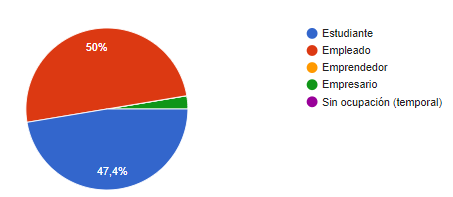
the role or activities that are carried out in their day-to-day work, 47.4% of
the respondents are economically independent, some students have their own
business or provide services for a company under a dependent role, and 50% of
the respondents are dedicated to their academic training.
Figure 2
Activities carried out by FATV students
Source: Own elaboration
From
the survey applied to the sample of 70 students, the most relevant information
will be considered to summarize in 4 points the barriers that make it
impossible for students to learn on virtual platforms.
First
technological barrier
When
analyzing the collected questions, it can be observed that the low performance
of the students in many of the cases is due to the fact that they use the
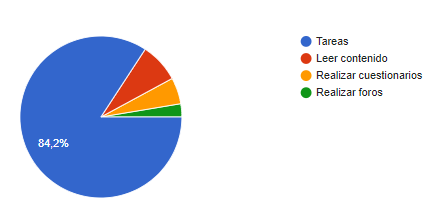
Moodle platform to fulfill their weekly tasks, which represents 84.2% of the
respondents, and only 8.6% enter to read the contents of the class ideas, whose
asynchronous activity should be the most important for their learning process
Figure 3
Activities that students carry out when they enter the EVA platform
Source: Own elaboration
Second
technological barrier
For
this analysis, data will be used from two questions that were aimed at
determining if technological tools can become an impediment to the learning
process, for this it should be emphasized that the use of mobile phones
predominates as the main resource in the reception of synchronous classes,
obtaining 77.1% of the total respondents.
therefore, for a virtual session or class to take place without any
obstacle, the student must have good signal reception and battery charge, which
becomes one of the main limitations in their learning process, these
restrictive situations are due to the fact that many of the students are not in
cities with 4G coverage and the battery capacity in a mid-range phone, It lasts approximately 5 hours on
indefinitely, and as mentioned in the demographic questions, 47.4% of students
carry out work activities, so they usually interrupt classes to be absent
because they do not have a phone charge or signal.
Figure 4
Technological devices are used to receive synchronous classes.
%20(1)_archivos/image015.png)
Source: Own elaboration
Third
Barrier Lack of Time Availability
The
current lifestyle leads many people to perform multiple activities at the same
time, which in English is called multitasking people, for this reason when
asked what are the most common problems that have led to their learning process
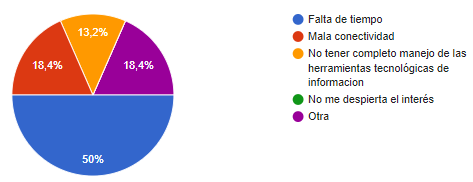
being impossible, 50% of those surveyed were able to express that it is due to
the lack of availability of time, for
this reason they usually enter the virtual classroom late, deliver the activity
outside the established schedule, etc. This can be caused by the impact on student
motivation, this has been observed in the exercise of teaching, where students
begin to decrease their interactions when teachers do not give them feedback on
their activities on the Eva platform and they are not recognized in public for
their contributions.
Figure 5
Third Barrier that makes meaningful learning impossible.
Source: Own elaboration
Conclusions
At the end of this presentation, it can be concluded that FATV students
do not exploit in depth the information provided by the Moodle virtual learning
environment, which they only use as a storage cloud to download and upload
asynchronous tasks, this could be corroborated in the previous research that
showed that 84.2% only enter the platform to carry out this activity, relegating the review of content and
observing recorded classes, master talks.
Therefore, the tool that predominates to receive synchronous classes is
the mobile phone, which on many occasions comes to have intermittency within
the signal which makes it impossible to receive messages properly due to the
lack of 4G coverage nationwide and the capacity of battery life in constant use.This causes students to lose
interest in continuing to participate in the classroom.
It should be noted that one of the main limitations that make it
impossible for students to obtain an interest in synchronous classes and that
the training process is affected due to the lack of availability of time that
represents 50% of the respondents, which shows an overload of daily activities,
which has an impact on a scarce interaction in virtual classrooms and the
sending of activities after the deadlines.
One of the causes is that the motivation of students over time decreases
for this reason, it is important to recognize that the commitment to the
training of FATV students is a joint effort of students, teachers and the
educational institution. To continuously improve educational processes, for
this to be carried out, a self-critical examination and the implementation of
improvement plans are required. To all this, we have a shared responsibility to
adapt methodologies, provide training in virtual learning environments and the
faculty give all their knowledge with charisma, dedication and providing
constant feedback to ensure meaningful learning.
References
Aguilar Parra, J.
C., Reasco Garz n, B. C., & Coello V squez, V. J.
(2024). La inclusi n educativa en la educaci n superior: desaf os y
perspectivas en Ecuador. Revista InveCom, 4(2).
https://doi.org/10.5281/zenodo.10558676
Bailey, C., & Reverte, M. (2020). "Hyperfocus", a practical
guide to managing your attention: the most powerful resource you have to get
things done, be more creative and live a meaningful life (1.ed).
REVERTE.
Bhalla, R., Tiwari, P.,
& Chowdhary, N. (2021). Digital natives leading the world: paragons and
values of Generation Z. In Generation Z marketing and management in
tourism and hospitality: The future of the industry (pp. 3-23). Cham:
Springer International Publishing. https://doi.org/10.1007/978-3-030-70695-1_1
Bravo, M. G. E.,
Qui nez, M. B. R., Vargas, K. L. C., Moyano, C. B. V., & Mendieta, D. A.
F. (2024). La influencia de tecnolog as emergentes en la educaci n superior: The influence of
emerging technologies in higher education. LATAM
Revista Latinoamericana de Ciencias Sociales y Humanidades, 5(1),
894-904.
Fardoun, H., Gonz lez, C., Collazos, C., & Yousef, M. (2020). Exploratory
study in Ibero-America on teaching-learning processes and evaluation proposal
in times of pandemic. usal. https://doi.org/10.14201/eks.23437
Galdames, S., Perez, M. J.
O., & C rdenas, P. V. M. (2022). An (inter)personal decision: a
generational comparative study of the work trajectory of directors in Chile.
RLE. Journal of Educational Leadership, (1), 85-111.
Guayasam n, L. G. S.,
Sarabia, C. A. S., Orozco, G. S. S., & Orellana, Z. M. R. (2024). Formaci n Intercultural en Salud:
desaf os y oportunidades en la Educaci n Superior en Ecuador. Revista Imaginario
Social, 7(2). https://doi.org/10.59155/is.v7i2.188
Klarin, A. (2024). How to
conduct a bibliometric content analysis: Guidelines and contributions of
content co‐occurrence
or co‐word
literature reviews. International Journal of Consumer Studies, 48(2),
e13031.
National Institute of
Statistics and Census (INEC). (2023, 05, 30). Ecuador in figures. Retrieved
from Ecuador in figures: https://www.ecuadorencifras.gob.ec/documentos/web-inec/Poblacion_y_Demografia/Matrimonios_Divorcios/2022/Principales_resultados_MYD_2022.pdf
Peredy, Z., Vigh, L., Wei, Q., & Jiang, M. (2024). Analysing
Generation Z Communication Attitudes, Values and Norms. Acta Periodica
(Edutus), 30, 4-19. https://doi.org/10.47273/AP.2024.30.4-19
R squez Navarro, A. (2023). An lisis comparativo del
comportamiento de compra online de las generaciones X-Y-Z: el caso del sector
de la restauraci n en Espa a. Universitat Polit cnica de Val ncia. http://hdl.handle.net/10251/192792
Santana Sardi, G., Guti rrez Santana, J. A., Zambrano Palacios, V.
C., & Castro Coello, R. L. (2020). Ecuadorian
Higher Education in the time of the Covid-19 pandemic. SCIENTIFIC, 6(3),
757-775. http://dx.doi.org/10.23857/dc.v6i3.1428
V squez Pailaqueo,
M. P., Inostroza Naranjo, R. F., & Acosta Antognoni,
H. (2021). Transformational leadership: its impact on organizational trust,
work engagement and work performance in millennial workers in Chile. Journal
of Psychology (Santiago), 30(1), 1-17.