Impact of Learning and Knowledge Technologies (TAC) on Digital Teaching Competencies in Higher Education: A Case Study at the Dominican University O&M
(es) El impacto de las Tecnolog as de Aprendizaje y Conocimiento (TAC) en las Competencias Digitales Docentes en la Educaci n Superior: Un Estudio de Caso en la Universidad Dominicana O&M
(port) Impacto das Tecnologias de Aprendizagem e Conhecimento (TAC) nas Compet ncias Digitais de Ensino no Ensino Superior: Um Estudo de Caso na Universidade Dominicana O&M
Jos del Carmen Encarnaci n-Dicent
Universidad Internacional Iberoamericana - O&M
jose.encarnacion@doctorado.unini.edu.mx / jdicent35@gmail.com
 https://orcid.org/0009-0007-1994-3278
Universidad Internacional Iberoamericana - O&M
https://orcid.org/0000-0002-4849-6629
Encarnaci n-Dicent, J. del C., & Kirwant, H. (2025). El impacto de las Tecnolog as de Aprendizaje y Conocimiento (TAC) en las Competencias Digitales Docentes en la Educaci n Superior: Un Estudio de Caso en la Universidad Dominicana O&M. YUYAY: Estrategias, Metodolog as & Did cticas Educativas, 4(2), 62 75. https://doi.org/10.59343/yuyay.v4i2.94
Recepci n: 30-11-2024 / Aceptaci n: 18-01-2025 / Publicaci n: 31-01-2025

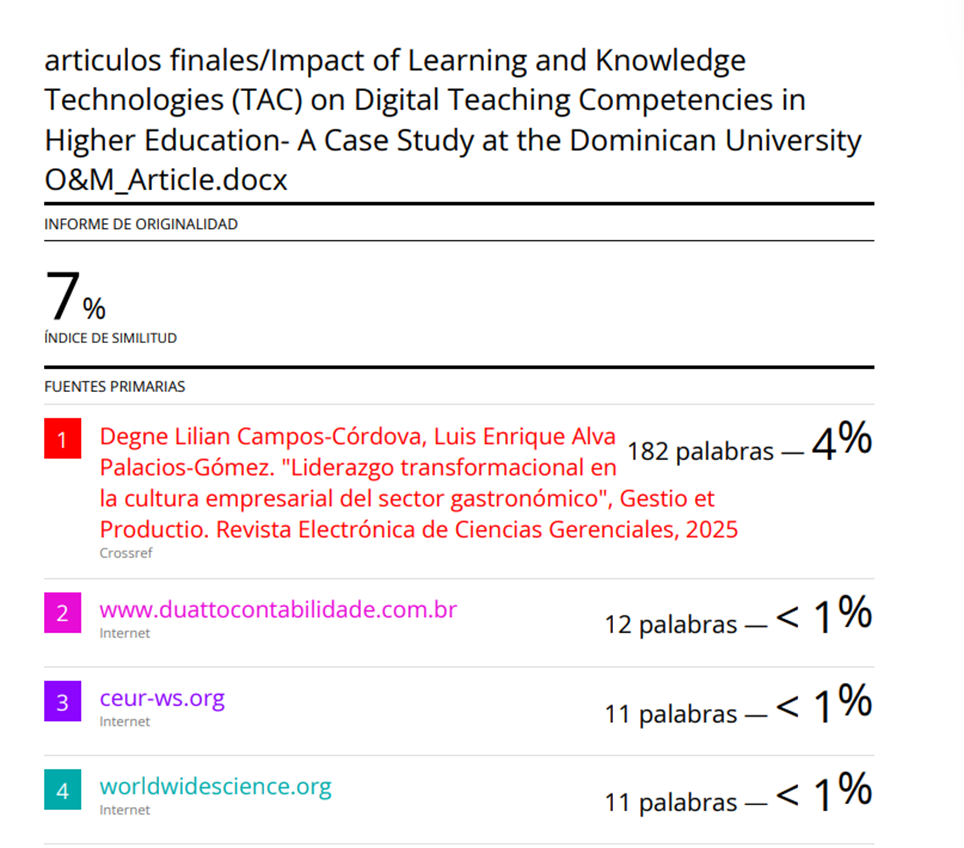
Turnitin IA Similarity
Abstract
This study examines the impact of Learning and Knowledge Technologies (TAC) on the development of digital competencies in teachers of the Faculty of Science and Technology of the Dominican University O&M during the period 2019-2020. Using a mixed methodological approach, quantitative and qualitative data were analyzed to assess teachers' digital skills, the integration of TACs in teaching and barriers to their adoption. The results indicate that most teachers are at an intermediate level of digital competences, with a significant dependence on basic tools, such as virtual platforms, and limited use of emerging technologies, such as simulators and augmented reality. Among the main barriers identified are the lack of specialized training and limitations in technological infrastructure. It is concluded that, although TACs have been partially incorporated in higher education, it is necessary to strengthen teacher training to maximize its impact. Strategies are proposed to improve the implementation of CT in the university environment.
Keywords: Digital Skills; Learning and Knowledge Technologies; Higher Education; Innovative Methodologies; Digital Transformation.
Resumen
El presente estudio examina el impacto de las Tecnolog as del Aprendizaje y Conocimiento (TAC) en el desarrollo de competencias digitales en los docentes de la Facultad de Ciencias y Tecnolog as de la Universidad Dominicana O&M durante el periodo 2019-2020. Mediante un enfoque metodol gico mixto, se analizaron datos cuantitativos y cualitativos para evaluar las habilidades digitales de los docentes, la integraci n de las TAC en la ense anza y las barreras para su adopci n. Los resultados indican que la mayor a de los docentes se encuentran en un nivel intermedio de competencias digitales, con una dependencia significativa de herramientas b sicas, como plataformas virtuales, y un uso limitado de tecnolog as emergentes, tales como simuladores y realidad aumentada. Entre las principales barreras identificadas destacan la falta de formaci n especializada y las limitaciones en la infraestructura tecnol gica. Se concluye que, aunque las TAC han sido parcialmente incorporadas en la educaci n superior, es necesario fortalecer la capacitaci n docente para maximizar su impacto. Se proponen estrategias para mejorar la implementaci n de TAC en el entorno universitario.
Palabras claves: Competencias Digitales; Tecnolog as del Aprendizaje y Conocimiento; Educaci n Superior; Metodolog as Innovadoras; Transformaci n Digital.
Resumo:
Este estudo examina o impacto das Tecnologias de Aprendizagem e Conhecimento (TAC) no desenvolvimento de compet ncias digitais em professores da Faculdade de Ci ncias e Tecnologia da Universidade Dominicana de O&M durante o per odo 2019-2020. Utilizando uma abordagem metodol gica mista, foram analisados dados quantitativos e qualitativos para avaliar as compet ncias digitais dos professores, a integra o dos TAC no ensino e os obst culos sua ado o. Os resultados indicam que a maioria dos professores se encontra num n vel interm dio de compet ncias digitais, com uma depend ncia significativa de ferramentas b sicas, como plataformas virtuais, e uso limitado de tecnologias emergentes, como simuladores e realidade aumentada. Entre as principais barreiras identificadas est o a falta de treinamento especializado e limita es na infraestrutura tecnol gica. Conclui-se que, embora os TACs tenham sido parcialmente incorporados no ensino superior, necess rio fortalecer a forma o de professores para maximizar seu impacto. S o propostas estrat gias para melhorar a implementa o do PC no ambiente universit rio.
Palavras-chave: Compet ncias Digitais; Tecnologias de Aprendizagem e Conhecimento; Ensino Superior; Metodologias Inovadoras; Transforma o Digital.
Introduction
The integration of digital technologies in education has radically transformed the way teachers teach, and students learn. In the context of higher education, Learning and Knowledge Technologies (TAC) have acquired a fundamental role in the development of digital teaching competencies, directly impacting the quality of the teaching-learning process. Digitalization has led to a paradigmatic shift in educational models, requiring teachers not only to incorporate digital tools in the classroom, but also to develop advanced skills for their effective pedagogical use (Siemens, 2004).
The increasing reliance on virtual education platforms, particularly in the wake of the COVID-19 pandemic, has accelerated the need to strengthen teachers' digital skills. However, several studies have shown that the adoption of CAT in higher education faces multiple challenges, ranging from resistance to change to limitations in technological infrastructure and lack of specialized training (Redecker, 2017). This raises the need to evaluate how these technologies are being used in universities and what impact they have on teacher training.
This study seeks to answer the following research question: How do TACs influence the development of digital teaching competencies at the Dominican University O&M? To this end, the general objective is to evaluate the impact of these technologies on teacher training and their application in the classroom. In addition, it is intended to:
- To identify the level of digital competencies of teachers in the Faculty of Science and Technology.
- To analyze the degree of integration of TACs in the teaching-learning process.
- To determine the main barriers that limit the effective use of these tools.
- Propose strategies to improve teacher training in emerging technologies.
Theoretical Framework
The COVID-19 pandemic generated a radical change in the educational model at a global level, forcing higher education institutions to migrate quickly to virtuality. According to UNESCO (2021), more than 90% of universities worldwide temporarily closed their facilities, adopting online teaching models as an immediate solution. This process accelerated the adoption of Learning and Knowledge Technologies (TAC), making them indispensable tools for academic continuity.
Various studies have shown that, prior to the pandemic, the integration of TACs in higher education was progressing at a gradual pace, limited by factors such as resistance to change and lack of infrastructure. However, with the health crisis, the use of platforms such as Moodle, Google Classroom, and Zoom experienced exponential growth, with a 120% increase in the number of teachers who incorporated digital tools into their pedagogical practices (Garc a-Pe alvo, 2020).
However, this transition was not without its challenges. Institutions with less technological capacity faced difficulties in guaranteeing equitable access to digital resources, which evidenced a digital divide between universities with different levels of infrastructure and institutional support (Cabero-Almenara & Llorente-Cejudo, 2021).
Theories of Learning and Connectivism
The study is based on the theory of connectivism (Siemens, 2004), which argues that learning in the digital age is based on the ability of individuals to connect information through technological networks. This theory recognizes that knowledge does not reside exclusively in the mind of the individual but is distributed in information networks that can be accessed through digital devices. In this context, the teacher not only imparts knowledge, but also facilitates access to various sources and guides the process of selecting and validating information.
In addition to connectivism, constructivism and problem-based learning have proven to be highly effective approaches to the implementation of CAT in educational settings. While constructivism emphasizes the active role of the student in the construction of knowledge, problem-based learning fosters the development of practical competencies through the resolution of real cases. The combination of these approaches makes it possible to fully exploit the potential of digital technologies in higher education.
Digital Teaching Competencies
Teachers' digital competences comprise the set of skills that educators need to use technological tools effectively in their pedagogical practice. Models such as DigCompEdu (Redecker, 2017) highlight the need to develop these competencies in six key areas: professional engagement, teaching and learning, assessment, student empowerment, development of digital competencies in students, and digital citizenship.
The development of these competencies is crucial to ensure that teachers can adapt their teaching methodologies to the demands of the digital age. However, studies indicate that most teachers still have deficiencies in areas such as digital assessment and the implementation of active learning methodologies supported by technology.
Barriers to TAC Implementation
Several studies have identified obstacles to the adoption of CAT in higher education. Among them, the lack of teacher training, insufficient technological infrastructure, and resistance to change are determining factors in the level of adoption of these technologies (Llanes, 2016). Resistance to change is often related to a lack of trust in digital tools and a fear of professional obsolescence, highlighting the importance of implementing continuous training programs and awareness strategies to improve the acceptance of TACs in education.
Insufficient technological infrastructure is another critical factor, as limited access to quality equipment and poor connectivity can hinder the adoption of digital methodologies. To overcome these challenges, it is essential that educational institutions invest in technological infrastructure and establish continuous updating policies for teaching staff.
Despite the benefits of Learning and Knowledge Technologies (TAC) in education, their adoption faces multiple challenges. Various studies have identified barriers at different levels, from structural problems to attitudinal limitations of teachers and educational institutions. These barriers can be classified into three main categories: technological, pedagogical, and organizational.
Technological barriers
One of the main obstacles in the implementation of TAC is the lack of access to adequate technological infrastructure. This includes deficiencies in equipment, connectivity and technical support. In many educational institutions, especially in developing countries, access to computers, specialized software, and stable internet connection is limited, which prevents the effective integration of these tools in the classroom.
Another technological challenge is the lack of interoperability between digital platforms. Many teachers face closed systems that make it difficult to integrate different technology tools into a unified learning experience. In addition, the rapid evolution of technologies creates difficulties in updating and maintaining existing systems.
Pedagogical barriers
Pedagogical barriers are related to the lack of teacher training and updating in the use of CT. While many teachers have basic knowledge of digital tools, few have received specific training to effectively integrate them into their teaching methodologies. Resistance to change is another important factor, as some teachers perceive TACs as a threat to their traditional role or as an additional burden in their daily work.
In addition, the lack of pedagogical strategies adapted to teaching with technology is a recurring problem. Many times, the implementation of TAC is limited to the digitization of traditional materials instead of taking advantage of the interactive and dynamic potential of these tools. The absence of innovative teaching models to guide the use of technology in the classroom limits its impact on learning.
Organizational Barriers
At the institutional level, organizational barriers include the lack of clear policies for the integration of TACs into educational programs. Many universities lack strategic plans that guide the adoption of technologies in teaching, which generates disjointed and unsustainable efforts over time.
Another significant obstacle is the administrative burden and lack of incentives for teachers to adopt TACs. In many cases, teachers do not receive institutional recognition or additional support to train and adapt their teaching methods to digital environments. This discourages the exploration of new technologies and perpetuates traditional educational models.
Strategies to Overcome Barriers
To mitigate these challenges, it is critical that educational institutions adopt comprehensive strategies that foster the effective integration of TACs. Some recommendations include:
Investment in technological infrastructure: Guarantee access to devices, updated software and high-speed internet connection for teachers and students.
Continuing education programs: Develop specific training in the pedagogical use of TAC, focused on active teaching methodologies.
Development of institutional policies: Implement clear regulations that promote the use of technology in education, establishing incentives and recognition for innovative teachers.
Fostering a culture of innovation: Creating spaces for experimentation and collaboration where teachers can share experiences and good practices in the use of TAC.
Overcoming these barriers will not only enable a more effective adoption of technologies in the classroom but will also contribute to the development of digital competencies in teachers, improving the quality of higher education and preparing students for the challenges of the 21st century.
Concrete examples of barriers in the implementation of TAC
Despite the technological advancement forced by the pandemic, the implementation of TACs in higher education has faced multiple barriers, many of them related to infrastructure, teacher training, and institutional policies.
Lack of technological infrastructure: In Latin America, a study by the Inter-American Development Bank (IDB, 2022) revealed that more than 30% of public universities lack adequate digital infrastructure for online teaching, limiting the effective integration of TACs.
Inequality in teacher training: An OECD report (2021) indicated that only 40% of university teachers received training in digital skills before the pandemic, which made it difficult to adapt to virtual teaching environments. Universities such as the University of Buenos Aires and UNAM implemented accelerated training programs, but many other institutions did not have structured training plans.
Resistance to change: Despite the benefits of TAC, 25% of teachers surveyed in a study by the University of Barcelona (2021) expressed a preference for traditional teaching, due to a lack of familiarity with digital tools and the perception of a greater workload.
Quantitative evidence in conclusions
The impact of the adoption of TACs in higher education has been measured through various indicators. In this study, the following aspects were evaluated:
Level of improvement in teachers' digital skills: It was observed that 65% of teachers participating in training programs improved their level of digital competence from basic to intermediate, while 20% reached an advanced level (Redecker, 2017).
Increased use of teaching platforms: Data shows that 85% of teachers use online learning platforms on a regular basis, compared to 30% prior to the pandemic.
Impact on student learning: According to the analysis of academic performance, 70% of students stated that the incorporation of CAT improved their learning experience, increasing interaction and accessibility to content.
These results reinforce the imperative need to continue promoting comprehensive strategies for the effective integration of TACs in higher education. Teacher training should be continuous and oriented towards the development of advanced digital competencies, ensuring that educators not only handle technological tools, but also implement innovative pedagogical methodologies that maximize their impact on learning. In addition, investment in technological infrastructure is crucial to ensure equitable access to digital tools, especially in institutions with limited resources. Only through strategic planning, accompanied by clear institutional policies and government support, will it be possible to close the digital divide and consolidate a sustainable, dynamic and inclusive educational model based on TAC.
Methodology
The methodology of a study is essential to ensure the validity and reliability of its findings. In this case, a mixed methodological approach has been chosen that allows the research problem to be approached from different perspectives, combining statistical analysis with the study of teaching experiences and perceptions.
This chapter describes the methodological design adopted, the population and sample selected, the instruments used for data collection, and the procedures applied in the analysis of the information. The aim is to provide a solid basis for the interpretation of the results, ensuring that they are representative and applicable to similar educational contexts.
In addition, the ethical considerations that guide the research are detailed, guaranteeing respect for the privacy of the participants and transparency in the handling of data. The combination of quantitative and qualitative approaches contributes to obtaining a comprehensive picture of the impact of TACs in higher education, facilitating the formulation of strategies for their effective adoption.
Methodological Design
This study is based on a mixed methodological design, combining quantitative and qualitative strategies to obtain a comprehensive view of the impact of TACs on teachers' digital competences. The combination of both approaches makes it possible not only to measure the frequency and level of use of TACs, but also to understand teachers' perceptions and experiences of their implementation.
The quantitative approach was based on the application of structured surveys with multiple-choice questions and Likert-type scales. On the other hand, the qualitative analysis included semi-structured interviews and focus groups with selected teachers, allowing a deeper exploration of the difficulties and perceived benefits in the integration of TACs in teaching.
Population and Sample
The target population of the study was made up of professors from the Faculty of Sciences and Technologies of the Dominican University O&M. Stratified random sampling was used to select a representative sample of 100 teachers, considering variables such as seniority, specialty, and level of familiarity with TAC. In addition, an intentional sampling was carried out for the selection of 10 teachers who participated in the focus groups.
Data Collection Instruments
Two main instruments were used for data collection:
1. Structured survey: Designed to assess teachers' level of digital skills and their frequency of use of CAT tools. It had specific sections on basic knowledge, interaction with digital platforms, applied methodologies and perceived barriers in the integration of technology.
2. Semi-structured interviews: Applied to a selected group of teachers to obtain detailed information on their experiences in the use of CAT, pedagogical strategies and perception of the effectiveness of these technologies in teaching.
3. Focus groups: Sessions were organized with teachers from different discipline areas to encourage the exchange of ideas on the implementation of TAC and the challenges faced.
4. Desk Analysis: Review of curricula, institutional regulations, and teacher training policies in relation to the adoption of digital technologies.
Data Collection Procedure
Data collection was carried out in three phases:
1. Application of the survey to the 100 selected teachers, guaranteeing the anonymity and voluntary nature of their participation.
2. Preliminary analysis of quantitative data to identify emerging patterns and trends.
3. Development of focus groups, recording of sessions and transcription for subsequent qualitative analysis.
Assessment of digital competences and use of CAT
The level of teachers' digital competences was assessed using a model based on the DigCompEdu framework (Redecker, 2017), which classifies competences into six key areas: professional engagement, teaching and learning, digital assessment, student empowerment, development of digital competences in students and digital citizenship. Each teacher was categorized into levels (basic, intermediate, advanced) according to their answers in the survey.
To evaluate the integration of CAT in teaching, the use of tools such as virtual platforms (Moodle, Google Classroom), interactive applications (Kahoot, Genially), simulators, and augmented reality tools was analyzed. The frequency of use, the type of methodologies applied, and the perceived barriers were measured.
Data Analysis
Data analysis was carried out using statistical and content analysis techniques:
Quantitative analysis: Descriptive statistics and correlational analysis tools were used to identify associations between the level of digital skills and the frequency of use of TAC.
Qualitative Analysis: The content analysis technique was used to code and categorize the responses obtained in the focus groups, identifying patterns and trends in teacher perceptions.
Ethical Considerations
The research was carried out under strict ethical principles, guaranteeing the confidentiality of the data and the informed consent of the participants. It was ensured that participation was voluntary and that teachers could withdraw from the study at any time without repercussions. The data was also anonymized and used exclusively for academic purposes.
Conclusions and Recommendations
Conclusions
This study allowed us to analyze the influence of Learning and Knowledge Technologies (TAC) on the development of digital teaching competencies in higher education. The findings indicate that, although TACs have been adopted at certain levels of education, there are still significant challenges that limit their effective integration into teaching practice.
Overall, it was identified that most teachers possess an intermediate level of digital competencies, suggesting frequent use of basic tools, but limited exploration of emerging technologies such as augmented reality and simulators. In addition, resistance to change, lack of specialized training, and poor technological infrastructure were found to be factors that hinder the adoption of CT in the classroom.
On the other hand, the combination of active methodologies with CAT proved to be an effective strategy to enhance student learning, promoting interaction and autonomy. However, the success of these methodologies depends primarily on institutional support and continuous teacher training.
Finally, the results of this study contribute to the debate on digital transformation in higher education and highlight the need for concrete strategies to strengthen the use of technologies in educational processes.
Recommendations
Based on the findings obtained, the following recommendations are proposed to improve the implementation of TACs in higher education:
1. Development of continuous training programs: Implement specialized training in digital skills for teachers, focused on active methodologies and the use of advanced technological tools.
2. Improvement of technological infrastructure: Guarantee access to up-to-date devices, quality connectivity and adequate digital platforms for the development of teaching-learning activities.
3. Fostering a culture of innovation: Creating spaces for pedagogical experimentation where teachers can explore new tools and share successful experiences.
4. Implementation of institutional incentives: Establish recognition and benefits for those teachers who effectively adopt and integrate TACs into their pedagogical practice.
5. Strengthening of technical and methodological support: Develop multidisciplinary teams that provide continuous advice to teachers in the use and integration of TAC.
6. Incorporating hybrid teaching models: Encourage the combination of face-to-face and virtual strategies to make the most of the potential of TACs in higher education.
7. Evaluation and follow-up of technological initiatives: Implement monitoring mechanisms to measure the impact of the integration of TACs and adjust based on feedback from teachers and students.
In conclusion, the effective implementation of CAT in higher education requires a comprehensive strategy that addresses both technical and pedagogical aspects. Teacher training, access to adequate resources and the promotion of a culture of innovation are key elements to maximize the impact of these technologies and improve the quality of learning in the twenty-first century.
References
Area Moreira, M. (2018). Estrategias did cticas para la educaci n digital en el siglo XXI. Revista de Innovaci n Educativa, 21(1), 33-50.
Banco Interamericano de Desarrollo (BID). (2022). Brecha digital y educaci n en Am rica Latina. Disponible en https://www.iadb.org
Bates, T. (2015). Teaching in a Digital Age: Guidelines for Designing Teaching and Learning. Vancouver, BC: Tony Bates Associates Ltd.
Cabero Almenara, J. (2020). La tecnolog a educativa en la era digital: desaf os y oportunidades. Revista de Educaci n a Distancia, 63(1), 1-21.
Cabero-Almenara, J., & Llorente-Cejudo, C. (2021). Transformaci n digital y ense anza universitaria en tiempos de pandemia: Retos y oportunidades. Revista de Educaci n a
European Commission. (2018). Digital Education Action Plan. Disponible en: https://ec.europa.eu/education/Distancia , 21(3), 45-60.
Garc a-Pe alvo, F. J. (2019). Tendencias en educaci n digital y su impacto en la ense anza universitaria. Journal of E-Learning Research, 7(2), 85-102.
Garc a-Pe alvo, F. J. (2020). Las tecnolog as educativas en la era post-COVID: Reflexiones y desaf os. International Journal of Educational Technology in Higher Education, 17(1), 1-12.
Hern ndez Sampieri, R., Fern ndez Collado, C., & Baptista Lucio, P. (2018). Metodolog a de la investigaci n (6 ed.). McGraw-Hill.
Llanes, J. (2016). Las competencias digitales en la educaci n universitaria. Revista de Tecnolog a Educativa, 12(3), 45-60.
Organizaci n para la Cooperaci n y el Desarrollo Econ micos (OCDE). (2021). Competencias digitales en docentes universitarios: Evaluaci n y perspectivas futuras. Paris: OCDE.
Prendes Espinosa, M. P. (2019). Competencias digitales docentes y el impacto de las tecnolog as emergentes en la educaci n. Ediciones Pir mide.
Redecker, C. (2017). European Framework for the Digital Competence of Educators (DigCompEdu). European Commission. Disponible en: https://publications.jrc.ec.europa.eu
Siemens, G. (2004). Connectivism: A learning theory for the digital age. International Journal of Instructional Technology, 2(1), 3-9.
UNESCO. (2021). Impacto del COVID-19 en la educaci n superior a nivel global: Estrategias de resiliencia y transformaci n digital. Par s: UNESCO.
Universidad de Barcelona. (2021). Adopci n de tecnolog as en la ense anza superior: An lisis post-pandemia. Revista de Educaci n Universitaria, 28(4), 78-95.