The Impact of Thinking Routines on The Development of Critical Thinking in Students in The Sixth Grade of Basic Education
(en) El impacto de las rutinas de pensamiento en el desarrollo del pensamiento crítico en estudiantes de sexto grado de educación básica
(port) O Impacto das Rotinas de Pensamento no Desenvolvimento do Pensamento Crítico em Alunos da Sexta Série do Ensino Básico
Universidad Estatal de Milagro
 https://orcid.org/0000-0003-3474-3120
Caroline Allison Moreira-Cagua
Unidad Educativa Bilingüe ¨Javier
https://orcid.org/0000-0002-2183-3867
Valeria Lilibeth Santillan-Saona
Centro de Atención Integral ¨KRAAKER
valeriasantillansaona@hotmail.com
https://orcid.org/0000-0001-7578-5410
Fernanda Paola Bajaña-Palomino
Escuela de Educación Básica Victoria Macías de Acuña
https://orcid.org/0009-0000-7139-3858
Saona-Lozano, R. V., Moreira-Cagua, C. A., Santillan-Saona, V. L., & Bajaña-Palomino, F. P. (2025). El impacto de las rutinas de pensamiento en el desarrollo del pensamiento crítico en estudiantes de sexto grado de educación básica. YUYAY: Estrategias, Metodologías & Didácticas Educativas, 4(2), 94–111. https://doi.org/10.59343/yuyay.v4i2.100
Recepción: 30-10-2024 / Aceptación: 18-01-2025 / Publicación: 31-01-2025

Turnitin AI Similarity
Abstract
The purpose of this article is to analyze thinking routines and their contribution to the development of critical thinking in sixth-year students of basic education. It also seeks to show what extent teachers use thinking routines in the teaching-learning process. This study responds to research with a quantitative approach of descriptive design, using survey techniques and content analysis to reflect on the use of these routines in the teacher's methodology. Thinking routines are determined as an independent variable and critical thinking as an independent variable. The results of this research indicate the importance of applying educational strategies such as summaries, reflective questions and graphic organizers, which facilitate students' identification and structuring of key ideas, while reinforcing their critical thinking skills.
Keywords: Thinking routines, creativity, innovation, auto-didactics.
Resumen
El propósito de este artículo es analizar las rutinas de pensamiento y su contribución al desarrollo del pensamiento crítico en estudiantes de sexto año de educación básica. También busca mostrar en qué medida los profesores utilizan las rutinas de pensamiento en el proceso de enseñanza-aprendizaje. Este estudio responde a una investigación con enfoque cuantitativo de diseño descriptivo, utilizando técnicas de encuesta y análisis de contenido para reflexionar sobre el uso de estas rutinas en la metodología del docente. Se determinan las rutinas de pensamiento como variable independiente y el pensamiento crítico como variable independiente. Los resultados de esta investigación indican la importancia de aplicar estrategias didácticas como los resúmenes, las preguntas reflexivas y los organizadores gráficos, que facilitan a los estudiantes la identificación y estructuración de las ideas clave, a la vez que refuerzan sus habilidades de pensamiento crítico.
Palabras claves: Rutinas de pensamiento, creatividad, innovación, autodidáctica.
Resumo
O objetivo deste artigo é analisar as rotinas de pensamento e sua contribuição para o desenvolvimento do pensamento crítico em alunos do sexto ano do ensino fundamental. Também busca mostrar em que medida os professores utilizam as rotinas de pensamento no processo de ensino-aprendizagem. Este estudo responde à pesquisa com uma abordagem quantitativa de design descritivo, usando técnicas de pesquisa e análise de conteúdo para refletir sobre o uso dessas rotinas na metodologia do professor. As rotinas de pensamento são determinadas como uma variável independente e o pensamento crítico como uma variável independente. Os resultados desta pesquisa indicam a importância da aplicação de estratégias educacionais, como resumos, perguntas reflexivas e organizadores gráficos, que facilitam a identificação e a estruturação de ideias-chave pelos alunos, ao mesmo tempo em que reforçam suas habilidades de pensamento crítico.
Palavras-chave: Rotinas de pensamento, criatividade, inovação, autodidática.
Nota de Autor:
Se utilizó Open AI para generar el 13% del contenido del Resumen. La autoría verificó la exactitud y originalidad del contenido generado por IA sometiéndolo a pruebas antes de su envío.
Author's note:
Open AI was used to generate 13% of the content of the Abstract. The authorship verified the accuracy and originality of the AI-generated content by testing it before submission.
Nota do autor:
Open AI foi usado para gerar 13% do conteúdo do Resumo. O autor verificou a precisão e originalidade do conteúdo gerado por IA testando-o antes do envio.
Introduction
This research explains the reason why, from the paradigms or pedagogical approaches that see the student as an active subject, with the ability to direct their own learning processes, strategies such as the routines of thinking based on metacognition are beneficial so that students do not become not recipients of information and content, but individuals capable of transforming information into knowledge (Gómez, 2023).
It is essential that learning obtained through metacognitive strategies allows students to go beyond the instrumental cognitive approach, which limits their ability to develop cognitive skills and strategies (Salazar & Cáceres, 2022). This development is crucial to ensure the successful procedure of learning activities or problem-based solving, also addressing activities such as planning, review and evaluation.
The scarce teaching guidance in cognitive processes directs students to be passive subjects of reception, without specifying the constructive process of knowledge, as well as the raising doubts or issuing questions depending on their experience and environment. The limited feedback in activities generates confusion and misrepresentation in the development of skills. In the learning environments, students have been detected who only copy the notebook, despite not having the slightest idea of the subject that was addressed. In the Ecuadorian reality, the form of teaching has been largely addressed, however, learning has been scarcely reviewed, that is, in addition to exploring what they learn, it is necessary to perceive exhaustively how they manage to internalize learning.
Through questions that usually have a "simple" or easy nuance, the aim is to land on the metacognition of each student. Precisely each learner operates as active agents, capable of transforming ideas, make decisions, and assume problem-based conflict resolution (Enríquez, 2021). It is very worrying that, from the different stays of interdisciplinary activities (understood as individual workshops, group work or linking projects) of the objectives designed, to specify or detail what the goals of the comprehension. Likewise, short or incomplete answers have materialized as a gap between knowing how to learn and knowing how to do it. Through this research, we seek to transcend the social structure of learning and therefore the following question is asked: Thinking routines contribute to learning that leads to the development of thinking critically in students in the sixth year of basic education?
Methodology
Methodological approach
The present research is based on the positivist paradigm, recognized for the ability to provide objectivity, systematic observation and quantification of perceptible phenomena. This methodological approach allows structuring a rigorous analysis of cognitive processes and their influence on the development of critical thinking in students. In this context, a hypothetical-deductive system is used that considers knowledge as a systematic, verifiable process subject to empirical control, which makes it possible to identify causal relationships and observable patterns in the phenomena studied (Miranda & Ortiz, 2020).
As for the methodology, the focus of this research is quantitative, standing out for the precise measurement and detailed analysis of numerical data. This methodological model is characterized by the structured collection of information that can be quantified, which allows the application of various statistical techniques to obtain concrete and objective results. In this way, priority is given to recognizing causal relationships and detecting patterns of behavior in broad scenarios (Vizcaíno et al., 2023). This methodological approach is pertinent to measure the impact of thinking routines on specific variables, such as cognitive development and the strengthening of critical thinking.
In relation to the type of research, this study is descriptive-correlational. From the descriptive approach, it seeks to identify and characterize the fundamental elements of the phenomenon under study, while the correlational component focuses on analyzing the existing relationships between the variables investigated. This methodological design provides an adequate framework for understanding how thinking routines influence the development of critical thinking and allows for the establishment of meaningful associations that support the conclusions obtained. And its scope is descriptive and correlational because it will be possible to summarize and describe the basic characteristics of the data collected.
As for the type of research, the characteristics of the phenomenon are already known and what is sought is to expose its presence in a certain human group. In the quantitative process, analysis of central tendency and dispersion data is applied. In this scope, it is possible, but not mandatory, to propose a hypothesis that seeks to characterize the phenomenon of the study (Ramos, 2020). The relationship between the implementation of thinking routines and the cognitive development of students is thus determined.
Population
An estimated 21 students belong to the middle school level and the sixth-year sublevel of basic education, in the city of Guayaquil, Ecuador. Surveys aimed at students are used to collect information on their cognitive development before and after the implementation of thinking routines. A non-sampling type was selected probabilistic by judgment, which has been awarded to the 21 students who make up a parallel in the sixth year of basic education.
Technique
The assessment instrument consists of 4 dimensions. In the first block, 7 questions are detailed that revolve around the topic Culture of thought, composed of a scale Dichotomous. Rita Castro's investigation in 2021 was held as support. In the second block, the survey referred to the students, 3 questions are detailed that revolve around the Modalities of thinking routines to introduce and explore ideas. On the other hand, in the Third block, 3 questions are delimited that concern the modalities of routines of Thought to synthesize and organize ideas. And the last section determines three questions based on the modalities of thinking routines to deepen the idea. The structure of the last three blocks will be developed under the Likert scale: 1: never 2: almost never 3: sometimes 4: almost always 5: always. The research of Felipe Chiliquinga y Jorge Balladares (2019) was supported. Items 1 to 9 explore in the variable thinking routine. While the following 7 items show the variable of critical thinking with the dimension of movement of thought.
The survey tool used in this analysis has been adapted from the work carried out by Chiliquinga and Balladares, entitled Thinking routines: an innovative process in the teaching of mathematics. This adaptation was made with the purpose of adapting the items to E.B.G. students, while ensuring the validity and reliability of the original measurements. Adjustments were made to the language and educational context to ensure that the items were relevant and appropriate for the participants of this research. It will be done individually to the students with a brief explanation of each block.
Analysis and Interpretation of Results
The survey that was applied to students consists of 3 dimensions, which are detailed below:
· Dimension 1: Modalities of thinking routines to introduce and explore ideas. Items 1, 2 and 3.
· Dimension 2: Modalities of thinking routines to synthesize and organize ideas. Items 4, 5 and 6.
· Dimension 3: Modalities of thinking routines to deepen ideas. Items 7, 8 and 0
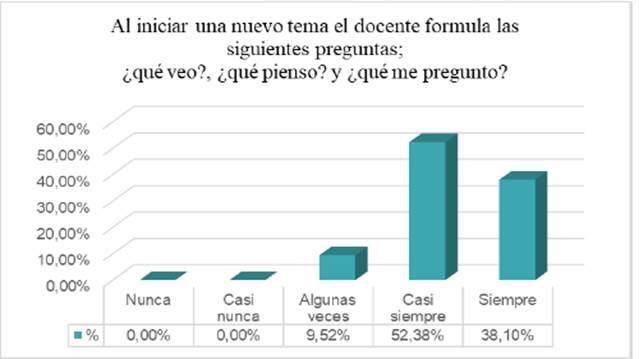 |
Figure 1
Item 1 The routine I see, I think, I wonder
Note: Indicates the frequency of the thinking routine: I see, I think, and I wonder. Diagnostic test, 2019. Adapted from the evaluation instrument of Balladares and Chiliquinga, 2019.
The graph supports the results of the first item that asks about the frequency with which teachers ask the questions "What do I see?", "What do I think?" and "What do I ask myself?" when starting a new topic. The data reveal that no student opted for the "Never" option (0.00%), which implies that all teachers at a given time use these questions at the beginning of a class. Likewise, the option "Almost never" was also selected by no participant, which suggests that these questions are almost always part of the pedagogical methodology. 9.52% of the respondents selected "Sometimes", indicating that a small group of teachers use this strategy occasionally. On the other hand, 52.38% of the participants selected "Almost always", which indicates that this practice is common and habitual among educators.
Finally, 38.10% of the students answered "Always", which indicates that a significant number of teachers ask these questions on a regular basis when starting a new topic. In general terms, it is observed that a large majority of teachers carry out these questions consistently, either "Almost always" or "Always", which highlights the relevance of these questions in the teaching process. Only to a lesser extent (9.52%) does it do so "Sometimes", and no one was recorded who stated that these 38 questions are asked "Never" or "Almost never". This indicates that the questions "What do I see?", "What do I think?" and "What do I ask myself?" are considered as fundamental elements of the educational process by most of the students surveyed.
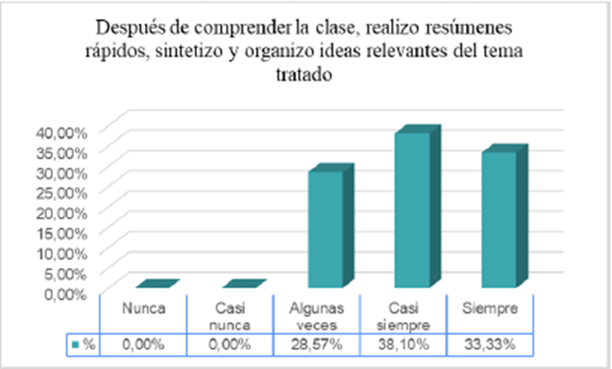
Figure 2
Frequency with which students prioritize ideas according to
the state of relevance.
Note: Diagnostic test, 2019. Adapted from the evaluation instrument of Balladares and Chiliquinga, 2019.
The results obtained in item 4 indicate that most of the participants in the survey are dedicated to summarizing and structuring key ideas after having assimilated the content of the class. It is pertinent to note that none of the students surveyed selected the categories "Never" or "Almost never", which shows the absence of individuals who perform these activities with low frequency. In relation to the "Sometimes" option, 28.57% of the participants indicated that they carried out these tasks occasionally, which suggests the existence of a group that performs them sporadically and not systematically.
Likewise, 38.10% indicated that they "almost always" summarize and organize relevant ideas, which reflect frequent practice and a partial integration of these activities into their academic habits. Finally, 33.33% stated that they carry out these actions "Always", which denotes a constant commitment and a structured dedication towards the synthesis and organization of information. In general, the data allows us to conclude that a significant proportion of the students surveyed maintain a recurrent practice of summarizing and organizing ideas after understanding the classes. This shows that a relevant group of students carry out these activities continuously or with high regularity, consolidating their importance in the learning process.
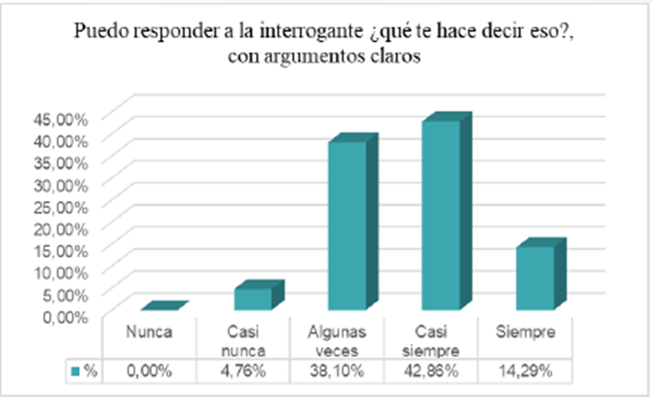
Figure 3
Students answer questions such as: what makes you say that?
with clear arguments.
Note: According to the Diagnostic Test, 2019 (adapted from the assessment instrument of Balladares and Chiliquinga, 2019),
The evaluation of the results obtained allows us to analyze the perceptions of the respondents when answering the question: "What makes you say that?", focusing on the strength of their arguments. It is essential to indicate that none of the respondents selected the "Never" option, which shows that all of them perceive themselves as capable of expressing their answers in an understandable way. On the other hand, only 4.76% of the participants indicated the option "Almost never", which suggests that difficulties in arguing clearly are rare in this group of participants.
In relation to the "Sometimes" option, 38.10% of respondents indicated that, on certain occasions, they manage to answer clearly, which implies that there is a significant proportion that faces obstacles to articulate solid arguments on a constant basis. On the other hand, 42.86% stated that "Almost always" can provide clear arguments, which indicates a recurrent ability to develop well-founded answers. Likewise, 14.29% stated that "Siempre" manages to articulate clear arguments, reflecting an advanced level of
argumentative competence. In conclusion, when considering the results globally, it is observed that more than half of the respondents (55.95%) can argue clearly at least in most cases. A significant group (42.86% and 14.29%) that achieves it frequently or permanently stands out. However, there is still a relevant percentage of individuals who only manage to respond clearly in specific situations, which suggests the need to strengthen argumentative skills in certain cases. On the other hand, 42.86% stated that "Almost always" can provide clear arguments, which indicates a recurrent ability to develop well-founded answers. Likewise, 14.29% stated that "Siempre" manages to articulate clear arguments, reflecting an advanced level of argumentative competence.
In summary, when considering the results globally, it is observed that more than half of the participants (55.95%) can present clear and coherent arguments in various contexts. However, a significant group (42.86% and 14.29%) stands out that demonstrates argumentative capacity almost always or always which indicates that a significant proportion of the respondents have a solid ability to express arguments clearly, although there is a percentage that only occasionally achieves it.
Figure 4
Students ask questions to deepen their ideas
Note: Diagnostic test, 2019. (Adapted from the Balladares and Chiliquinga, 2019).
The analysis of the results shows the level of commitment of the students with the exploration of concepts, the formulation of questions and the identification of possible inconsistencies in their arguments. In the first place, it is relevant to note that none of the participants selected the "Never" category, which suggests that all of them, to some extent, are involved in activities aimed at deepening ideas and critical analysis. However, 4.76% of those surveyed indicated "Almost never", which indicates that these practices are unusual for this group, evidencing a lower frequency in their involvement with these activities. On the other hand, 33.33% opted for the "Sometimes" category, which reflects an intermittent participation in the formulation of questions and the identification of errors, without these actions being consolidated as a recurring practice.
Consequently, 57.14% positioned themselves in the "Almost always", which reveals a high frequency in their willingness to delve into concepts, raise questions and look for argumentative inconsistencies. This majority percentage shows a significant tendency towards reflective and critical analysis. On the other hand, 4.76% of those surveyed stated that they carry out these activities constantly, placing themselves in the "Always" category. This result highlights a strong and sustained commitment to the practice of analytical and argumentative skills. The data obtained allow us to infer that most of the students surveyed (61.90%, adding "Almost always" and "Always") demonstrate a habitual inclination towards the deepening of ideas, the formulation of questions and the search for errors in argumentation. This finding underscores a favorable attitude towards critical and in-depth analysis in their thought processes, although there is still a percentage that still needs to strengthen these skills more consistently.
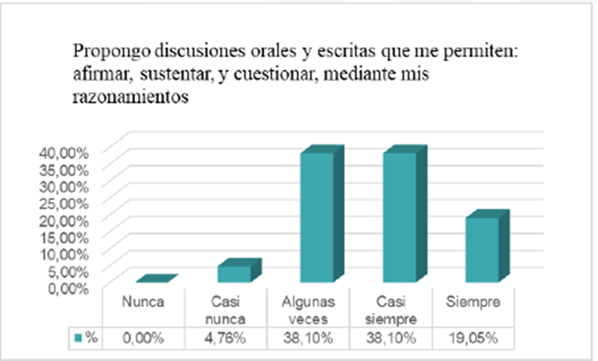 Figure 5
It demonstrates the regularity with which students
intervene in debates to express, justify and defend their ideas.
Note: Diagnostic evaluation, 2019. (Based on the evaluation
instrument developed by Balladares and Chiliquinga, 2019).
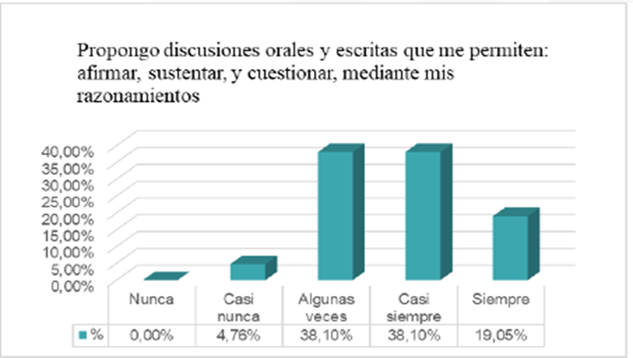
According to the results obtained in the last item, it is observed that students actively participate in discussions aimed at affirming, reasoning and arguing with solid foundations. In relation to the frequency of participation, it is relevant to note that none of the respondents selected the "Never" option. This finding suggests that all participants show some degree of engagement in academic discussions, reflecting a widespread willingness to engage in these activities.
The analysis of these data highlights the importance of dialogue spaces to strengthen students' argumentative and critical skills. Through these dynamics, participants not only can express their ideas, but also subject them to questions that favor the construction of logical and structured thinking. 4.76% of those surveyed indicated that they do so "almost never", that is, for this group it is unusual to initiate such dialogues. On the other hand, 38.10% participate "sometimes", although these interactions do occur, they are not regular. An equal percentage, 38.10%, is involved "almost always", which shows a habitual participation in these activities to support and question arguments. Finally, 19.05% affirm that they always participate in these discussions, which reflects a high degree of commitment to the affirmation, substantiation and questioning of ideas. In conclusion, most of the respondents engage in dialogues at least intermittently. It is understood that the practice of reasoned discussion is common among participants, although with variations in its frequency.
Survey of teachers
The survey that was applied to teachers consists of 7 items, which are detailed below:
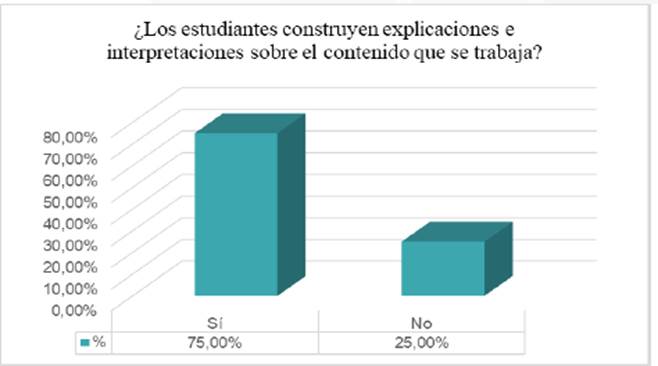 |
Figure 6
Frequency of students when performing interpretations and analyses.
Note: Test for Movement of Thought (Adapted from the Rita Castro, 2019).
The results support the perception of students' ability to formulate explanations and interpretations in relation to the content addressed. The analysis of the results reveals that 75.00% of the teachers surveyed considered that students construct meaningful explanations and interpretations on the topics addressed. This finding suggests that a considerable majority of students actively participate in their learning process, demonstrating the ability to develop well-founded interpretations based on the knowledge acquired. This percentage shows that the methodological strategies and activities implemented in the classroom are generating an environment conducive to critical analysis and the autonomous construction of ideas around the contents covered.
However, 25.00% of the teachers indicated that the students present areas of improvement in their ability to construct explanations and interpretations. Although this proportion is lower, it highlights the existence of certain challenges that can limit the ability of students to carry out more in-depth analysis. These difficulties could be linked to factors such as the pedagogical strategies used, the level of interest of the students or the inherent complexity of the contents. While most students demonstrate strong competencies in interpretation and analysis, a relevant proportion requires greater support to strengthen these skills. This scenario emphasizes the importance of adjusting teaching methodologies to ensure that all students achieve a full development of their analytical and reflective capacities.
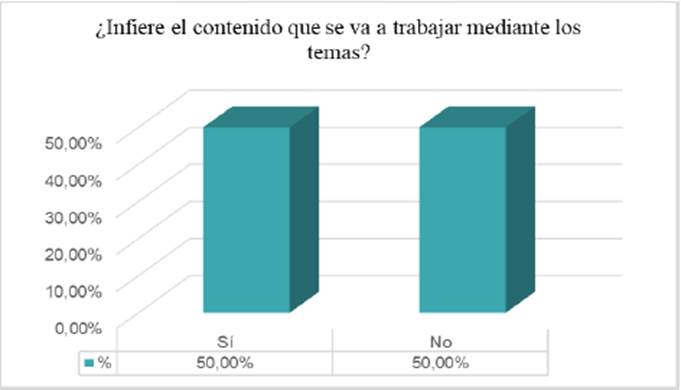 |
Figure 7
Frequency of students making inferences.
Note: Test for the Movement of Thought (Adapted from the evaluation instrument by Rita Castro, 2019).
The results show a division of opinions regarding the students' ability to infer the content from the proposed topics. On the one hand, 50% argues that students do indeed anticipate content, indicating that a considerable portion observes students' ability to deduce what will be addressed in class based on general topics. On the other hand, the remaining 50% believe that students find it difficult to make such inferences, that is, on certain occasions students find it difficult to make such inferences. It is difficult to clearly foresee the content based on the topics presented.
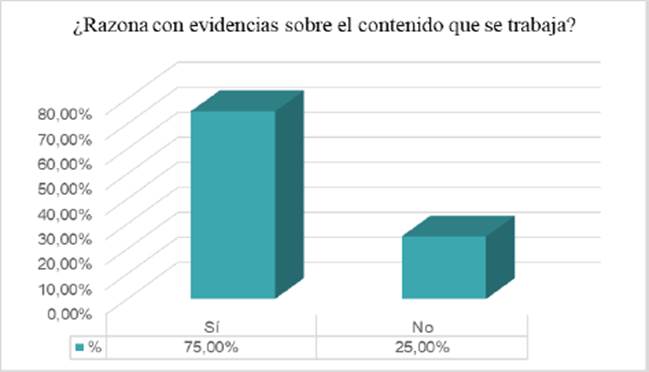 Figure 8
Advertise how often students reason with evidence of their
work
Note: Test for Movement of Thought (Adapted from the Rita Castro, 2019).
Given the results regarding the students' ability to reason with Evidence in relation to the content addressed is as follows: 75.00% state that the students rightly proceed with evidence to support their reasoning. So not only do they understand the material, but they are also able to back up their arguments with facts, data, or examples discussed in class, a significant level of critical thinking is reflected. On the other hand, 25.00% say that students find it difficult to reason with Evidence. A small group that faces difficulties in using evidence to support their arguments or reasoning is contemplated.
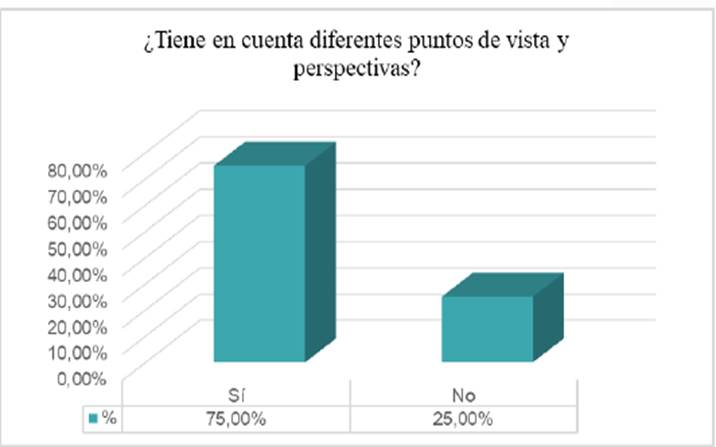 Figure 9
Frequency of learner’s different perceptions.
Note: Test for Movement of Thought (Adapted from the Rita Castro, 2019).
75.00% consolidate if various opinions and approaches are considered. Work has been done on the ability to integrate multiple perspectives when addressing content, which denotes an openness and development of critical thinking in the educational environment. On the other hand, 25.00% consider that students do not value different points of view, demonstrating that there is difficulty in including different perspectives in their analysis or discussion of the topics discussed. According to the results obtained in the surveys for both teachers and students, it is determined that the most accurate thing to do is to investigate the reasons that lead certain students not to be fully involved in the learning process and to consider strategies that can optimize this situation to achieve an increase in the percentage of participation.
In the first instance, a positive aspect that stands out in the results is that it is mostly held that students possess the ability to make inferences on the material presented, indicating that the teaching method could be the sufficiently clear or well-structured for certain students (García, 2021). However, the fact that the other 50% or 25% have stated that students are unable to infer the content emphasizes a possible lack of clarity in the presentation of the topics or in the way in which the content is related to the central concepts. The need to improve in the creation of explicit connections between topics and content is raised, to promote deeper understanding and more effective anticipation by students.
Secondly, it is highlighted in the answers obtained that half of the respondents say that students can make inferences about the material presented, which indicates that the teaching method could be clear or well-structured enough for certain students. However, the fact that the other 50% or 25% have stated that it is difficult for students to infer the content leads to a possible lack of clarity in the presentation of the topics or in the way in which the content is related to the central concepts. This could indicate the need for improvement in creating explicit connections between topics and content, to promote deeper understanding and more effective anticipation by students. To optimize this study variable, it would be of great contribution to adapt methods that help students recognize fundamental ideas, such as the preparation of summaries at the end of each class, the formulation of reflective questions or the implementation of graphic organizers that facilitate a better organization of information (Pérez et al., 2022). The development of critical thinking skills, as well as the ability to identify relevant information, represents a key strategy for students to make significant progress in valuing different perceptions.
Third, the data collected allows us to identify a pedagogical approach that encourages the use of evidence as an essential tool in the learning process. This approach aims to strengthen critical skills among students, promoting detailed analysis of facts and data before reaching conclusions (Cruzado et al., 2021). This emphasis on grounded thinking could be closely related to didactic strategies that encourage students to question and reflect in a structured way on the information they receive. However, a percentage of students still face significant difficulties in the association and reflective analysis of ideas is observed. These limitations may be due to a lack of understanding of the importance of using evidence, insufficient access to relevant resources, or insufficient practice in evidence-based reasoning.
Therefore, it is imperative to ensure that all students acquire a solid understanding of the crucial role that evidence plays in validating their arguments. In addition, it is necessary to implement playful and dynamic activities, such as debates and discussions focused on the analysis of concrete data. Likewise, learners should be provided with accessible resources, such as readings, practical examples, and methodological guides, which facilitate the identification and appropriate use of evidence in their reasoning.
Therefore, it is imperative to ensure that all students acquire a solid understanding of the crucial role that evidence plays in validating their arguments. In addition, it is necessary to implement playful and dynamic activities, such as debates and discussions focused on the analysis of concrete data. Likewise, learners should be provided with accessible resources, such as readings, practical examples, and methodological guides, which facilitate the identification and appropriate use of evidence in their reasoning. The consolidation of these strategies will not only contribute to the strengthening of students' critical competencies but will also allow them to more effectively assess the different perceptions in a framework of reflective and well-founded analysis.
This study is of utmost importance for teaching practice, since it promotes the development of students with innovative skills. The following fundamental aspects are also highlighted: Students who regularly participate in activities that encourage critical thinking, such as the formulation of reflective questions and the use of graphic organizers, experience a marked improvement in their ability to understand, especially compared to those who face difficulties in integrating these strategies into their everyday learning.
The strengthening of essential competencies, such as critical thinking through thinking routines, are key tools to enhance critical skills such as questioning, justifying, and supporting ideas with concrete evidence (Rodríguez et al., 2021). Students who implement these activities tend to generate deeper and more informed responses, reflecting a higher level of analysis and reasoning.
Diversity of perspectives: According to Zavala and Nieto (2022), the adoption of thinking routines fosters in students the ability to consider multiple perspectives and opinions. This approach enriches debates and analyses, as well as favoring a more empathetic and flexible development in their critical reasoning.
Autonomy in learning is reflected in students who integrate thinking routines into their educational process, optimizing a greater ability to reflect on their learning and make informed decisions. This autonomy allows them to apply the knowledge acquired in novel situations more effectively, enhancing their adaptability.
Fostering creativity through cognitive strategies such as thinking routines is crucial for human development and social transformation in the current context (Ramírez, 2021). These strategies not only promote innovation but also contribute to the formation of individuals with initiative and skills to solve complex problems in a globalized and constantly evolving environment.
However, it is important to note that the development of critical thinking cannot be considered a universal solution to educational challenges if it is not supported by a sound methodological approach. Programs or plans that lack adequate scientific backing will have limited impact. In other words, the use of well-grounded thinking routines has the potential to transform ordinary students into agents of change capable of turning basic ideas into effective solutions to complex problems (Gutiérrez et al., 2024).
Therefore, this study aims to inspire educators to explore the relationship between the development of critical thinking and different disciplines, especially in the educational field. This will allow us to identify strategies that provide students with the necessary tools to face the challenges of a competitive society with wisdom.
Finally, promoting an investigative spirit is essential for the development of critical thinking. This arises from curiosity, commitment to autonomous learning and the search for relevant information. Comprehensive education must go beyond the academic field and be projected into the social environment, considering the student as a reflective, curious individual open to new perspectives, with the honesty to confront their own prejudices and confidence in their reasoning abilities.
References
Castro Rita. 2018. Pensamiento visible: Rutinas de pensamiento en aulas unitarias rurales.Universidad de Valladolid.
Chiliquinga-Campos, F., & Balladares-Burgos, J. (2019). Rutinas de pensamiento: Un proceso innovador en la enseñanza de la matemática. Revista Andina de Educación, 3(1), 53-63.
Cruzado, M. O. D. M., Gonzales, M. N. T. A., & de Dios Ruiz, M. M. A. (2021). Pensamiento crítico para mejorar el aprendizaje en educación básica. Ciencia Latina Revista Científica Multidisciplinar, 5(6), 13871-13889.
Enríquez Chasin, R. I. (2021). La Efectividad del aprendizaje activo en la práctica docente. EduSol, 21(74), 102-111.
García Bartolomé, M. (2021). Desarrollo de las Funciones Ejecutivas en Educación Primaria. Gómez Rubio, M. I. (2023). Trabajar con rutinas de pensamiento en Educación Infantil.
Gutiérrez, E. M. M., Garcés, C. G., & Puruncaja, G. C. (2024). Rutinas del Pensamiento que Fortalecen la Lectura Comprensiva. Ciencia Latina Revista Científica Multidisciplinar, 8(5), 2467-2485.
Miranda Beltrán, S., & Ortiz Bernal, J. A. (2020). Los paradigmas de la investigación: un acercamiento teórico para reflexionar desde el campo de la investigación educativa. RIDE. Revista Iberoamericana para la Investigación y el Desarrollo Educativo, 11(21).
Pérez, T. E. L., Pérez, R. S. M., Pérez, R. J. M., & Herrera, L. F. Z. (2022). Estrategias metodológicas para reforzar el proceso de enseñanza-aprendizaje en niños de educación básica. Salud, Ciencia y Tecnología, 2, 254-254.
Ramírez, A. G. (2021). EL PENSAMIENTO Y LOS PROCESOS CREATIVOS. Cuerpo Académico Análisis Territorial, Ambiental y Urbano Universidad de Guanajuato, 7.
Ramos Carlos. (2020). Los alcances de una investigación. CienciAmérica. Vol. 9 (3). recimundo/4.(3).julio.2020.163-173
Rodríguez, M. Á. J., Angelini, M. L., & Tasso, C. (2021). Orientaciones metodológicas para el desarrollo del pensamiento crítico. Ediciones Octaedro.
Salazar Béjar, J. E., & Cáceres Mesa, M. L. (2022). Estrategias metacognitivas para el logro de aprendizajes significativos. Conrado, 18(84), 6-16.
Vizcaino, P., Maldonado, I. y Cedeño, R. (2023). Metodología de la investigación científica: guía práctica. Ciencialatina.
Zavala, C. P., & Nieto, M. M. C. (2022). Fuerzas que influyen en la cultura de pensamiento.