Narratives in the Age of AI: Reflections on Literature and Communication
(en) Narrativas en la era de la IA: Reflexiones sobre la Literatura y la Comunicación
(port) Narrativas na Era da IA: Reflexões sobre Literatura e Comunicação
Universidad Estatal de Milagro
olucasm2@unemi.edu.ec
 https://orcid.org/0000-0001-5132-429X
Jennifer Núñez Díaz
Universidad Católica de Santiago de Guayaquil
jenniffer.nunez@cu.ucsg.edu.ec
https://orcid.org/0009-0008-4322-5417
Lucas-Moreira, O. D., & Núñez-Díaz, J. (2025). Narrativas en la era de la IA: Reflexiones sobre la Literatura y la Comunicación . YUYAY: Estrategias, Metodologías & Didácticas Educativas, 4(2), 77–93. https://doi.org/10.59343/yuyay.v4i2.99
Recepción: 16-09-2024 / Aceptación: 22-11-2024 / Publicación: 31-01-2025

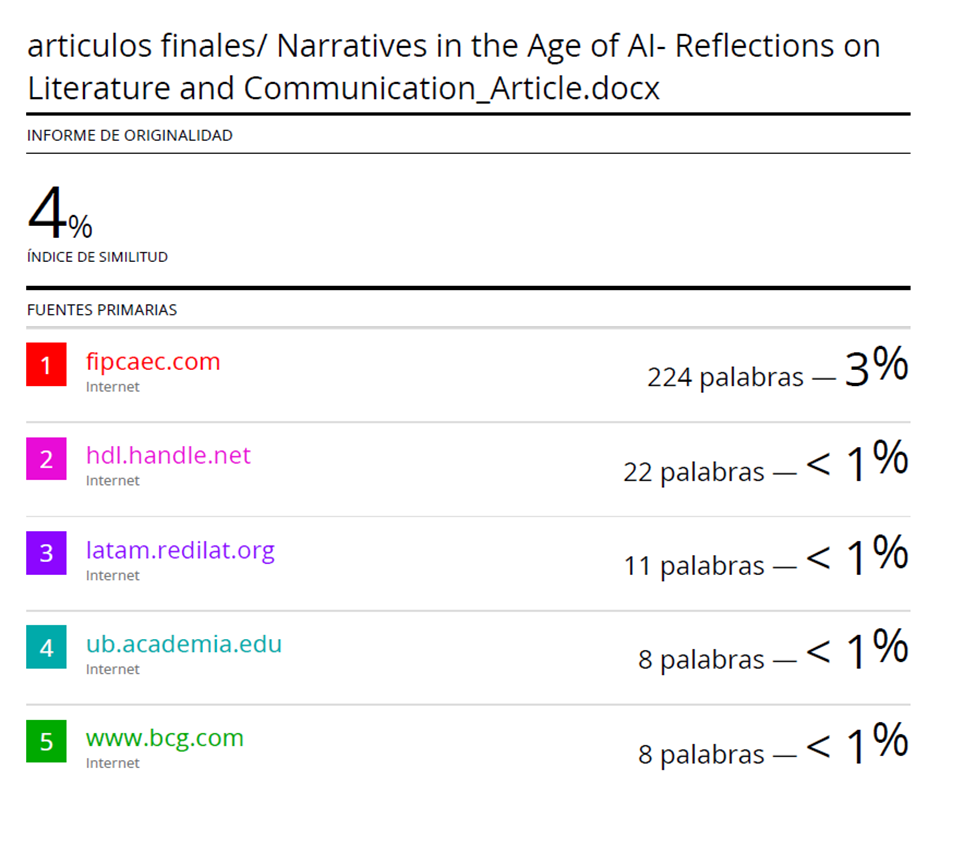
Turnitin AI Similarity
Abstract
In the age of artificial intelligence, narratives are undergoing a profound transformation, reshaping the ways we create, interpret, and engage with storytelling. This paper explores the intersection of AI and narrative structures, examining how machine-generated content challenges traditional notions of authorship, creativity, and meaning-making. By analyzing the implications of AI-driven storytelling in literature, film, and digital media, the study highlights the evolving role of human agency in shaping narratives alongside intelligent systems. It also considers ethical concerns, such as bias in AI-generated content, the potential loss of originality, and the implications for cultural representation. As AI-generated narratives become increasingly sophisticated, the line between human and machine creativity blurs, prompting critical discussions on ownership, artistic integrity, and the future of storytelling. This research aims to provide a theoretical and critical framework for understanding how AI influences contemporary storytelling, offering insights into its opportunities and challenges in a rapidly evolving digital landscape.
Keywords: Artificial Intelligence; Narrative Transformation; Authorship; Machine-Generated Content; Ethical Concerns.
Resumen
En la era de la inteligencia artificial, las narrativas están experimentando una profunda transformación que está reconfigurando las formas en que creamos, interpretamos y nos relacionamos con la narración. Este artículo explora la intersección de la IA y las estructuras narrativas, examinando cómo el contenido generado por máquinas desafía las nociones tradicionales de autoría, creatividad y creación de significado. Al analizar las implicaciones de la narración impulsada por IA en la literatura, el cine y los medios digitales, el estudio destaca el papel cambiante de la agencia humana en la configuración de las narrativas junto con los sistemas inteligentes. También considera preocupaciones éticas, como el sesgo en el contenido generado por IA, la posible pérdida de originalidad y las implicaciones para la representación cultural. A medida que las narrativas generadas por IA se vuelven cada vez más sofisticadas, la línea entre la creatividad humana y la de las máquinas se difumina, lo que da lugar a debates críticos sobre la propiedad, la integridad artística y el futuro de la narración. Esta investigación tiene como objetivo proporcionar un marco teórico y crítico para comprender cómo la IA influye en la narración contemporánea, ofreciendo información sobre sus oportunidades y desafíos en un panorama digital en rápida evolución.
Palabras clave: Inteligencia artificial; transformación narrativa; autoría; contenido generado por máquinas; preocupaciones éticas.
Resumo:
Na era da inteligência artificial, as narrativas estão a passar por uma profunda transformação que está a reconfigurar as formas como criamos, interpretamos e interagimos com a narrativa. Este artigo explora a intersecção entre IA e estruturas narrativas, examinando como o conteúdo gerado por máquinas desafia as noções tradicionais de autoria, criatividade e criação de significado. Analisando as implicações da narrativa baseada em IA na literatura, no cinema e nos meios digitais, o estudo destaca a mudança do papel da agência humana na formação de narrativas juntamente com sistemas inteligentes. Também considera questões éticas, como preconceitos no conteúdo gerado por IA, potencial perda de originalidade e implicações para a representação cultural. À medida que as narrativas geradas pela IA se tornam cada vez mais sofisticadas, a linha entre a criatividade humana e a da máquina está a confundir-se, levando a debates críticos sobre propriedade, integridade artística e o futuro da narrativa. Esta investigação visa fornecer um quadro teórico e crítico para a compreensão de como a IA influencia a narrativa contemporânea, oferecendo insights sobre as suas oportunidades e desafios num cenário digital em rápida evolução.
Palavras-chave: Inteligência artificial, transformação narrativa, autoria, conteúdo gerado por máquina, preocupações éticas.
Author's note:
Data Analyst (Open AI) was used to generate 15% of the content of the introduction. The author verified the accuracy and originality of the AI-generated content by testing it before submission.
Nota de autor:
Se utilizó Data Analyst (Open AI) para generar el 15% de la interpretación numérica del muestreo. La autoría verificó la exactitud y originalidad del contenido generado por IA sometiéndolo a pruebas antes de su envío.
Nota do autor:
O Data Analyst (Open AI) foi utilizado para gerar 15% do conteúdo da introdução. O autor verificou a precisão e originalidade do conteúdo gerado por IA testando-o antes do envio.
Introduction
This work is an inquiry into narrative structures in the literary and communicational environment, in the face of computer systems with cognitive and linguistic capacities, specifically in the contexts of writing literary works, and the adaptation and rewriting of press articles. To carry out this analysis, the approaches about the role that artificial intelligence plays in the processes of literary creation and writing are considered. Currently, there are computers developed with the ability to make their decisions almost perfect and create their own language systems based on simplified cognitive structures, like those shown by human beings. In this context are those based on biological neural networks, artificial neural networks, and less paradigmatic systems such as fuzzy systems, inductive machines, evolutionary systems, fuzzy logic or fuzzy set systems, sub-symbolic or non-symbolic algorithms, among others.
In addition, artificial intelligence would also intervene in the entry and retrieval of the information produced within communication networks, by analyzing digital traces from smart mobile devices, gadgets or personal home automation systems that, in this way, acquire new material on which to support themselves for their presentations, personalized "recommendations". In addition, in a promotional field, the results obtained can be used in an advertising or communication strategy aimed at a group whose traits they want to identify with and share, and with whom they can consequently connect using the cultural register they can share, which is interesting to go on to spot the people who infiltrate their images. We will call this group of subjects a personal network, a term not necessarily linked to the virtual, although it is true that communicative processes have been transformed in one direction and another.
Throughout time, we have witnessed human evolution in the technological field and, consequently, in society. Today, we can accept that artificial intelligence has come to transform a large part of our lives and our human activities (Pedraza Caro, 2023). This phenomenon is not alien to literature, communication and the media, as AI poses new challenges to us as creators, storytellers and communicators, and forces us to rethink what citizens' digital literacy should look like.
Not everyone knows the meaning of artificial intelligence and, even less, how it can transform or even creating literary content. One of the most important and striking uses is focused on its ability to analyze and classify large amounts of information. Another more direct application is to use AI as a text editor to correct existing errors. Likewise, AI is being used to create literary stories, which call for a contextualization of narrativized ideas and concepts and, therefore, of the action (Ochoa Mojica, 2023); and the prediction of what will happen, that is, how ideas and concepts should be temporalized. In relation to speakers, information message systems and persuade which are the non-linguistic resources that speakers use to be able to interact appropriately with their receivers (Basanta & Romero, 2010).
Background
Flowers of Learning is one of the AI developments that is having a strong impact when it comes to generating literary content of different types (Baños, 2024). A clear precedent for the construction of artistic content by AI can be found in the so-called generative works produced through a set of algorithmic procedures according to patterns established by a human being (Martínez, 2008). In the case of literature, we are already able to show very relevant developments through the process known as automatic writing based on generative and predictive processes.
Clouds of Literariness is, as far as we know today, the first operation of writing a narrative generated from the analysis of data collected in its interaction environment. Using machine learning processes, it compares the data obtained (frequency, depth and duration of the interaction) with the data of what to read at what time in the narrative that have been incorporated into the grammar or recurrent and generate afternoons and sunsets. These gradual grammars make it possible to distinguish the sizes of the frame of a song and create a transmittable message.
How does AI affect literature and communication as cultural practices?
This essay aims to study how literary and communication practices are affected, since the emergence and expanded use of artificial intelligence (AI) mainly in the field of generative writing, and reading, where this changes human cognitive processing, contact with text and, in short, how these technologies change the ways in which we narrate, we read and communicate. The creation of literary or communicational texts by algorithmic systems is controversial, as it challenges concepts such as authenticity or genius.
Given the importance of the "symbolic flesh of writing" or "mental writing" on the written, it is essential not to limit ourselves to addressing the impacts from a simple logic that opposes artificial intelligences with human capacities, since, from the outset, literal writing – that which exists in a medium – cannot be seen as a universal act of expression of forms of thought, on the margins of the cultural space and the platforms and technical apparatus (Amaiquema, 2020). In any case, if AI already prefigures a future that transforms the acts of writing, narration and comprehension of texts, our perspective should not understand it as a mechanistic continuation or apology of the technical mediation of human cultural activities but rather reflect on how these changes make us wonder about the very historical and technological roots of these activities.
The hypothesis of this work is that artificial intelligence affects literature and communication by modifying two central levels: the production and processes of text comprehension. In addition, the specific ways in which AI affects, in turn, affect different fields of the production of related meaning, such as narratology, literature, AI itself and culture. The objective will be, then, to analyze proposals, in constant updating and innovation made by devices with AI for the production, reading, analysis and navigation of literary texts and their impact on narratology. Both AI and digital and cognitive-computational technologies are today agents that offer wide possibilities in the field of human communication.
The Evolution of Narrative: From Paper to Algorithms
The following software was used to analyze the perceptions of the private business sector regarding hard and Amenders, a disciple of Aristotle, personally stated this about his teacher, and it is likely that it was true. If we talk about literature, we can cite where he defended writing and the printing of books. But if we extend the concept to any form of communication, it is more than evident that both the Greeks and the Greeks were referring to the books that they themselves had occupied.
For years, as a young science, communication has always drawn on and learned greatly from literature and its developed narrative theories; These have been his greatest source of reference. While we were a discipline controlled by groups that were either indirectly or directly related to literary language, we have been following, regardless of the media, the influence of traditional ways of telling, whose object of study of communication is meanings, influence or information. For this reason, it has been said that the best inheritance of fiction literature to the theory of communication was the early social atomization typical of the nineteenth century, which found in the serials and in the novels not only the minimum elements for its formation, but also the motives, emotions and political feelings to join. Thus, achieving an effectively popular and mobilizing character.
Impact of digitalization:
Literature to reflect and communicate cultural values. The act of telling and communicating stories is directly linked to the development of society and culture. From family or group oral communication, through the appearance of writing and the great literary creations considered as a community of readers. Literature, any type of literary work written or spoken with a certain form is, without a doubt, a first-rate tool as it uses a symbolic language full of aesthetics capable of interpreting reality and communicating cultural values, which is why the development experienced in recent decades by scientific-technical advances has determined the way in which literature is created and transmitted through the so-called digital literature.
The impact of digitalization. In recent years, there has been a readjustment of artificial intelligence at the bibliographic level. The release of these techniques to all the media in which mass information transactions took place has made the generalization of the term almost obligatory. But what is certain and relevant is that such techniques are still ad hoc and used with success in all applications, only consultative or retroactive, in no case at a level capable of accumulating knowledge to help its development. Documentation of some kind of general theoretical guide, which allows supporting the development of computer products applied to these fields. Sociology of information in the last two years.
The shift from physical to digital formats and the emergence of new platforms.
The revolution in the technology and communication sector over the years is more than evident. Any user, dependent or student related to both markets can affirm that they are constantly changing. Consumers, of different ages, tastes and interests, today demand something new and more sophisticated than in the past. The growing competitiveness between companies encourages the progressive development of different products. As a result, advertising, education, professional literature, ICT and even scientific research related to these subjects have been forced to evolve, either by changing their forms of expression, presentation media, distribution methods or even becoming part of a new type of area.
In the early years of written communication, the way books were presented was enhanced by the very way in which they were worked. These were very separate and representative books, typical of a high social class; the work contained in this support represented in the same way. Over time, under the parallel protection of the faculty of communication, books with greater contribution of information, more dynamic communication or dissemination books were popularly appearing, influencing current and future communication media. The sudden expansion and continuous evolution of ICT has significantly increased competition, giving rise to the need to find and select relevant research in increasing quantities. Leaving aside the printed versions, the most used medium to disseminate research is electronic; Most scientific journals are published in these ways.
The advent of AI: Text generators such as GPT, storytelling platforms, and algorithm-based interactive narratives.
The current conjunctures are marked by the appearance of an enormous number of changes and developments that will possibly generate a revolution never imagined in letters and communications. Some of these developments are: (1) the globalized increase in available data, (2) the growth of the field of artificial intelligence (AI), and (3) the improvement of technologies. The technological milestones of the last decade led to a new concept of AI based on machine learning, where machines can make complex decisions and performing previously ubiquitous jobs, ceasing to be strictly programmable systems. For the first time, punctually, machines made complex decisions previously reserved for human beings. AIs with exponential computing capacity above human and the ability to learn in a brain-like way have led to the possibility of modeling complex human intellectual tasks.
Within AI, the field of media intelligence stands out, that is, the development of programs and algorithms to generate intellectual activity in mediated information environments. Communication tasks were also the primary objective, since with this technology the first text generators emerged. For the first time, words apparently written by real beings emerged, but which were the result of algorithms. Currently, several technology companies have developed text generation engines, representing an important development in the field of algorithms for the automatic generation of text and narration.
Artificial intelligence as an author: A threat or an evolution?
AI in literary creation
Literature has created digital literary machines capable of producing poems, prose capsules and novels. However, the characteristics that distinguish these texts are that, despite trying to emulate the style of recognized writers, they have a certain coherence thanks to the use of a database. Current texts are based on word selection algorithms at the semantic level, which allow them to make complete sense separately, and the sets generate sentences, fragments and complete texts from the previously selected data.
Thanks to the evolution of technology, specialized programs have been created in the field that are known as literary digital macro systems. Research has been carried out in the following areas: automatic poetry generation, the study of lexical creation in literature, literary robotics, robot prose, the representation of literary time in digital narration and project literature. These data confirm the digital transformation that companies, institutions and even universities and databases talk about so much and summarize how the introduction of these in communication and literary creation has led to a true revolution in human processes. On the other hand, as the creators of these bots themselves have reported, they have also meant a radical change in the way words are combined to form sentences and texts, something that was previously reserved for human beings and that machines are now able to imitate.
Examples of AI-generated works and their critical reception. Ethical and creative dilemmas
The generation of literary works from specific algorithms has had such an impact that it has sparked controversy and even concern in the literary and artistic community. "Sedín" and "Desdemona" are the pseudonyms of two members of the Antirrobos collective, programmers who designed software capable of writing poems that have achieved some success, having managed to be published. However, aware that this action requested, on the one hand, an exploitation of the absurd and of wanting to deceive the reader, the collective chose not to reveal the identity of the programmers until the publication on paper did not accumulate a notable momentum thanks to a considerable development in social networks. Let us contextualize the information before posing, about these literary algorithms, certain ethical questions.
The debate on this subject is fertilized with grotesque examples such as the collection of novels presented and published by the French photographer; decided to undertake half of the process: filming the situations, taking the frames to an AI that, using a database of more than twenty thousand examples, composes a text for each one: the exclusive copies are sold together with the corresponding video and a diploma on the execution procedure. Consequently, these ethical questions that we outline no longer affect only the nature of works and narrative genres, the roles of readers and creators, etc.; in the narrative generated by algorithms, the craft, not the poetic Ars, of AIs in their role as manipulators of decisions and thoughts begins to be called into question and, in the face of them, it is worth asking whether literature, philosophy, politics, economics, science, etc., can ever be wisely replaced by current technologies.
Originality, authorship and the human-machine relationship in literary production.
When we talk about literary creation, the codes used by the machine to generate literary segments are basically two: on the one hand, algorithms trained by machine learning to reach the literary corpus of references already marked, from style manuals to award-winning competitions, or to carry out, in a more ambitious case, the analysis of huge amounts of literary text to extract patterns that allow cognitive mimicry through the writing of Prayers in a new story. However, it is another question whether this new sequence of sentences is also meaningful for the reader. The question of the originality and authorship of the story obtained becomes clear. On the other hand, this same question does not extend to the creative processes developed by writers, tending to justify their dependence on machines, their argumentative proposals and their resources used, for obtaining the frame, sample or help, something that they also emphasize has been vital in the evolution of literary history, especially in the avant-garde.
Based on the definition of interaction as reciprocal communication between two individuals or entities, a growing number of researchers in the field of computational story generation and automatic fiction writing are assessing the possible live interactivity with these artificial narrative entities (Vega, 2024), literary chatbots that can respond in real time to the reader's actions, such as the congresses that make up, among others, the Congress on Collaborative Writing and Writing Practices on the Internet, or the triad of fictitious entities represented by Pixar's brilliant computer engineering department in the film Toy Story. However, to the extent that these writings or generations succeed each other because of the exchange of text messages, it would not yet be an interactive creative process in its strictest sense, as several international symposia point out.
Literary Communication in the Age of AI: New Forms of Interaction Between Readers, Writers, and Texts.
In 2017, a group of programmers and specialists in migrant literature developed a story generated entirely by an artificial intelligence system, with the aim of "studying the border that separates human creation from algorithmic imagination". This is how the text came about, which, unlike other examples of the creation of literary works using AI techniques, contains several clear references or evidence that associate the story with a controversial treatment of the issue of conversion to Judaism. Despite the novelty, the literary work generated by AI systems in the last two decades is a topic that has generated very little interest in academic and professional literature.
The text highlights the cognitive limitations of AI that, at least for the moment, distance it from the margins not only of necessary expressive mastery, but rather of basic knowledge of the thematic indicators that define literary genesis. Both algorithmically constructed judgments and their rules of procedure are, for the moment, incapable of reaching the level of narrative creativity that the human species can generate or reveal. Ignoring this fact even gives rise to a deep and widespread epistemological misunderstanding with serious consequences in both the creative and research fields. Literature opens the field to diversity, entry and creative creation, while AI offers logical results that comply with the internal rules of the language without reaching the poetic threshold.
Literature and communication: a transformed dialogue
In the interactivist paradigm there is no single reality, singular and shared by all: reality is interpreted by human collectivities and the individuals who compose them, in communicative dialogue. The interactivist vision of the gaze illustrates that each comrade asks for and offers interpretation, help and teaching, in a kind of mutual gift. The interactivist proposal—for which literature would already have a dialogic nature—confronts certain forms of gaze in the social sciences and in communication, cultural and literary in general, illustrative of the underlying modern tendency to consider that the world, that is, social and cultural reality, is in front of us as something objective, we possess the cognitive codes necessary to unravel it, and our main function is to represent it. Once the author is consolidated, then, he attracts the reader with his direct gaze, colonizing him. In the operation passed from one to the other of the individual instance of the common reality, the mediator suppresses the plural. Literature, in pieces, transformed into an artificial measure of the universe, will capture a motionless reality in the text. Reading is a reality switcher, from dreamed to meaning, from meaning to dreamed.
But we don't have the feeling of living in any fiction. Having borrowed the existence of a thing, it is the lender himself who enjoys it and suffers and struggles with it. Let us not deceive ourselves: by dint of pretending, one finally encounters real emotions. We do not transcribe what is perceived and felt in everyday life, but what we live and feel, under certain clothing, in the inventive trance. Each fictional narrator-perspective contained therein, instead of being vertically directed from author to reader, horizontally unfolds a space of interactive communication.
Mass communication vs. personalization: How AI redefines access to narratives and adapts them to specific profiles.
The massification of messages and their adaptation to mass audiences has characterized the mass media. This feature avoided wasting time in the selection of information to the detriment of people's privacy and intimacy. Currently, access restrictions significantly limit journalistic work, readers are no longer exposed to the diversity and heterogeneity of ideas, privileging even more alternative forms of symbolic capital, where personalization by the algorithm, based on a collection of data that allows predicting tastes, preferences and behaviors of users, it is the answer to reach your audience.
In addition, although reading has mutated, so have the forms of consumption of cultural products that cease, in general, to be done passively to become participants; as youtubers, streamers or tiktokers who become creators and protagonists of new narratives with characters and practices that are no longer governed by the old grammars of television or music videos (Quintero, 2023). This migration, around traditional content from old devices to increasingly modern ones, could also be analyzed from the textual turn that these had, which today depend on a drier, more concise, direct and concrete language in the sense of, as far as possible, reflecting the preferences and customs of each user.
Narrative as a communicative bridge: The role of literature in connecting individuals in a world mediated by technologies.
We live in a digital age in which society is bombarded by an endless number of messages that are conceived, designed and adapted according to the digital footprints that people generate in their interaction with digital platforms. These traces, together with artificial intelligence, allow the recipients to be segmented into these called profiles, which function as an approximation to an individual's specific habits and preferences. Literature, on the other hand, stands out from other written texts because of the greater possibility of dialoguing with readers in successive interpretations. The nature of AI and digital narratives alters these assumptions in two respects: personalization of messages and hyperstition.
These characteristics place literary texts in an ideal place for people to rethink the relationship with technologies and their consequent life stories in a narrative space that connects them with others. This perspective proposes a shift from the creative center of storytelling to audiences, with a retreat from digital technologies and redefining an active role in discussions about communication and audience advocacy. This also requires that the texts reach sufficient ambiguity so that the debates between audiences do not reveal the author's intentions and avoid building a new box based on his consumption. A reconfiguration of "the personal" and the individual will result in the reading of written productions, in their writings and their political definitions. Literature as a communicative bridge: the role of literature in connecting individuals in a world mediated by technologies.
Critical Reflections: The Future of Human Narratives
Preservation of the human:
What literary values remain irreducible in the face of AI?
AI challenges an authoritarian ideal of the world that has in the word a spiritual triumph over emptiness. Under this canonical morality, textually describable as an effort to achieve the formal finish that culminates both writing and interpretation, AI is a terrifying experiment that seeks the unconscious origin of that finish, the secret formula that produces it at will, nothing contributing to the ethical purpose of the narrative work. But insofar as it questions the current limits of what can be narrated, and that it is capable of writing. However, is it possible to identify a field of study that AI, freeing ourselves from the formological shell, would not cover? One of the most surprising literary objects, in my opinion, and one that would not only be unscathed by the onslaught of AI but would also gain renewed virtues, is the point of view. We will see how the narrative capabilities of AI hardly clash with the assertions of narratologists, nor are they a challenge to genotextual perspectives.
He once said, "Whoever measures a field with a beat of his heart, measures it twice." Beyond the peace of wisdom, three classic threats loom over the work of narratologists: empirical descriptions, the psychologization of the author, and prescriptively. To the first attack he replies: we are not trying to specify what is "the deep and invisible structure of all possible stories", but what are the ways in which they are formally assumed by certain literature. Regarding the incorrect association of a narrative mode with the author's biographical conditions, researchers, expanding these unfathomable attributes to measurable cultural traits, would think that when it comes to pragmatically facing narrative decisions framed in the construction of meaning, AI comes up against the insurmountable wall of ideology.
New forms of expression:
The virtual archipelago is considered, an aesthetics of cyberspace, decentered, fictionalized and expansive (Luño, 2024). In these products, the union of digital aesthetics and the writing machine appears, understanding the machine as electronics. Due to the traditional cliché of this space, its referential decline would disintegrate over the parameters. It is in the logic of simulation and hyperlinking. This culture has a grammar of surplus. If we start from an infinite number of combinations that the hyperlink supposes in writing, we will see that we will never reach the exhaustion of the text.
Sometimes, there are peep shows made in 3D environments such as narrative, which are usually digital projects that are born as literary projects sustained by a cybernaut reader. 3D digital storytelling projects, like the rest in general, are set around stereoscopic 3D environments that can be navigated in real time. The browsers of these spaces, usually organized in environments whose structure simulates that of the physical world, have the illusion of being immersed in a scenario and can interact in real time. This is the high point of these narratives: the psychological simulation that occurs when exchanging informational content in this environment. On the other hand, works of art realities also use this type of environment so that the viewer can move and virtually explore the created world, often using technological devices to see and interact with its elements. They are usually works of art properly speaking whose raison d'être is based on the form of interaction through the displacement or movement of the viewer.
Role of education and literary criticism:
Educating does not so much mean teaching a corpus of knowledge but rather developing the student's critical sense so that a constant process of verification mediates between them and reality. The acquisition and management of information cannot be done blindly; he is the critical and committed man. Or in other words, to understand is to assent with intelligent freedom to everything that the evidence objectively and rationally shows us to be true, this being the key to both philosophical and literary edification.
Literature can move readers and elicit in them an intimate, special, and unique response (Durán, 2024). Multiple readings, interpretations, opinions and even the self-provocation of alteration of feelings are the result of a work well done; therefore, by using literature in the critical seminar, an opportunity for the exchange of ideas is provided, providing the student with the opportunity to express their own judgments and interpretations about something as personal as literary reading. Humanistic disciplines have traditionally placed in the hands of the teacher the skills for a correct sensitivity of literature; however, these must converge in the formation of critical thinking that determines the current purpose in these disciplines. Next, we will address those studies that have been carried out over the years, whose objective is to determine to what extent the critical competencies of students have evolved.
Prepare readers to interact with AI-generated narratives.
There are different assessments about the intelligence applied by the narrative generated by AI. AI-generated fiction has a narcotic essence, an ephemeral sense of originality in each reading process because we have no guarantee that the machine will even remember every decision it has made in the narrative to the point where it is. Several AI-generated novels that are perceived as original, knowing that a machine has selected words and contexts, stand out. Many tend to describe the robot that writes news as fast and effective sources of information, but the truth is that the informative narrative that is born from algorithms is contemporary in its forms and is not born from its own authorship even if it is presented to it by the media. He was rather alarmed: while I confess my own enthusiasm for the productive applications of generative creation technologies, I see no way to even conceive of the idea that an artificial intelligence could ever actually write a poem, or compose music, or of course, make a movie.
Now, when with the telegraph, telephone, and phonograph, machines assume a gradual portion, alliance with, or even replacement of human functions, literature undergoes changes in its universe, and just as it holds that when technological forms of experience change, human agents must adjust. This does not exempt literature reluctant to evolutionary change, such as the mention of an author in these pages, from the critical examination that corresponds to discerning its discussion outside of other realities such as computational digital visual creation or other forms in which literary phenomena are manifested today.
At the same time, the educational function that was given to critical and creative literary interpretation. The reason is clear, digital technologies and artificial intelligence open up unique possibilities for the self-realization of the receiver both in terms of textual reception itself and in terms of the meta-poetic, meta-discursive operations of active, interactive participation that is made possible by reading or viewing devices dominated by intelligent applications to the point of reaching a narrative code that is reached by the unusual synergy of both. What is at stake is the enhancement of literary reception and with it the construction of the literary phenomenon.
Conclusion
Automation is the result of the incorporation of systems equipped with the characteristics of artificial intelligence, such as natural language processing, to perform tasks that would otherwise be carried out by human beings. To acquire this knowledge from machines, professionals from different disciplines have collaborated in the configuration of databases, algorithms and models of expert systems, capable of simulating different modes of reasoning. This study breaks down the different automated systems generated to produce cultural goods instantaneously, as well as how humans create synergies with them to interpret them. In general, large productions are apparently losing the identity character that makes them unique, as their features are homogenized with those of other artificially produced goods.
The world of culture generated through automated processes has appeared. That the human character of art is losing weight, as it quickly incorporates the decisions of artificial operators, is especially intuited in an example related to the world of cultural publications, but also in sound archives, generated drawings, or in any field in which it is desired that there be a narrative, interpretative, sui generis component... indeed, creative. Also in the editorial context, which seeks to increase and analyze production, it contributed by determining new rankings based on indexed publications or including the impact of scientific publications, which can go beyond content. Perhaps, from now on, the potential impact of artificial intelligence on the narrative could be considered. The Faculty of Library and Information Science underlines the technological dimensions, demonstrable effectiveness and profitability associated with access to and use of information.
Future projection
In a world where a group of scientists built a robot that presented a fragment of theatrical art in a collective play, or in which the first presentation of a new original fragment of a work of music was made, it is not difficult to imagine the emergence of literature written and or thought from intelligent devices, but what kind of literature? If the novel, comics, essays and articles, how do we control emotions - mechanical, electronic, by photons - is a machine capable of thinking, imagining? Or even write? Let's remember Maria, the first woman created and designed with artificial intelligence, where Maria finally reaches through human emotions, she becomes a destructive machine, will she follow Maria's path? The twentieth century was marked by a rationalist humanist vision and current philosophical trends have emerged that have found these ideas and have taken them to their ultimate consequences: it is still thought that there is something essential about humans.
A scientist proposed solutions to the risk that launching large-scale projects would bring: "Theoretically, there are threats from computer viruses; also, in the field of information espionage; an intelligent system will not be able to recognize differences between humans and present threats worldwide." What he did not consider is that he assented to a cognitive autonomy like that of humans, scientists and researchers will rightly emphasize artificial intelligence that, unlike supercomputers, managed to learn, but did not think why? According to some specialists, a theory was developed that criticizes the recent philosophy of science, where it was said that found after an experimental task there was no possibility for the system to lose patience.
Call for reflection
The social and emotional repercussions of the knowledge society and the implementation of artificial intelligence in different aspects of life, such as work, learning relationships, leisure time, entertainment, newspapers, conversational guests, avid readers and artificial thinkers, are evident.
The impact produced at the level of literature, communication or even in the field of emotion would not be minor, but have we stopped to reflect or undertake research on the emotional impact of any type of interaction with pragmatic, monotonous, mechanical or predictable objectives, such as interactions with devices equipped with artificial intelligence? Feelings seem to be inherent to the human being, not only to one of the tasks with which we maintain continuous amendments and verifications over time, such as reading, but also to activities and interactions such as those carried out at work, leisure, entertainment and social relationships. Along with the growing emergence of stories, artificial and digital conversational objects, it is precisely literature, communication and emotion that are the three main academic supports on which to build reflection and analysis on fruitful but undervalued artificial stories and objects.
Those called upon to ensure the management and improvement of computer resources in our environment are increasingly aware of the important emotional role of artificial intelligence, of its intellectual processes, often so automated, and of the potential benefits that, in a double terrain of pragmatic interlocution and fundamental interlocution, it can offer in tasks such as reading. Artificial intelligence, with its ability to understand and contextualize human language, has the potential to enrich our reading experience by offering personalized recommendations and making it easier to investigate relevant information. In addition, by interacting with devices equipped with artificial intelligence, we can experience a sense of companionship and emotional connection, as these devices can respond to our needs and provide emotional support.
This is especially important in the context of work, where interactions with smart devices can help reduce stress and foster a positive work environment. In leisure time, entertainment and social relationships, artificial intelligence can provide new forms of interaction and participation, improving our satisfaction and enriching our experiences. However, it is crucial to consider the ethical and social aspects of artificial intelligence, ensuring that it is used responsibly and respectful of human values. Research and reflection on the emotional impact of interactions with AI devices are critical to fully understanding the implications of this technology. In summary, artificial intelligence has the potential to transform our lives and offer significant benefits in various areas, but it also poses emotional challenges that require careful consideration and exploration. By understanding and properly managing these emotional implications, we can make the most of technological advances without compromising our well-being and humanity.
References
Pedraza Caro, J. D. (2023). Artificial Intelligence in Society: Exploring Its Current Impact and Future Challenges. upm.es
Ochoa Mojica, S. A. (2023). Analysis of the written discourse in the information on the coronavirus pandemic in the cybermedia of El Espectador and El Tiempo in the last quarter of 2020. uniboyaca.edu.co
Baños, G. (2024). The Dream of Artificial Intelligence: The Project of Building Thinking Machines: A History of AI udllibros.com
Basanta Zamudio, G. J., & Romero Parra, R. M. (2010). Theoretical Guidelines of Persuasive Communication and its Relationship in the Mediation of Organizational Conflicts in National Experimental Universities of the State of Zulia. Journal of Social Sciences, 16(1), 28-38.
Martínez Martínez, P. F. (2008). Aesthetic analysis of the work "Flowers of learning" by Roman Verostko as a representative of algorithmic art (Doctoral dissertation, Universidad Autónoma de Nuevo León).
Amaiquema, C., and J. Eduardo. "Writing as Technology." 2020,
Luño, A. E. P. (2024). The Philosophy of Law in the Face of the Pandemic: A Seville Reflection. Yearbook of Philosophy of Law, (40), 29-46.
Vega Suárez, G. (2024). Superfluous Anglicisms in X: A Linguistic Phenomenon That Transcends the Screens in Gran Canaria (Bachelor's thesis).
Durán Escobar, D. A. (2024). Visual Representation of the Monuments of the Ambato Canton as a contribution to the Directorate of Culture and Tourism of the GAD Municipality of Ambato in the promotion of cultural belonging.
Quintero Uribe, A. (2023). This is how you mark your provenance: a social study on the marks of provenance in the city of Medellín as a status symbol for the elites (1850-1900). An experience applied from the bibliographic heritage of the collection (Bachelor's thesis, School of Theology, Philosophy and Humanities).