Palavras-chave: comunicação educativa,
desenvolvimento profissional docente, informação compartilhada, redes,
ensino-aprendizagem.
Introduction
The
exchange of knowledge is directed towards professional development in a line in
which teachers support programs of updating and continuous training. The
objective is to identify the relationships of internal and external motivation
with shared intention within the school and self-efficacy of comparted outside
the school. The research process allowed us to observe that there is a
tendency from the teaching staff of the rural educational units of the
Ecuadorian region for not making use of digital tools or resources. The
general argument supports the technological imposition, its geographical area,
and socioeconomic factors. This study allows to clarify this attempt with
concrete data to analyze the possibilities of exchange of knowledge related to
teaching, the adoption of new perspectives and resolutions and the contribution
to the implementation and operation (Campana, 2018; Liou and Canrinus, 2020).
The
proposal to generate spaces for the distribution of knowledge, content
associated with Digital Educational Resources (DER) requires a historical
review of referents with parallel or similar research. Wang, Tigelaar and Admiraal,
(2020) postulate that "identifying the relationships of internal and
external motivation with shared intention within the school and self-efficacy
mediated the relationship between internal motivation and shared intention
outside the school" (p. 12) are a fundamental element when investigating
distribution environments or intentionality for sharing.
The
expansion of digital communications together with the possibility of replacing
traditional sources of study can influence the behavior of teachers inside and
outside the classroom space, where the "EVA" Virtual Learning
Environment (VLE) and in turn the Massive Open Online Course (MOOC) that
include autonomous characteristics which share that education could be
digitized in its entirety (Bruillard, 2017) because the didactic potential of
technological resources promote educational needs (Santana-Bonilla and
Rodríguez-Rodríguez, 2019).
The
authors highlight that "often" the documentation that is collected as
a research exercise serves for issues that lead to administrative processes,
and these, almost always, are an obstacle because they do not usually fit the
sociocultural and socioeconomic realities of the space in which they will work
(Al-Huneini, et al., 2020). Carrying out a data collection process according to
Ahmed et., (2019) evidences the series of potential obstacles among which the
lack of willingness to share, time, previous knowledge, the risk of losing
their own advantages and even makes the act of participation in the exchange of
knowledge difficult.
The
study determines the existence of a degree of distrust about the forms of
participation and sharing of verified information, which in general terms
discourages the exchange of knowledge among teachers. It should be remembered
that participation in the exchange is crucial, given that those who share
knowledge benefit much more than recipients (Zhu, et al., 2018) and this should
be possible regardless of knowledge or technology gaps that may exist in an
educational ecosystem.
The
degree of distrust about the forms of participation and the sharing of verified
information, discourages the exchange of knowledge between teachers,
participation in the exchange is crucial, since those who share knowledge
benefit much more than the recipients (Zhu, et al., 2018), this exchange is
independent of the knowledge or technology gaps that may exist in an
educational ecosystem
Therefore,
it is important for researchers and policymakers to consider whether teachers
(especially those in rural settings) share REDs, and therefore establish
potential ways for teachers to share.
It
is proposed
to understand how the exchange of knowledge under the consideration that this
action represents "a core activity for the improvement of organizational
capabilities, as well as team performance" according to Singh (2019); Zhu,
Chiu and Holguin-Veras (2018). This exchange is absent in our context, despite
being aligned with the way of doing education and the updating programs offered
by the governing body of education in Ecuador.
Despite
the importance of digital educational resources within the teaching-learning
process, rural educational units "have problems when it comes to carrying
out a correct socialization inside and outside the community" (Akosile and
Olatokun, 2020). The lack of communication infrastructure, both in the
establishment and in the community, has caused a detachment from the basic
practices of educational action, which makes these conditions blockages for the
generation and dissemination of information (Charband, et al., 2016), and,
consequently, less availability of knowledge for children and adolescents and
adolescents. the intrinsic and extrinsic influence of motivation,
self-efficacy, attitude, intention, so that we talk about the organizational
climate and the significant supports of knowledge exchange (Hagger et al.,
2006).
There
is a tendency from the teaching staff, in the rural educational units of the
Ecuadorian coast not to make use of digital educational resources which has
been an obstacle imposed by technology, its geographical area, among others.
For this reason, it is proposed to generate a space to share, distribute
knowledge and content associated with the DER following the proposal of Wang,
Tigelaar and Wilfried, all with the aim of "identifying the relationships
of internal and external motivation with the shared intention within the school
together with the self-efficacy that mediated the relationship between internal
and shared motivation outside of school" (Wang et al., 2021. p. 12).
Attitude
to share.
To
understand this tendency organizational behavior, it is necessary to start from
the concept of IMBP model where attitudes to transmit knowledge are described
as determinant by the intention to share. As a result, teachers come to tend
to avoid and contribute to knowledge, it is considered that this may become
unnecessary.
In
this context, it is necessary to think about educational subjects, who possess
innovative characteristics since they are the ones who choose to adapt new
forms of communication, interaction and therefore associativity with new
technologies that can be adhered to education. However, the samples obtained in
our research showed that it is possible, due to the geographical delimitations
of Ecuador, to inherit aspects that in other contexts correspond to only rural
realities.
Part
of the study collected by Yang, Song, Zhao and Yu, (2018) referring to the
attitudes that can be taken towards the act of sharing and exchanging
knowledge, are constituted as important positive attitudes to improve teachers
and their performance. Zhang and Liu (2019) found that the more valuable the
sharing behavior of teachers, the greater the effort that was presented during
the act of learning, especially in digital interfaces. However, it was
identified that the lack of empathy and familiarity in digital resources
results as a personal sponge that absorbs negative attitudes from one's own
research activity that discourages participation and knowledge sharing.
Cooperative
work
Although
this can be associated with collaborative work because both have a coincidence
in the way in which, as a set of instructional or training methods, they can be
used by working groups as a methodological strategy to promote (facilitate or
promote) a growth of skills related to social learning and personal development
(mixed skills).
The
particularity of collaborative work is that, during its projection or planning,
each participant of the group or team is responsible for their learning, but at
the same time, it is also closely related to the learning of the other members
of the table or work team, "articulating and creating connections of
information and sharing of knowledge" (Sedighi et al., 2018).
Communication
Ileana
Audum-Rodríguez (2018) investigated the work of J. Teixidó (1999) from which
she rescues that, within the communicational aspects for the sharing of inputs,
it is necessary to express everything that allows the transmission and exchange
of ideas, thoughts, knowledge, feelings, and information between groups of
people and through different media (Adum-Rodríguez, 2018).
Part
of the communicative actions are those that allow an educational center that
functions properly with the aim of increasing the possibility and favoring the
act of distributing information among teachers, so "it is a fundamental
aspect to submit it to study" (Hew and Hara, 2007) understanding that,
without adequate and fluid communication, it is impossible to think about
knowledge sharing.
Coexistence.
The
reflections on coexistence in the XXI Century propose that it be based on the
retrospective proposed by Torrego, (2001), defines coexistence as the
interaction of modern society indicating that “, it is an exercise of conflict
resolution, it is a creative process and of indagating within the limits of
respect. Its objective is to prevent the occurrence of conflict or to avoid
escalation when it has already arisen" (p. 22).
Torrego's
reflection is threaded with the mention and work by UNESCO that through the
International Commission on Education (CIE) for the XXI Century. In the report
entitled "Rethinking Education: Towards a Global Common Good? “published
in 201 5, and in which appears n two of the four pillars for coexistence
(UNESCO, 2015., p. 23) that Martí-Noguera et al, would collect to mention the
importance of "learning to live together" and “learning to be” as
necessary bridges for the education of the future then, "interconnect
networks of knowledge through digital spaces" (2018, p.16).
On
"learning to be", Eirín-Nemiña (2018) has explained that this implies
that the subjects carry out a conscious reflection from and for their learning
experiences which, according to Eirín, "cannot be conceived or planned
without their respective guidance" (Eirín-Nemiña, 2018, p. 261) or that
they cannot build bridges of interaction with which the principle of
"learning to be" could be sustained for the increase of knowledge in
network.
That
said, "we must start living together" Eirín-Nemiña requires that one
of the main missions of education in a democratic society be made effective and
that it is related to the symbolic connotation of "forming citizens"
(Eirín-Nemiña, p. 262).
Urbanity
and rurality
When
talking about sociodemographic aspects that divide the habits of appropriation
and cultural coexistence, it is necessary to review the particularities that
make up urban circuits or spaces and what their distinctions are from the
rural. To this end, the interpretation of these two categories has been
reviewed through an exploration of the studies carried out by Heyneman and
Loxley (1983), Harbison and Hanushek (1992), Fuller and Clarke (1994), Gamoran
and Long (2006) and Behrman (2010) who agree that the school -with respect to
its structure- has a significant effect on school performance in developing
countries.
Coleman
and Hoffer (1987), Hanushek (1986), Stevans and Sessions (2000), Vandernberghe
and Robin (2004) Opdenakker and Van Damme (2006) among others who have
published their reflections, agree that students obtain a higher performance
in generally urban schools – except for small examples of large private
institutions that are built in spaces far from urbanity – that In the case of
rural areas, despite this, all the authors referenced agree that the effect
of school size on student performance does not influence much because each one
gave different types of definition to their analyzed contexts and that in some
cases they represent milestones of rurality where their institutions are more
technological than urban ones.
Due
to this, it is considered pertinent to argue from the generalities established
by the UN and on which the different models of socioeconomic measurement have
been constituted, detail that rurality would be conformed "by a very high
percentage of population classified as economically active and that
occupationally has agriculture as an activity, generally lacks electricity,
drinking water (installed inside the dwelling), limitations of access to the
health care system, schools, recreational facilities (parks) according to the
weighted distinctions in the ONU-Habitad conference of 2017" (ONU, 2017).
The
style of socialization of the information of five educational units of the
Ecuadorian coast in the provinces located as: Los Ríos and Guayas,
respectively, will be observed. The selection process of two educational
units in Guayaquil to complement the sample. It is important that all elements
of the education curriculum are in place to promote educational quality and
have resources for teaching staff.
The
study
This
body of research aimed to analyze the increase in knowledge and whether this
occurs due to the factors that influence the distribution and sharing of DER
among teachers at rural schools. Based on the literature regarding the
distribution of teacher behavior and relying on the IMBP model of Wang,
Tigelaar and Wilfried (2021) and which can be seen in Figure 1.
In
the context of this research, the list of determinants follows Wang's model and
expands with motivation, since the literature indicates that for teachers
"sharing behavior cannot be fully understood without taking individuals to
contrast" (Wang et al., 2021. p. 5).
In
addition, inspired by the distinction between the exchange of interpersonal knowledge
and being based on the Internet through foundations carried out in the study of
Van Acker cited by Tigelaar we obtain that the relative effects of the
determinants for the exchange of knowledge occur in two different contexts: the
first has to do with the sharing with colleagues within their school and with
the others outside their school.
In
that sense and due to the high correlations between knowledge and skills and
self-efficacy, we leave out knowledge and skills and only include self-efficacy
and that is detailed with the following systematization:
RQ1. Is
motivation related to each of the dispositional variables (a) self-efficacy,
(b) attitudes and (c) subjective norm, (d) sharing intention within the school,
and sharing behavior within the school?
RQ2. Is
motivation related to each of the dispositional variables (a) self-efficacy,
(b) attitudes and (c) subjective norm, (d) sharing intention, and e) sharing
behavior outside of school?
RQ3. Is it (a)
sharing intention, (b) sharing climate, and (c) work pressure related to
sharing behavior within the school?
RQ4. Is it (a)
sharing intention, (b) sharing climate, and (c) work pressure related to
sharing behavior outside of school?
RQ5. Is there an
indirect effect of motivation on the intention to share within the school
through dispositional variables?
RQ6. Is there an
indirect effect of motivation on intention to share outside of school through
dispositional variables?
Methodology
Except for the demographic information of the
respondents, the questionnaire included all the constructs of the model
proposed by Wang, Tigelaar and Wilfried. All measures come from existing
instruments with a high level of validity and reliability based on similar
studies.
To better contextualize the instrument, some
semantic modifications were made in relation to the sociodemographic and
sociocultural reality of the spaces where the instrument was applied. To avoid
semantic biases, a researcher with extensive command of the language translated
the original instruments in English into Spanish and provided us with a series
of alternatives for cultural and contextual adaptation. At the end of this
research body, the elements of each variable have been included and maintained
in the final analyses, which can be seen in Table 1.
The arguments of the sample allowed to delimit the
measurement model and articulate the motivation indicators according to the
size of the probabilistic sample where x, and q are used for the
analysis of quantile vectors and where p was used to measure the
reliability of the probability vector of the sample.
In this way in corresponding to the number of
observations (variables used) corresponded to the following formula in the
length of the number required for the value of length (n) > 1, having this a
total of 127 samples executed and 123 samples validated and where the degrees
of freedom df (> 0, maybe non-integer). df = Inf is allowed and allow the
determination of an ncp as worked in the sample and collection of Wang,
Tigelaar and Wilfried where the centrality parameters allow recurrent
exceptions on the value of rt (), only for abs(ncp) < = 127
is omitted and uses the central distribution of T log, and log. p logical;
where is TRUE (true), where the probabilities pt
are given as log(p). of the bottom point and logic; the true value TRUE
(default), probabilities in which P [X ≤ x], otherwise P [X > x] and
which determine that the distribution with gl = n
determine the following formula detailed in equation 1:
As
can be seen in the graphic simulation, according to the number of validated
interviews, the growth data for intentionality to be shared are visually
evident, however, it is also clear that this is an escalated intentionality,
that is, it does not necessarily correspond to a personal notion, but there is
an influence from collective factors.
This
scalability suggests that it is necessary to consider group or external factors
to individuals that go beyond intentionality and that these depend on
structural factors at the educational level which are linked to the
attributions that a teacher may have to exercise the research activity -even to
be able to prepare their classes-. To analyze the internal and external
motivations of the act of sharing and the climate generated in educational
subjects the dissemination and interrelation of information that can be used in
the educational environment, the results have been processed in the illustration.
Figure
1
Result
of the structural model within the school
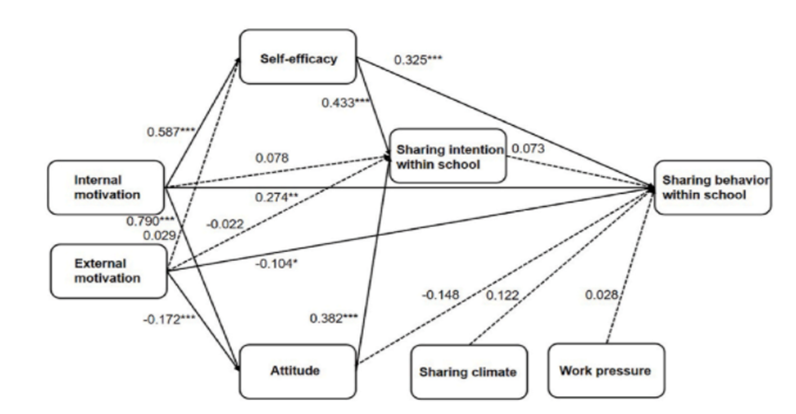
Note:
*** p < 0.001, ** p < 0.01, *p < 0.05 based on the structure
model of the research model of Wang, Tigelaar and Wilfried (2021)
The structure foreseen for the act of sharing and
presented by Wang, Tigelaar and Wilfred suggests a percentage of %28.8
acceptance based on a scale of Cronbach and Robustness-aware 2-bit
quantization where the approximation of each of the coefficients allows us
to predict how much it is possible or not the existence of an intentionality to
share both internal and external factors and that it is validated through
review of the two coefficients, the one for the reliability of the sample and
the second for the interpretation of the results.
Measurement
model
The model of measurement and information collection
was based on a structure of simplification of three sub-constructions for the
indicators of motivation, to these was added a contextual study to evaluate the
sociocultural and sociodemographic conditions but supported by the models that
the CFA provided to Wang, Tigelaar and Wilfried to factor the results of the
first order and that are linked to the representation of the attitude towards
sharing when it is known. and that acts as a motivational source, a situation
that is verified through the residual variance of the sampling and that is
detailed in the histogram of Figure 2 of an equivalent to minus 10 where N =
123.
To favor the explanation of the motivational factor,
we decided to eliminate introjected regulation from the main model and stick to
the recommendations of Wang, Tigelaar and Wilfried and include only two
first-order factors in which external regulation was considered as external
motivation and intrinsic motivation was considered as internal motivation. The
relationships were adjusted, resulting in the final model presented in the
vocational inclination curve and which can be verified in figure 4.
The referential elements in the instrument can be
verified in Appendix B as evidence of the applied model and the description of
the demographic variables for the determination of space and perception of the
educational environment. For the intra-school model, the Continuing Education
Analysis (AFC) included 19 variables, of which 8 are related to external
indicators of perception and the rest was closed to routine educational
practice.
The results of the analysis show a convergent and
acceptable validity of internal reliability of the measurement model. The
standardized factor loads of all measurement items range from 0.645 to 0.919,
and all are significant at the p-level <0.001.
The composite reliability (CR) values are greater
than 0.8 out of 1, confirming that all constructs have good reliability. The
extracted average variance values (AVE) for all constructs are above 0.5,
supporting convergent validity (Cabello, Ringle, & Sarstedt, 2011). In
addition, all los Cronbach ' The values of
"k" are greater than 0.8, which indicates that all constructs have an
adequate internal consistency following the application of Nunnally in 1978)
and applied by Wang, Tigelaar and Wilfried, main references of this study and
presented in Figure 5.
Discussion:
The
process of collecting information allowed to identify how teachers and the
participation they must share affects the educational processes and therefore
the possibilities of innovation within it. The reluctance on the part of
teachers to share their knowledge is underpinned by what seems to be a problem
of the "public system" and its provisions for educational action.
Table 1
Analysis of scales diagrammed
on methodological notions.
|
Scales
|
Does sharing represent a meaningful
decision for me?
|
Do
I consider sharing an important goal for me?
|
If
I share information, do I think I enjoy doing so?
|
Do
I find the act of sharing entertaining for me?
|
If
I share my digital educational resources, do I feel satisfied?
|
|
1 Strongly disagree
|
4,9%
|
2,4%
|
4,7%
|
1,6%
|
3,3%
|
|
2 disagree
|
1,6%
|
1,6%
|
1,6%
|
11,4%
|
3,3%
|
|
3 agree
|
38,2%
|
38,2%
|
43,1%
|
56,9%
|
46,3%
|
|
4 strongly agree
|
57,7%
|
57,7%
|
51,2%
|
30,1%
|
47,2%
|
Sharing
knowledge results, both by interaction and predisposition, a difficulty derived
from costs, access to appropriate literature and of course spaces that allow a
conscious and professional exploration.
It
was possible to precisely see the access to open access sources or adequate
repositories, it is one of the main problems when generating working groups due
to the incompatibility of the spaces with the teaching research action.
Table 2
Analysis of the scales diagrammed
on the "I" as a collective subject.
|
Scales
|
If I share my digital educational
resources, do I feel good about myself?
|
If
I share my digital educational resources, do I feel valuable?
|
If
I share my digital educational resources, do I feel benefited to any degree?
|
|
1 Strongly disagree
|
1,6%
|
1,6%
|
3,3%
|
|
2 disagree
|
2,4%
|
13%
|
10,6%
|
|
3 agree
|
48%
|
47,2%
|
56,1%
|
|
4 strongly agree
|
48%
|
38,2%
|
30,1%
|
That is,
in the local context one of the main problems does not have to do with
capacity, intentionality or the need to share; but there is a need that has
sought and tries to the extent of its own possibilities, share, and create
niches of collaborative work.
This is
directly related to the common mistake of believing or assuming that the use of
ICTs empowers the act of sharing knowledge, since it represents one more factor
in the long dynamic to build collective knowledge. The generation of values
based on knowledge and the inquiry regarding possible innovations come to be
understood as an expanded field of the act of sharing and organizational
knowledge.
In
this way, collective work is linked in the sense of access to digital resources
available to an educational institution. For this reason, the need to share has
shown a high percentage of acceptability to be able to start, even despite
institutional limitations.
Table 3
Analysis of diagrammed scales
on institutional support
|
Scales
|
I believe that, in my educational unit,
there is enough support to share digital educational resources.
|
I
believe that in my educational unit, teachers share conceptions and ideas
about their educational vision.
|
I
consider that my educational unit, teachers share knowledge about the
evolution of education.
|
In
my educational unit, teachers share knowledge and experiences about the
changes they implemented in their lesson practices.
|
|
1 Strongly disagree
|
8,1%
|
3,3%
|
3,3%
|
4,1%
|
|
2 disagree
|
22,8%
|
9,8%
|
11,4%
|
14,6%
|
|
3 agree
|
48%
|
65,9%
|
63,4%
|
57,7%
|
|
4 strongly agree
|
21,1%
|
21,1%
|
22%
|
23,6%
|
We
can say then that the circumstances necessary to motivate or that there is a
motivation
in individuals to share or transfer knowledge depend in the case of the
educational context of the Ecuadorian coast to factors more than cognitive,
they depend on logistical factors that require understanding the dynamic
structure of sharing knowledge raised and that has been raised by Camelo-Ordaz
and others, (2010) and taken up by Cabrera J. (2023) as detailed in Figure 6.
In
this structure, the facilitators of motivation relate to those of facilitation
of opportunities and levels of action when sharing knowledge from knowledge, influence,
and ability to use ICT or other resources within virtual and physical databases
or data.
Table 4
Analysis of scales diagrammed
on intentionality.
|
Scales
|
Is there a greater possibility of
sharing digital educational resources at school?
|
If
you had the choice or not, would you share digital educational resources at
school?
|
Would
you intend to share digital educational resources at school?
|
|
1 Strongly disagree
|
4,1%
|
0,8%
|
1,6%
|
|
2 disagree
|
17,1%
|
13,8%
|
1,6%
|
|
3 agree
|
56,1%
|
52%
|
52,8%
|
|
4 strongly agree
|
22,8%
|
33,3%
|
43,9%
|
These
links are the factors that enable an investigative process and that, as part of
their immutable relationship, ends up being part of the act of sharing
according to what was identified by Mujica et al., (2022) when talking about
intentionality within teaching-learning practices at different educational
levels.
Table 5
Analysis of scales diagrammed
on diffusion.
|
Scales
|
What is the greatest possibility of
sharing digital educational resources outside of school?
|
Do
you plan to share digital educational resources outside of school?
|
Do
you intend to share digital educational resources outside of school?
|
|
1 Strongly disagree
|
2,4%
|
2,4%
|
2,4%
|
|
2 disagree
|
17,9%
|
17,9%
|
18,7%
|
|
3 agree
|
56,9%
|
58,5%
|
58,5%
|
|
4 strongly agree
|
22,8%
|
21,1%
|
20,3%
|
The
intention to share is interpreted from a clear need to look for different
alternatives to carry out new methodologies for the development of the classes
or even for their own research purposes. An average of 40% of the sample is
willing to the possibility of sharing even outside the educational space and
through virtual environments to facilitate their field of consequence.
The
exchange of digital resources in rural educational units can be a process that
presents complications, so it is important to know the way in which it is
carried out. (Al-Huneini et al., 2020) These establishments have limited access
to the optimal conditions for the learning process, in view of this it is
essential to determine factors that contribute to the motivation of teachers to
share these study tools with other members of the educational system of their
unit and their community. (Yang et al., 2018).
Conclusions:
The
results of the survey and the research allowed to identify part of the reality
of teaching knowledge. In addition, it was evident that not necessarily a high
rate of validation of knowledge implies a high desire for the act of sharing
because the fear is clear, either due to discomfort or lack of confidence
regarding what is known or not and even more so in the absence of logistical
resources that allow interaction between subjects and knowledge.
The
index of probability of sharing evidenced graphically in figure 5, shows us
precisely this index which, was supported with the external review to obtain
the formula that allowed to determine in the Alpha coefficient that the
exchange of resources has a proximity to "1" but that, nevertheless,
there is a tendency that only 20-25% of the respondents apply truly this
interest in sharing information based on their knowledge.
The
collection of this information is directly related to the training and updating
guidelines provided by the educational authorities and that must do directly
with the permanent training programs for teachers and the way in which these
trainings influence the performance of these according to the degrees of
dimensionality collected during sampling and research.
The
programs that are promoted do not recognize or include the need to cooperate
but to generate project-based work which, although it requires collective work,
does not promote collective capacity from individualism, but articulates the
strengths of each participant, something that is required for the act of
sharing, especially for the construction of knowledge.
In this sense, it has been possible to detect that
in the absence of a greater interest in sharing knowledge, it becomes
quantifiable regardless of the number of courses or programs that are developed
within the institutions, regardless of whether they are rural or urban, a
connection between the faculty and the action of building knowledge networks or
sharing information will not be achieved. All due to the fears generated
possibly by generational gaps or the tendency to consider that information is not
available to the researcher, in this case teaching.
We
can conclude that it is necessary to promote a complementary study to this
exploration in which not only the identification of motivational factors is
sought, but also articulates the basic principles for the investigative act,
which does have to do directly with the intentionality to share.
This will allow to investigate the intentionality to
investigate in the interest for the leveling of both pedagogical and
educommunicational criteria generating knowledge circuits based on the
principles of open communication and mastery of new digital trends, which are
not necessarily related to ICT.
In
this way, this study surpassed the primary initiatives and allows us to urge
those who approach this body of research to reflect on the ways in which we do
research and collect literature for our students.
Likewise, this study met our expectations regarding
the collection of data in a primary way to verify the rate of sharing of the
faculty at the different levels of education and, added new vital information
to determine that not necessarily sharing or lack of intentionality to share
this is a problem of rural education, but of the educational models that are
developed in Ecuador.
References
Adum-Rodríguez, I. de las M. (2018). "La construcción de los
mensajes y la influencia en los receptores." (“La construcción de los
mensajes y la influencia en los ...”) COMPLUTENSE UNIVERSITY OF MADRID. https://eprints.ucm.es/id/eprint/49864/1/T40519.pdf
Akosile, A., & Olatokun, W. (2020). Factors influencing
knowledge sharing among academics in Bowen University, Nigeria. Journal of
Librarianship and Information Science, 52(2), 410–427. (“Literature Review
NEW.pdf - FACULTY OF BUSINESS AND ...”) https://doi.org/10.1177/0961000618820926
Cabrera-Amaiquema, J. E. (2022). Un encuentro con lo digital:
nuevas formas de “aprender a aprender”. YUYAY: Estrategias, Metodologías
& Didácticas Educativas, 1(1), 16–22. https://doi.org/10.59343/yuyay.v1i1.3
Camelo-Ordaz, C., García-Cruz, J., & Sousa-Ginel, E. (2010).
Facilitadores de los procesos de compartir conocimientos y su influencia sobre
la innovación. Revista: Cuadernos de Economía y de Dirección de la Empresa
(42), 113-150. https://dialnet.unirioja.es/descarga/articulo/3155410.pdf
Charband, Y., & Jafari Navimipour, N. (2016). On-line
knowledge sharing mechanisms: a systematic review of the state-of-the-art
literature and recommendations for future research. (“Online knowledge sharing
mechanisms: a systematic review ...”) Information Systems Frontiers, 18(6),
1131–1151. https://doi.org/10.1007/s10796-016-9628-z
Eijó, Juan Carlos; Orrego S, T. (n.d.). "Modelo integrado de
regulación de la convivencia y el tratamiento de conflictos: Un proyecto que se
desarrolla en centros de la Comunidad de Madrid." (“Juan Carlos Torrego
Seijo -
Google Scholar”) 18(2004), 31–47.
Eirín-Nemiña, R. (2018). Comunidades de aprendizaje como
estrategia de desarrollo profesional de docentes de Educación física. Revista:
Estudios Pedagógicos, 44(1), 259-278. doi: http://dx.doi.org/10.4067/S0718-07052018000100259
Hagger, M. S., Chatzisarantis, N. L. D., & Harris, J. (2006).
Necesidad psicológica de satisfacción e intencionalidad: Testing a Motivational
Sequence in Two Behavioral Contexts. (“Abstract: Hagger, Chatzisarantis, &
Harris, J. (2006)”) Personality and Social Psychology Bulletin, 32(2), 131–148.
https://doi.org/10.1177/0146167205279905
Hew, K. F., & Hara, N. (2007). Artículo original: the
empirical study of motivators and barriers of teacher on-line knowledge
sharing. (“Debbie Collins - University of Arizona”) Educational Technology
Research and Development, 55(6), 573–595. https://doi.org/10.1007/s11423-007-9049-2
Martí-Noguera, Juan José, Licandro, Óscar, & Gaete-Quezada,
Ricardo. (2018). La Responsabilidad Social de la Educación Superior como Bien
Común. Concepto y desafíos. Revista de la educación superior, 47(186),
1-22. http://www.scielo.org.mx/scielo.php?script=sci_arttext&pid=S0185-27602018000200001&lng=es&tlng=es
Mujica, P., Ortiz, P. P., Moreira, M. B., Amaiquema, J. C.,
Matute, G. C., D’aubeterre, L., ... & Pinzón, J. S. Entre la pedagogía y
las artes.
ONU. (2017). ONU-Hábitat - Distinciones entre lo rural y lo
urbano. https://onuhabitat.org.mx/index.php/distinciones-entre-lo-rural-y-lo-urbano
Sanjuán López, P. R. (2013). Problemas de comunicación en la
educación secundaria: una manera de abordarlos a través de las TIC´s.
Universidad de la Rioja. https://reunir.unir.net/bitstream/handle/123456789/1534/2013_01_24_TFM_ESTUDIO_DEL_TRABAJO.pdf?sequence=1&isAllowed=y
Sedighi, M., Lukosch, S., Brazier, F., Hamedi, M., & van
Beers, C. (2018). "Los multiniveles del comparitr: the role of perceived
benefits in different visibility levels of knowledge exchange."
(“Multi-level knowledge sharing: the role of perceived ...”) Journal of
Knowledge Management, 22(6), 1264–1287. https://doi.org/10.1108/JKM-09-2016-0398
Torrego, J. C. (2001). Modelos de regulación de la convivencia.
Cuadernos de Pedagogía, 304, 22–28.
UNESCO (2015). Replantear la educación ¿Hacia un bien común
mundial? París: UNESCO. 93 pp. ISBN-978-92-3-300018.6. Journal of
Supranational Policies of Education. https://unesdoc.unesco.org/ark:/48223/pf0000232697
Wang, J., Tigelaar, D. E. H., & Admiraal, W. (2021).
"Rural teachers” sharing of digital educational resources: From motivation
to behavior. (“Computers & Education | Vol 161, February 2021 ...”)
Computers and Education, 161, 1–17. https://doi.org/10.1016/j.compedu.2020.104055
ANNEXES
Equations.
-
Equation
1
Robustness-aware
2-bit quantización en tiempo real, https://www.sciencedirect.com/science/article/pii/S0925231221007177

Tables. -
Table 1
Demographic
distribution of the study
|
Demographic
statistics of participants (N = 123).
|
|
Measurement
|
item
|
Frequency
|
Percentage
|
|
Gender
|
Man
|
27
|
22%
|
|
Woman
|
94
|
76,4%
|
|
LGBTIQ+
|
2
|
1,6%
|
|
Educational
Level
|
1EGB
|
8
|
6,5%
|
|
2EGB
|
3
|
2,4%
|
|
3EGB
|
8
|
6,5%
|
|
4EGB
|
9
|
7,3%
|
|
5EGB
|
5
|
4,1%
|
|
6EGB
|
8
|
6,5%
|
|
7EGB
|
11
|
8,9%
|
|
8EGB
|
8
|
6,5%
|
|
9EGB
|
9
|
7,3%
|
|
10EGB
|
13
|
10,6%
|
|
1BGU
|
6
|
4,9%
|
|
2BGU
|
5
|
4,1%
|
|
3BGU
|
19
|
15,4%
|
|
OTHER
|
11
|
8,9%
|
|
Demographic
dimension
|
Rural
|
97
|
78,9%
|
|
Urban
|
26
|
21,1%
|
Note: Demographic statistics adapted to
sociodemographic instances in the local context.
Figures:
Figure
2
Structure
of the research model of Wang, Tigelaar and Wilfried (2021)
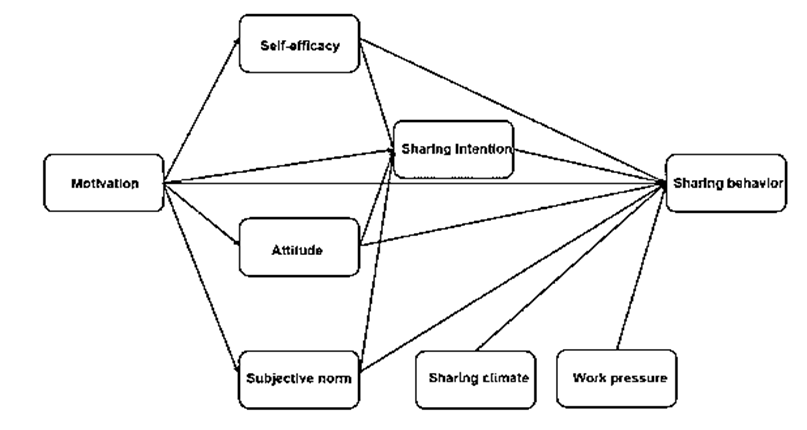
Structure proposed by
Wang et. al. (2021) for the process of sharing.
Figure
3
The student t
Distribution, http://stat.ethz.ch/R-manual/R-devel/library/stats/html/TDist.html.
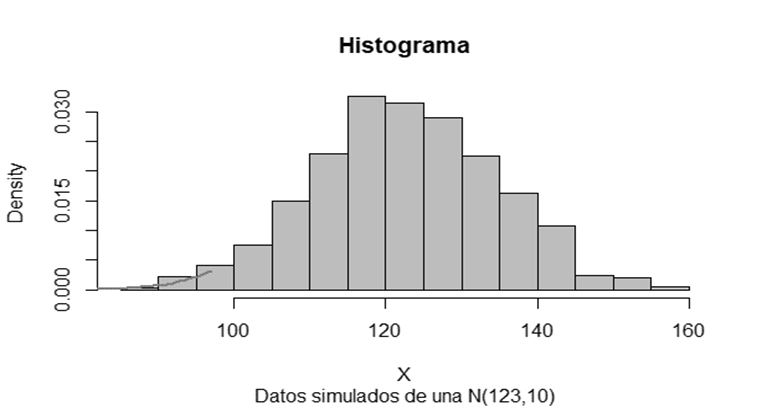
Note: Histogram RStudio Source: Lenth, R. V. (1989).
Figure
5
Inclination
curve towards sharing from the vocational 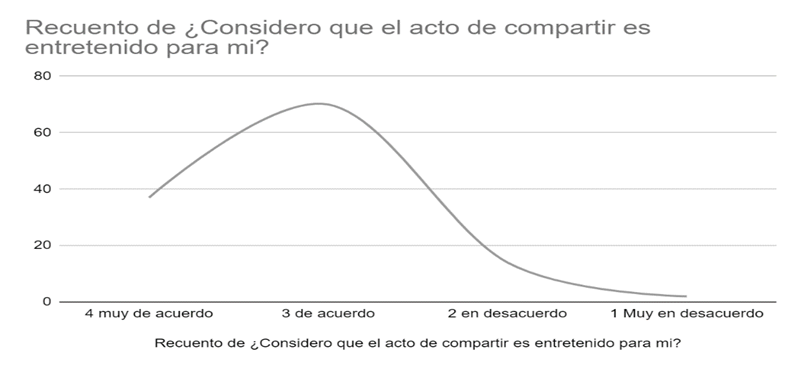
Note: Result of the sample and structured application from the
latent variables and their respective indicators.
Figure
6
Likelihood
of sharing based on survey results
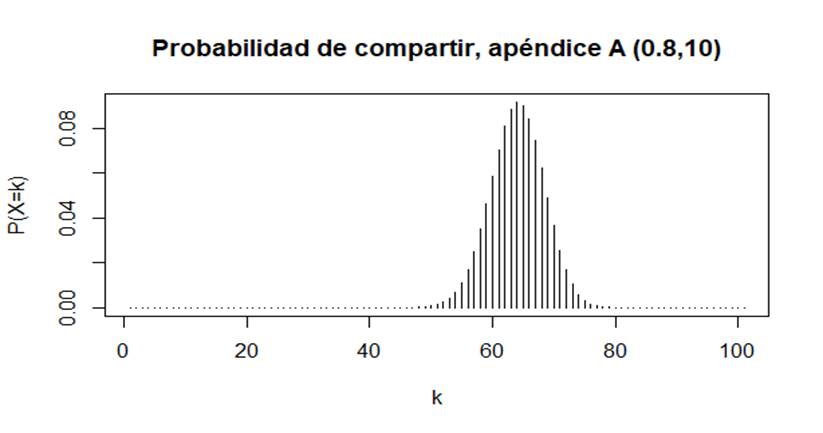
probability index to share based on Alpha coefficient designed
in RStudio, the formula was obtained from the revision of Cabrera Amaiquema
(2021) and its note in RStudio with the following plot equation (dbinom
(0 :100,90,0.7), type="h",xlab="k",ylab="P(X=k)", main= "Probability of sharing, appendix A
(0.8,10)")
Appendix:
Appendix
A
 https://orcid.org/0000-0002-2047-7573