Learning Analytics to Monitor Performance in Natural Sciences in Ninth-Grade Basic General Education: Early Detection and Ethical Pedagogical Response
(es) Learning Analytics para el monitoreo del desempeño en Ciencias Naturales en noveno año de Educación General Básica: detección temprana y respuesta pedagógica ética
(port) Learning Analytics para o monitoramento do desempenho em Ciências Naturais no nono ano da Educação Geral Básica: detecção precoce e resposta pedagógica ética
Patricia Maribel Amaluisa-Guevara
Ministerio de Educación del Ecuador
patricia.amaluisa@educacion.gob.ec
 https://orcid.org/0009-0000-5940-6425
Ministerio de Educación del Ecuador
https://orcid.org/0009-0003-9617-0361
Ministerio de Educación del Ecuador
elizabeth.miranda@educacion.gob.ec
https://orcid.org/0009-0001-5290-3426
Amaluisa-Guevara, P. M., Lozada-Andaluz, N. M., & Miranda-Escobar, R. E. (2025). Learning Analytics to Monitor Performance in Natural Sciences in Ninth-Grade Basic General Education: Early Detection and Ethical Pedagogical Response. YUYAY: Estrategias, Metodologías & Didácticas Educativas, 5(2), 84-98. https://doi.org/10.59343/yuyay.v5i3.g8a15
Recepción: 17-05-2025 / Aceptación: 02-08-2025 / Publicación: 30-09-2025

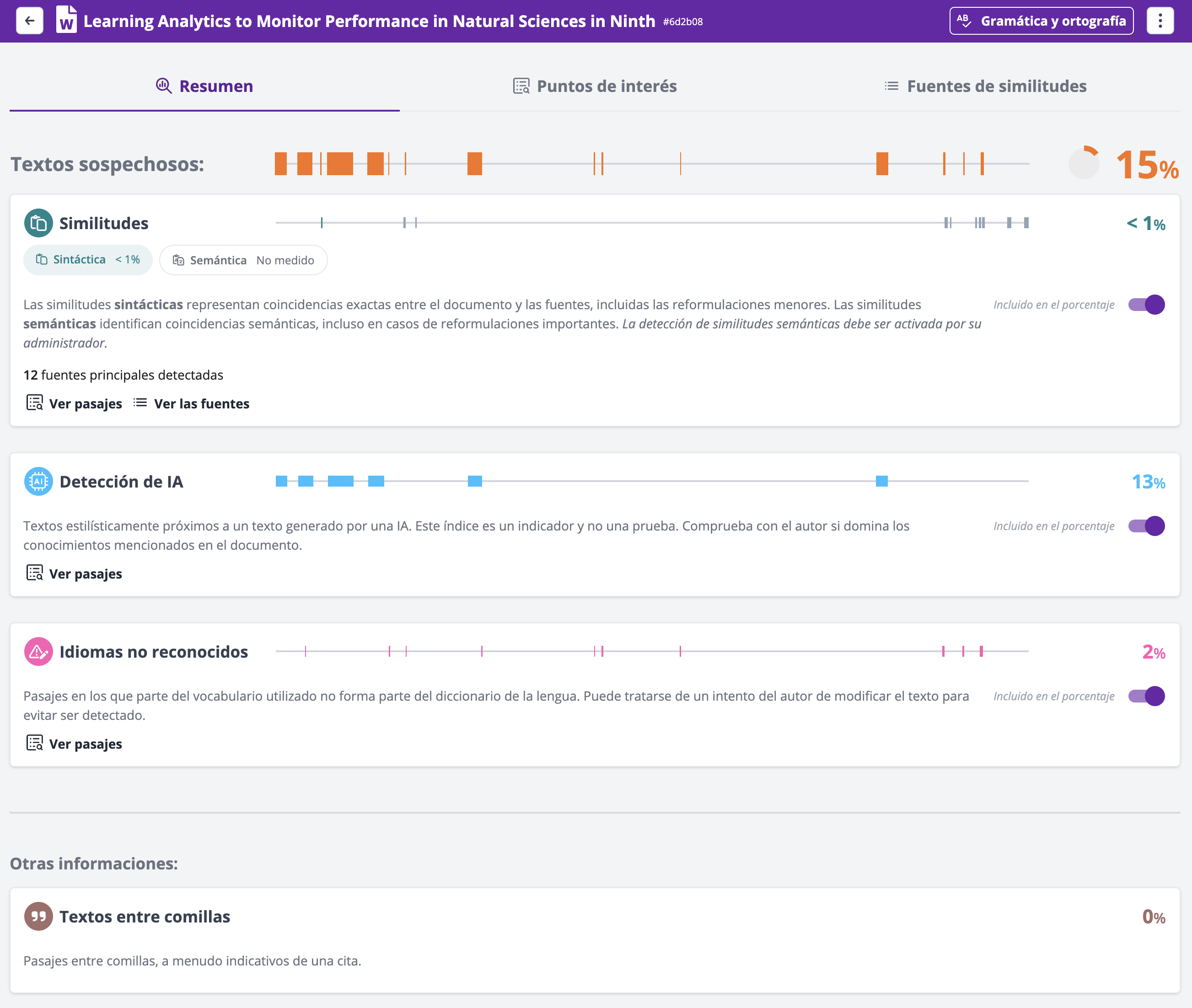
Compilatio Master+ IA Similarity
Abstract
This article presents a literature review on the use of Learning Analytics to monitor academic performance in Natural Sciences in ninth-grade Basic General Education, with an emphasis on the early detection of learning difficulties and ethical pedagogical responses. The study analyzes 32 scientific articles published between 2019 and 2025, selected through a narrative approach based on the IMRyD model and PRISMA guidelines. The results show that, although learning analytics–based early warning systems have a high potential to anticipate academic underachievement, their educational impact depends on curricular alignment, teacher interpretation, and the integration of ethical principles such as transparency, data protection, and non-stigmatization. Based on an analysis of the Ecuadorian Natural Sciences curriculum for ninth-grade Basic General Education, a Learning Analytics model oriented toward formative assessment and pedagogical care is proposed, conceived as a decision-support tool for teachers rather than a control mechanism. The article concludes that the contextualized and ethical implementation of learning analytics can significantly contribute to improving scientific learning in basic education.
Keywords: Learning analytics; natural sciences; basic education; early detection; educational ethics.
Resumen
Este artículo presenta una revisión de la literatura sobre el uso de Learning Analytics para el monitoreo del desempeño académico en Ciencias Naturales en el noveno año de Educación General Básica, con énfasis en la detección temprana de dificultades de aprendizaje y en la respuesta pedagógica ética. El estudio analiza 32 artículos científicos publicados entre 2019 y 2025, seleccionados mediante un enfoque narrativo basado en el modelo IMRyD y los lineamientos PRISMA. Los resultados evidencian que, si bien los sistemas de alerta temprana basados en analítica del aprendizaje muestran un alto potencial para anticipar el rezago académico, su impacto educativo depende de la alineación curricular, la interpretación docente y la integración de principios éticos como la transparencia, la protección de datos y la no estigmatización. A partir del análisis del currículo ecuatoriano de Ciencias Naturales para noveno año de Educación General Básica, se propone un modelo de Learning Analytics orientado a la evaluación formativa y al cuidado pedagógico, concebido como una herramienta de apoyo a la toma de decisiones docentes y no como un mecanismo de control. El artículo concluye que la implementación contextualizada y ética de la analítica del aprendizaje puede contribuir significativamente a la mejora del aprendizaje científico en la educación básica.
Palabras clave: Learning analytics; ciencias naturales; educación básica; detección temprana; ética educativa.
Resumo
Este artigo apresenta uma revisão da literatura sobre o uso de Learning Analytics para o monitoramento do desempenho acadêmico em Ciências Naturais no nono ano da Educação Geral Básica, com ênfase na detecção precoce de dificuldades de aprendizagem e na resposta pedagógica ética. O estudo analisa 32 artigos científicos publicados entre 2019 e 2025, selecionados por meio de uma abordagem narrativa baseada no modelo IMRyD e nas diretrizes PRISMA. Os resultados indicam que, embora os sistemas de alerta precoce baseados em analíticas da aprendizagem apresentem alto potencial para antecipar o baixo desempenho acadêmico, seu impacto educacional depende do alinhamento curricular, da interpretação docente e da integração de princípios éticos como transparência, proteção de dados e não estigmatização. A partir da análise do currículo equatoriano de Ciências Naturais para o nono ano da Educação Geral Básica, propõe-se um modelo de Learning Analytics orientado à avaliação formativa e ao cuidado pedagógico, concebido como uma ferramenta de apoio à tomada de decisão docente e não como um mecanismo de controle. Conclui-se que a implementação contextualizada e ética das analíticas da aprendizagem pode contribuir significativamente para a melhoria da aprendizagem científica na educação básica.
Palavras-chave: Analíticas da aprendizagem; ciências naturais; educação básica; detecção precoce; ética educacional.
Introduction
The digital transformation of education systems has generated a growing volume of data derived from teaching and learning processes, especially from the use of virtual learning environments, digital assessment platforms, interactive resources and academic management systems. In this scenario, Learning Analytics (LA) emerges as an interdisciplinary field aimed at the measurement, collection, analysis, and interpretation of educational data with the aim of understanding and optimizing learning and the environments in which it occurs (Siemens, 2013; Viberg et al., 2018). Over the past decade, LA has evolved from descriptive applications to predictive models and early warning systems capable of identifying students at academic risk before irreversible outcomes such as lagging, repetition, or dropout occur (Baker & Hawn, 2022; Paolucci et al., 2024).
While most of the research in Learning Analytics has historically focused on higher education, in recent years there has been a growing interest in its application in basic and secondary education (K-12) contexts, where the early detection of learning difficulties acquires critical pedagogical and social relevance (Kovanović et al., 2021; Spector et al., 2023). At these educational levels, LA is not only linked to the improvement of academic performance, but also to the prevention of interrupted school trajectories, the strengthening of educational equity and the guarantee of the right to inclusive and quality education.
Within the school curriculum, the area of Natural Sciences occupies a strategic place in the comprehensive education of students, particularly in the sublevel of Higher Basic General Education, corresponding to the 8th, 9th and 10th year in the Ecuadorian educational system. In the 9th year of EGB, the central purpose of the Natural Sciences is the development of scientific thinking, the understanding of physical, chemical, and biological phenomena, and the application of the scientific method as a tool to interpret reality and make informed decisions (Ministry of Education of Ecuador, 2016). These competencies require complex cognitive processes, pedagogical continuity and systematic accompaniment that allows conceptual, procedural or attitudinal difficulties to be identified in a timely manner.
Various international studies have shown that performance problems in science tend to manifest themselves progressively and cumulatively, starting with unaddressed conceptual gaps that, over time, translate into sustained low performance and academic demotivation (OECD, 2019; Pan, 2024). In this sense, early detection systems based on Learning Analytics offer an opportunity to identify risk patterns based on objective evidence of the learning process, such as recurrent errors due to skill, decreased participation, systematic delays in the delivery of activities or discrepancies between effort and results.
However, the incorporation of Learning Analytics in school contexts poses substantive challenges that transcend the technical and are inscribed in the ethical, pedagogical and legal planes. Unlike higher education, in basic education students are mostly minors, which requires reinforced standards of personal data protection, transparency in the use of information, and explicit guarantees against stigmatization and automated decision-making (Prinsloo & Slade, 2017; Cormack, 2022). Recent literature warns that predictive models, if not carefully designed and interpreted, can reproduce structural biases and amplify pre-existing educational inequalities, especially in contexts marked by socioeconomic and digital gaps (Deho et al., 2022; Li et al., 2022).
In Latin America, and particularly in Ecuador, these risks take on a specific dimension. The Ecuadorian education system presents a high heterogeneity in terms of access to technological infrastructure, connectivity and digital teaching skills, which conditions both the quality of the available data and the feasibility of implementing advanced learning analytics solutions (Ochoa, 2019; Ruipérez-Valiente, 2020). In addition, the recent entry into force of the Organic Law on the Protection of Personal Data in Ecuador establishes a demanding regulatory framework for the processing of personal information, including educational data, which forces us to rethink any Learning Analytics initiative from a perspective of legality, proportionality, and explicit pedagogical purpose (National Assembly of Ecuador, 2021).
Despite the growing body of international literature on Learning Analytics, studies specifically focused on its application in Natural Sciences in the 9th year of Basic General Education in the Ecuadorian context are scarce. Most of the works identified focus on higher education, teacher training or general experiences of using digital platforms, without delving into early detection models articulated with the national curriculum or ethical pedagogical response strategies applicable to the regular classroom. This research gap limits informed decision-making and the generation of educational policies based on contextualized evidence.
Faced with this scenario, it is necessary to develop a critical and systematic review of the recent literature to identify trends, methodological approaches, empirical results and ethical frameworks in the use of Learning Analytics for the early detection of learning difficulties in secondary education. Moreover, it is essential to translate these findings into viable pedagogical proposals, aligned with the Ecuadorian curriculum of Natural Sciences and with the real conditions of the country's educational institutions.
In this sense, this review article aims to analyze the scientific production published since 2019 on Learning Analytics applied to the monitoring of academic performance and early detection of risk, with emphasis on secondary education and science, and to critically examine its relevance and applicability in the Ecuadorian context of 9th grade of Basic General Education. Likewise, the study seeks to identify research gaps, ethical tensions and opportunities for pedagogical innovation, proposing a call to action aimed at the design of Learning Analytics models focused on pedagogical care, equity and effective improvement of learning in the regular classroom.
Far from conceiving Learning Analytics as a surveillance or control mechanism, this review is positioned from a perspective that understands educational data as inputs for reflective pedagogical action, where human interpretation, professional teacher judgment and respect for the rights of students are essential elements. In an educational context that demands early, ethical and contextualized responses, learning analytics will only be legitimate and transformative if it is integrated as a critical extension of formative assessment and not as a technocratic substitute for pedagogy.
Methodology (PRISMA)
This study adopts a literature review design with a narrative-systematic approach, structured according to the IMRyD model (Introduction, Methods, Results and Discussion), integrating principles of the PRISMA protocol as a guide to guarantee transparency, traceability and rigor in the process of selection and analysis of sources. A statistical meta-analysis is not proposed due to the heterogeneity of the methodological designs, educational contexts, teaching levels and variables analyzed in the studies reviewed, but a critical and thematic synthesis oriented to pedagogical and contextual interpretation.
The review is conceived as an expanded state-of-the-art study, whose purpose is not only to describe trends, but also to identify gaps, ethical tensions and opportunities for pedagogical application in school contexts, particularly in Basic General Education.
Search strategy and sources of information
The bibliographic search was carried out between January and March 2026 in high-impact academic databases and open access repositories, prioritizing literature published between 2019 and 2025, a period that coincides with the consolidation of ethical, critical, and applied approaches in Learning Analytics. Databases such as Scopus, Web of Science, ERIC, IEEE Xplore, ACM Digital Library, SpringerLink and ScienceDirect were consulted, as well as regional repositories such as SciELO and Redalyc to attract Latin American production.
The search strings included English and Spanish combinations of the following terms: learning analytics, early warning systems, at-risk students, secondary education, K-12, science education, ethics, privacy, fairness, learning analytics, early detection, basic education, Natural Sciences and Ecuador. Boolean operators and filters were applied by year, area of knowledge and type of document (scientific articles, systematic reviews, empirical studies and conceptual frameworks).
Inclusion and exclusion criteria
Inclusion criteria:
a) publications between 2019 and 2025;
b) studies focused on Learning Analytics, early warning systems, educational dashboards or related ethical frameworks;
c) research in secondary education, basic education or contexts transferable to K-12; d) articles with an empirical approach, systematic reviews or theoretical frameworks with pedagogical implications.
Exclusion criteria:
a) exclusively technical studies without educational link;
b) work focused solely on higher education without transferable contributions;
c) gray literature without academic peer-review;
d) publications prior to 2019.
Table 1
Classification of studies by approach (2019–2025)
|
Approach |
N° of studies |
Educational level |
Main findings |
|
Predictive Analytics |
13 |
Secondary/Higher |
High precision, low pedagogical transferability |
|
Teaching Dashboards |
9 |
Secondary |
Better decision-making when there is curriculum alignment |
|
Student-Centered Analytics |
6 |
Secondary |
Increases self-regulation and perception of fairness |
|
Ethics and governance |
4 |
Transversal |
Risks of bias and stigmatization |
Selection process (narrative PRISMA)
The process followed four phases:
× Identification, with an initial total of 186 records;
× Screening, removing duplicates and reviewing titles and abstracts;
× Eligibility, through complete reading of the texts;
× Inclusion, resulting in 32 scientific articles selected for final analysis.
× Table of analytical criteria
× The included studies were analysed using a categorisation matrix with the following criteria:
× Year of publication
× Country or region
× Educational level (basic, secondary, higher)
× Disciplinary area (sciences, general, transversal)
× Type of analytics (descriptive, predictive, diagnostic)
× Variables used
× Explicit or implicit ethical approach
× Type of pedagogical intervention proposed
The analysis of the 32 studies reviewed allowed us to identify four major approaches in the recent literature on Learning Analytics.
1. Predictive Learning Analytics and Early Warning Systems
A first majority group focuses on the development of predictive models aimed at identifying students at academic risk based on variables such as participation in platforms, assessment results and interaction patterns. These studies report acceptable levels of statistical accuracy, but recognize important limitations in terms of interpretability and pedagogical transfer (Baker & Hawn, 2022; Bañeres et al., 2023; Pan, 2024).
2. Educational dashboards and teacher decision-making
A second approach prioritizes the design of visualization boards for teachers, with the aim of facilitating the interpretation of data and supporting pedagogical decision-making. Evidence shows that dashboards are most effective when they are designed through co-creation processes with teachers and when indicators are explicitly aligned with curricular objectives (Susnjak, 2022; Mohseni et al., 2023; Valtonen et al., 2025).
3. Student- and agency-centric Learning Analytics
A third group of studies emphasizes the importance of preserving student agency, promoting explainable analytics, formative feedback, and active student participation in the interpretation of their own data. These works question overly automated approaches and advocate for models focused on well-being and self-regulation (Hooshyar et al., 2023; Soffer, 2024; Cabrera et al., 2025).
4. Ethics, Privacy, and Fairness in Learning Analytics
Finally, a growing body of literature explicitly addresses ethical challenges, including data protection, algorithmic biases, and educational justice. These studies warn that Learning Analytics systems can reproduce structural inequalities if they are not designed with equity and contextualization criteria (Cormack, 2022; Deho et al., 2022; Li et al., 2022).
Overall, the state of the art reveals a deficit of studies applied to Natural Sciences in basic education, as well as a scant attention to Latin American contexts and specific national curricula.
Analysis of the Ecuadorian Natural Sciences Curriculum – 9th EGB
The Ecuadorian Natural Sciences curriculum for the sublevel of Higher Basic General Education establishes as its central axis the development of scientific thinking, promoting systematic observation, the formulation of hypotheses, experimentation, and the critical analysis of natural phenomena (Ministry of Education of Ecuador, 2016).
In 9th grade, skills are organised around three domains:
a) conceptual understanding;
(b) scientific procedures;
c) attitudes and values towards science.
This approach provides a solid foundation for the implementation of Learning Analytics, as long as the indicators are aligned with skills, performance criteria and not superficial metrics. However, the curriculum does not explicitly incorporate guidance on the use of educational data or learning analytics, which creates a normative and pedagogical gap.
In addition, the real conditions of Ecuadorian educational institutions – technological heterogeneity, limited connectivity and teaching overload – demand models of low technical complexity, interpretable and compatible with formative assessment.
Proposed model: early detection and ethical pedagogical response
Based on the review carried out, a pedagogical-ethical model of Learning Analytics for Natural Sciences in 9th EGB is proposed, structured in four principles:
1. Curriculum alignment
Indicators should be derived directly from curriculum skills, linking each red flag to a specific competency and observable evidence of learning.
2. Non-punitive early detection
Alerts should be understood as pedagogical signals, not as risk labels. Its purpose is to activate timely support, not to classify students.
3. Mandatory human interpretation
No pedagogical decision should be automated. The teacher acts as a critical mediator between the data and the intervention, considering contextual, emotional and social factors.
4. Proportional and ethical pedagogical response
Interventions must be gradual, inclusive and documented, privileging strategies of reinforcement, mentoring, methodological adaptation and continuous accompaniment.
This model conceives Learning Analytics not as a control technology, but as a pedagogical care tool, consistent with the principles of equity, inclusion, and the right to education.
Results
Comparative synthesis of the evidence reviewed (2019–2025)
The analysis of the 32 selected studies allowed the identification of consistent patterns, methodological divergences and relevant gaps in the application of Learning Analytics for the early detection of academic performance in secondary education, with special emphasis on Sciences and related areas.
Table
2
Gaps identified
for Natural Sciences – 9th EGB
|
Dimension |
International evidence |
Ecuadorian context |
|
Curriculum Alignment |
Partial |
Weak |
|
Disciplinary studies |
Scarce |
Very scarce |
|
Explicit ethical framework |
Emerging |
Incipient |
|
Application in regular classroom |
Limited |
Practically non-existent |
Results by type of analytical approach
a) Descriptive and diagnostic analysis
Approximately one-third of the studies reviewed focus on the use of Learning Analytics for descriptive and diagnostic purposes, aimed at visualizing student progress, identifying frequent errors, and monitoring participation in learning activities. These studies report improvements in teaching capacity to identify specific difficulties, especially when the indicators are linked to clear curricular objectives (Susnjak, 2022; Mohseni et al., 2023). However, its impact depends to a large extent on the time available to the teacher and their data literacy.
(b) Predictive analytics and early warning systems
A second significant group of studies focuses on predictive models based on machine learning techniques, which aim to anticipate academic risk before the appearance of negative outcomes. These systems show varying levels of precision and, in some cases, high values of statistical accuracy (Bañeres et al., 2023; Pan, 2024). However, the results show that predictive capacity does not automatically guarantee improvements in learning if it is not accompanied by well-defined pedagogical interventions.
c) Action-oriented pedagogical dashboards
Studies that integrate dashboards designed to support teacher decision-making report more consistent results in terms of pedagogical impact. In particular, those developed through co-design processes with teachers and aligned with curricular competencies show greater acceptance and sustained use (Valtonen et al., 2025). These results suggest that usability and pedagogical relevance are more determining factors than technical sophistication.
d) Ethical and well-being-centred approaches
A growing body of research explicitly incorporates ethical dimensions, highlighting the need for transparency, informed consent, and bias mitigation. These studies indicate that Learning Analytics systems can negatively affect motivation and the perception of fairness if students do not understand how their data is used or if alerts are perceived as permanent labels (Cormack, 2022; Soffer, 2024).
Results by educational level and disciplinary area
Most of the studies analysed are developed in higher education or in general secondary education contexts, while less than 20% address specific disciplinary areas, such as Natural Sciences. In these cases, indicators tend to focus on conceptual and procedural performance, although they are rarely explicitly aligned with national curricula. This finding reinforces the need for contextualized studies that articulate Learning Analytics with official study programs, especially in Latin American countries.
Discussion
The results of this review highlight a central tension: while Learning Analytics advances rapidly in technical terms, its pedagogical integration in school contexts continues to be fragmented and uneven. In the case of Ecuador, this tension is amplified by the coexistence of a structured and ambitious curriculum with real limitations in infrastructure, teacher training and data governance.
The Natural Sciences curriculum of 9th EGB establishes a framework conducive to the implementation of early detection strategies, given its emphasis on processes, skills and evidence of learning. However, the absence of specific guidelines on the pedagogical use of educational data generates a void that is usually filled in an improvised or exclusively technical way, without systematic ethical reflection.
From a pedagogical perspective, the review confirms that early detection is only meaningful when it translates into concrete actions in the classroom. Predictive models that do not trigger clear pedagogical responses tend to become classification mechanisms rather than support tools. In this sense, the evidence supports hybrid approaches that combine descriptive analytics, teacher interpretation, and formative intervention strategies.
On the ethical level, the studies reviewed agree that the use of Learning Analytics in basic education should prioritize the principle of non-maleficence, avoiding practices that may stigmatize or exclude students. In contexts such as Ecuador, where social and digital inequalities are structural, the risk of misinterpreting data is particularly high. Low participation in digital platforms, for example, may reflect connectivity issues rather than a lack of engagement or capacity.
Likewise, recent Ecuadorian legislation on the protection of personal data introduces a regulatory framework that forces us to rethink the governance of Learning Analytics systems. The pedagogical purpose, data minimisation and transparency are no longer optional good practices and become unavoidable legal and ethical requirements.
Conclusions
This review article allows us to conclude that Learning Analytics has a high potential to improve the monitoring of academic performance in Natural Sciences in 9th grade of Basic General Education, as long as its implementation is based on solid pedagogical principles, curricular alignment and an ethic of educational care.
The evidence reviewed shows that early detection systems are most effective when they are conceived as tools to support formative assessment, and not as automated control or prediction mechanisms. In this framework, the role of the teacher as a critical interpreter of the data is irreplaceable.
In the Ecuadorian context, a significant gap in applied research persists, particularly in studies that articulate Learning Analytics with the national curriculum of Natural Sciences and with the real conditions of the regular classroom. This gap represents both a limitation and an opportunity for the development of contextualized innovative proposals.
As a future agenda, it is proposed:
- Develop pilot studies of Learning Analytics in 9th EGB with a specific disciplinary approach.
- Design early detection models of low technical complexity and high pedagogical interpretability.
- Integrate ethical and legal frameworks from the design phase of analytical systems.
- Evaluate the impact of these strategies not only on academic performance, but also on motivation, perception of fairness, and student well-being.
In short, Learning Analytics will only fulfill its transformative promise in basic education if it is understood not as an end in itself, but as a means to strengthen pedagogy, anticipate lagging behind and sustain dignified and equitable educational trajectories. Early detection, in this sense, is not to keep an eye on error, but to open space to learn before the silence of failure becomes normalized.
Referencias
Asamblea Nacional del Ecuador. (2021). Ley orgánica de protección de datos personales. Registro Oficial No. 459.
Baker, R. S., & Hawn, A. (2022). Algorithmic bias in education. International Journal of Artificial Intelligence in Education, 32(4), 1–25. https://doi.org/10.1007/s40593-021-00285-9
Bañeres, D., Rodríguez, M. E., & Serra, M. (2023). An early warning system to identify and intervene online students at risk of failure. Computers & Education, 192, 104657. https://doi.org/10.1016/j.compedu.2022.104657
Cabrera-Amaiquema, J. E., Quintero-Moreira, I. Y., Oviedo-Bonilla, C. M., & Cervantes-Avilés, R. P. (2025). Experiential Learning and the Optimization of Learning in Students with Neurodevelopmental Disorders through Educational Personalization. Sapiendus, 1(1). https://doi.org/10.70335/sapiendus.1.1.5
Cormack, A. N. (2022). Developing a code of practice for learning analytics: A critical reflection. British Journal of Educational Technology, 53(1), 1–16. https://doi.org/10.1111/bjet.13162
Deho, O. B., Zhan, C., Li, J., Liu, J., Liu, L., & Duy Le, T. (2022). How do the existing fairness metrics and unfairness mitigation algorithms contribute to ethical learning analytics?. British Journal of Educational Technology, 53(4), 822-843. https://doi.org/10.1111/bjet.13217
Hooshyar, D., Malva, L., Yang, Y., & Pedaste, M. (2023). Learning analytics in supporting student agency. Computers in Human Behavior, 139, 107504. https://doi.org/10.1016/j.chb.2022.107504
Jisc. (2015). Code of practice for learning analytics. https://www.jisc.ac.uk
Kovanović, V., Mazziotti, C., & Lodge, J. M. (2021). Learning analytics for primary and secondary schools. British Journal of Educational Technology, 52(6), 2139–2158. https://doi.org/10.1111/bjet.13107
Li, W., Zhao, K., & Chen, G. (2022). Disparities in students’ propensity to consent to learning analytics. Educational Research Review, 37, 100472. https://doi.org/10.1016/j.edurev.2022.100472
Ministerio de Educación del Ecuador. (2016). Currículo de los niveles de educación obligatoria: Ciencias Naturales. Quito, Ecuador.
Mohseni, Z., Masiello, I., & Martins, R. M. (2023). Co-developing a learning analytics dashboard for teachers in secondary education. Computers & Education, 195, 104703. https://doi.org/10.1016/j.compedu.2023.104703
OECD. (2019). PISA 2018 results: What students know and can do. OECD Publishing. https://doi.org/10.1787/5f07c754-en
Ochoa, X. (2019). Learning analytics in Latin America: An opportunity not to be missed. British Journal of Educational Technology, 50(4), 1851–1856. https://doi.org/10.1111/bjet.12874
Pan, Z. (2024). A systematic review of learning analytics in secondary education. Educational Technology Research and Development, 72(1), 45–68. https://doi.org/10.1007/s11423-023-10235-9
Paolucci, C., et al. (2024). Learning analytics opportunities and challenges for K–12 education. Computers & Education: Artificial Intelligence, 5, 100149. https://doi.org/10.1016/j.caeai.2024.100149
Prinsloo, P., & Slade, S. Ethics and Learning Analytics: Charting the (Un) Charted. Handbook of Learning Analytics, 49. https://doi.org/10.18608/hla17.004
Siemens, G. (2013). Learning analytics: The emergence of a discipline. American Behavioral Scientist, 57(10), 1380–1400. https://doi.org/10.1177/0002764213498851
Soffer, T. (2024). Students’ perceptions of using learning analytics for self-regulated learning. Internet and Higher Education, 60, 100904. https://doi.org/10.1016/j.iheduc.2023.100904
Susnjak, T. (2022). Learning analytics dashboards: A review of benefits and challenges. IEEE Access, 10, 13456–13470. https://doi.org/10.1109/ACCESS.2022.3145563
Valtonen, T., et al. (2025). Teachers’ perceptions of learning analytics dashboards. Teaching and Teacher Education, 122, 103987. https://doi.org/10.1016/j.tate.2024.103987
Viberg, O., Hatakka, M., Bälter, O., & Mavroudi, A. (2018). The current landscape of learning analytics. Computers in Human Behavior, 89, 98–110. https://doi.org/10.1016/j.chb.2018.07.027