Effective Pedagogical Practices in the Teaching of Language and Literature: Alternatives to Address Low Academic Performance
(es) Prácticas pedagógicas efectivas en la enseñanza de Lengua y Literatura: alternativas para abordar el bajo rendimiento académico
(port) Práticas Pedagógicas Eficazes no Ensino de Língua e Literatura: Alternativas para Enfrentar o Baixo Rendimento Acadêmico
Diana Jesús Burgos-Mendieta
Universidad Estatal de Milagro
 https://orcid.org/0000-0003-3198-675X
Nathaly Jakeline Burgos-Mendieta
Universidad Estatal de Milagro
https://orcid.org/0009-0004-5982-7173
Burgos-Mendieta, D. J., & Burgos-Mendieta, N. J. (2025). Effective Pedagogical Practices in the Teaching of Language and Literature: Alternatives to Address Low Academic Performance. YUYAY: Estrategias, Metodologías & Didácticas Educativas, 5(2), 40–56. https://doi.org/10.59343/yuyay.v5i2.130
Recepción: 02-06-2025 / Aceptación: 11-08-2025 / Publicación: 30-09-2025

Turnitin IA Similarity Report
Abstract
This review article analyzes the main pedagogical practices applied in the teaching of Language and Literature for basic education students with low academic performance. Based on literature indexed in Scopus, DOAJ, CLASE and Google Scholar between 2015 and 2025, innovative approaches were identified that contrast with traditional methodologies focused on grammatical memorization and mechanical analysis of texts. Evidence shows that strategies such as dialogic reading, reciprocal teaching, literary circles, guided creative writing and the integration of digital technologies favor reading comprehension, written production and intrinsic motivation of students. Likewise, the importance of incorporating socio-emotional dimensions in the teaching process is recognized, considering that students with low performance tend to accumulate negative experiences that condition their performance. The results of the review allow us to conclude that there is no single pedagogical practice sufficient, but that effectiveness emerges from the flexible combination of methods in integral didactic ecosystems. The need to rethink evaluation systems and strengthen teacher training is underlined, in order to promote meaningful, inclusive and sustainable learning in the field of Language and Literature.
Keywords: Language didactics; reading comprehension; creative writing; pedagogical innovation; low academic performance.
Resumen
Este artículo de revisión analiza las principales prácticas pedagógicas aplicadas en la enseñanza de Lengua y Literatura para estudiantes de educación básica con bajo rendimiento académico. A partir de literatura indexada en Scopus, DOAJ, CLASE y Google Scholar entre 2015 y 2025, se identificaron enfoques innovadores que contrastan con las metodologías tradicionales centradas en la memorización gramatical y el análisis mecánico de textos. La evidencia muestra que estrategias como la lectura dialógica, la enseñanza recíproca, los círculos literarios, la escritura creativa guiada y la integración de tecnologías digitales favorecen la comprensión lectora, la producción escrita y la motivación intrínseca del alumnado. Asimismo, se reconoce la importancia de incorporar dimensiones socioemocionales en el proceso de enseñanza, al considerar que los estudiantes con bajo rendimiento suelen acumular experiencias negativas que condicionan su desempeño. Los resultados de la revisión permiten concluir que no existe una única práctica pedagógica suficiente, sino que la efectividad emerge de la combinación flexible de métodos en ecosistemas didácticos integrales. Se subraya la necesidad de replantear los sistemas de evaluación y de fortalecer la formación docente, con el fin de promover aprendizajes significativos, inclusivos y sostenibles en el campo de la Lengua y Literatura.
Palabras clave: Didáctica de la lengua; comprensión lectora; escritura creativa; innovación pedagógica; bajo rendimiento académico.
Resumo
Este artigo de revisão analisa as principais práticas pedagógicas aplicadas no ensino de Língua e Literatura para estudantes da educação básica com baixo rendimento acadêmico. A partir de literatura indexada na Scopus, DOAJ, CLASE e Google Scholar entre 2015 e 2025, identificaram-se abordagens inovadoras que contrastam com metodologias tradicionais centradas na memorização gramatical e na análise mecânica de textos. As evidências mostram que estratégias como leitura dialógica, ensino recíproco, círculos literários, escrita criativa orientada e integração de tecnologias digitais favorecem a compreensão leitora, a produção escrita e a motivação intrínseca dos estudantes. Reconhece-se também a importância de incorporar dimensões socioemocionais ao processo de ensino, considerando que estudantes com baixo rendimento costumam acumular experiências negativas que condicionam seu desempenho. Os resultados da revisão permitem concluir que não existe uma prática pedagógica única e suficiente; a eficácia emerge da combinação flexível de métodos em ecossistemas didáticos integrados. Ressalta-se a necessidade de repensar os sistemas de avaliação e de fortalecer a formação docente, a fim de promover aprendizagens significativas, inclusivas e sustentáveis no campo de Língua e Literatura.
Palavras-chave: Didática da língua; compreensão leitora; escrita criativa; inovação pedagógica; baixo rendimento acadêmico.
Introduction
Language learning is one of the essential pillars of basic education, as it crosses all dimensions of school and social life. It is not only about the acquisition of technical reading and writing skills, but also about the construction of communicative, cognitive and cultural skills that allow the student to interpret the world, interact critically with their environment and exercise their citizenship. However, education systems in Latin America and other regions of the world face a persistent challenge: low academic performance in the subject of Language and Literature. This phenomenon not only limits students' school careers, but also perpetuates social and cultural inequalities, reducing their chances of full insertion into the knowledge society (González & Ramírez, 2022).
For decades, language teaching has been characterised by methodologies focused on the rote repetition of grammatical rules and the mechanical analysis of texts. This approach, heir to normative and encyclopedic traditions, has been questioned in multiple studies due to its inability to generate meaningful learning (Cassany, 2019). In fact, comparative studies carried out in different countries show that students exposed to traditional practices tend to have negative attitudes towards the subject, associating it with boredom, rigidity and demotivation (López & Pérez, 2020). Consequently, the persistence of these methodologies reinforces a vicious cycle: students with initial difficulties receive unstimulating teaching, which increases their levels of frustration and places them in low-performance trajectories that are increasingly difficult to reverse.
The problem of low performance in Language and Literature must be understood in a multidisciplinary key. It cannot be attributed solely to individual factors, such as the student's cognitive level or personal disposition. Various studies have shown that the quality of teacher accompaniment, the relevance of the methodologies used, the intrinsic motivation towards reading and writing, and even the socioeconomic and cultural conditions of the context, have a decisive impact on school results (UNESCO, 2021). From this perspective, school failure in the subject is, to a large extent, the reflection of inadequate or decontextualized pedagogical practices, as well as educational policies that do not recognize the diversity of students.
One of the most frequent criticisms of traditional language teaching is that it privileges the formal mastery of structures over the development of communicative competence. In the words of Cassany (2021), students are taught to identify the "skeleton" of language, but not to give it "life" in real contexts of use. This dissociation between theory and practice generates superficial learning, incapable of being transferred to authentic communicative situations. The immediate consequence is that students are unable to appropriate language as a tool for thinking, creating, and actively participating in society.
In contrast, pedagogical approaches have emerged that promote more active, participatory, and inclusive teaching. Strategies such as dialogic reading, reciprocal teaching, literary circles, creative writing workshops, and the integration of digital technologies have shown positive results in improving reading comprehension and written production (Mercer & Littleton, 2019; Hernández, 2020). These approaches conceive the student as the protagonist of the learning process, and the teacher as a mediator who guides, motivates and facilitates the construction of meanings.
Literary pedagogy has acquired particular relevance, understood as the set of practices that seek to bring students closer to literature not only as an object of analysis, but also as an aesthetic, cultural and personal experience. A recent meta-analysis confirms that there is a significant correlation between the use of literary pedagogy and motivation towards language learning, highlighting that literature can act as a driver for the acquisition of language skills (García, 2024). This finding is crucial, since motivation is one of the strongest predictors of academic performance. Students who identify with narratives, who find in literature a mirror of their reality or a window to new possibilities, are more likely to engage with reading and improve their skills.
However, the implementation of innovative practices faces significant barriers. Curricular overload, the lack of didactic training of some teachers, the resistance to abandoning traditional models, and the lack of technological resources in vulnerable contexts are recurrent obstacles pointed out in the literature (Jiménez & Soto, 2022). These factors limit the ability of schools to incorporate effective pedagogical approaches and deepen the gap between what research recommends and what actually happens in classrooms.
From an interdisciplinary approach, the teaching of Language and Literature should be approached as a field in which linguistics, learning psychology, pedagogy and educational technology converge. For example, research in cognitive psychology provides evidence on the importance of metacognition and self-regulation in reading comprehension processes (Flavell, 2019). In turn, linguistics contributes with models on language acquisition and construction of meaning, while technology offers tools to diversify reading and writing experiences. The intersection of these perspectives enriches didactics and opens up new possibilities to face low performance.
This article proposes a systematic review of effective pedagogical practices in the teaching of Language and Literature for basic education students with low academic performance, with the purpose of offering a theoretical and practical framework that guides future research and school interventions. The choice of a review approach responds to the need to synthesize existing knowledge, identify trends and establish effectiveness criteria that can be applied in diverse contexts. Unlike other studies, a multidisciplinary approach that recognizes the complexity of the phenomenon and the interaction of multiple variables is privileged.
This paper is organized into three sections. First, the systematic review methodology used is presented, including search criteria and study selection. Subsequently, the main findings on effective pedagogical practices are presented, highlighting both their benefits and their limitations. Finally, a critical discussion is offered that underlines the importance of adopting comprehensive and inclusive approaches, and recommendations are made for teachers, researchers and education policymakers.
The underlying hypothesis is that low performance in Language and Literature is not an inevitable fate, but a consequence of limited didactic approaches. Overcoming this problem requires rethinking the role of language teaching: moving from a transmissive and normative model to a critical, creative and motivating pedagogy, capable of awakening in students not only an interest in reading and writing, but also an awareness that language is a tool of power, identity and social transformation.
Metodology
The analysis of recent literature shows that low academic performance in Language and Literature is a multidimensional phenomenon, where cognitive, pedagogical, socio-emotional and contextual factors converge. Addressing this requires recognizing that language teaching is not a linear process, nor can it be reduced to the simple transmission of formal rules and structures, but rather involves a constant interaction between meanings, cultural contexts, and learning experiences. The studies reviewed show that traditional approaches, although still predominant in many education systems, have proven to be insufficient in the face of the demands of contemporary education and the specific needs of students in situations of school vulnerability (Cassany, 2019; López & Pérez, 2020).
Among the most analyzed methodologies is dialogic reading, which conceives the act of reading as a shared and cooperative experience. Unlike individual silent reading or the teacher's one-way interpretation, this approach proposes the collective construction of meanings, where students contrast their perspectives, ask questions, formulate hypotheses, and relate the text to their own lives. Mercer and Littleton (2019) showed that students who participated in dialogic reading dynamics increased their level of inferential comprehension by 30% compared to those who followed traditional methods. This result confirms that interaction and debate are powerful tools to activate metacognitive processes and promote intrinsic motivation towards reading.
Figure 1
CROWD
Strategy
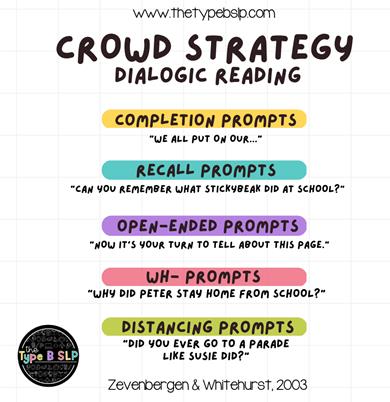
Note: (Zevenbergen & Whitehurst, 2003)
Another widely discussed strategy is reciprocal teaching, originally developed by Palincsar and Brown, and taken up in multiple contemporary studies. This technique is based on four cognitive processes: predicting, clarifying, questioning, and summarizing. The key to its effectiveness lies in the fact that students progressively assume the role of "teachers", explaining to their peers and guiding the analysis of the text. Recent research shows that this practice improves not only literal comprehension, but also critical ability and reading autonomy (González & Ramírez, 2022). In Latin American contexts, where orality has a significant cultural weight, reciprocal teaching acquires additional value, since it connects the community narrative tradition with formal learning.
Figura 2
Effect sice of reciprocal teaching
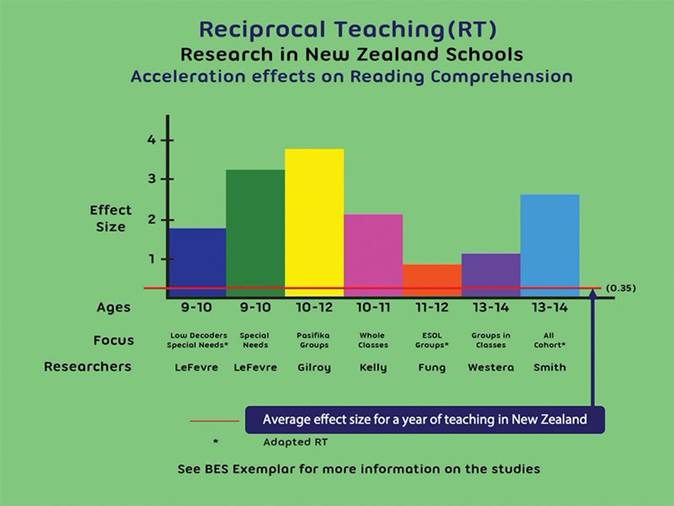
Note: The bar graph shows the effect sizes of various implementations of reciprocal teaching in different ages/school groups, compared against usual teaching (represented by a red reference line). The values of the effects reach considerable magnitudes in several cases (above 2, 3 or even 4 in some studies). In these contexts, the systematic use of reciprocal teaching generated significant improvements in reading comprehension after one year of application. The RTeach Institute in New Zealand presents it as evidence of the methodology's potential to accelerate reading learning.
Literary circles are another practice with demonstrated impact. Inspired by cooperative learning models, these spaces invite students to read and comment on literary works from different roles (moderator, context researcher, character interpreter, style critic). Studies carried out in Mexico and Colombia reveal that this methodology not only improves reading comprehension, but also strengthens students' self-esteem and social skills (Jiménez & Soto, 2022). Literature is no longer perceived as an imposed school content and is transformed into a space for the construction of collective identity, where each participant contributes their vision and enriches that of the others.
As for guided creative writing, the findings confirm that its potential lies in the integration of imagination with linguistic mastery. The use of reflective journals, short stories, poems, and digital narrative projects allows students to not only develop grammar and spelling skills, but also the ability to express personal emotions and reflections. García (2024) argues that creative writing works as a bridge between the student's inner world and the demands of the curriculum, reducing the anxiety associated with "error" and promoting more playful and authentic learning.
The socio-emotional dimension appears in a cross-sectional way in all the studies consulted. Numerous authors agree that students with low performance in Language and Literature have usually accumulated negative experiences associated with the subject: frustration, lack of confidence, fear of ridicule. Therefore, the effectiveness of any teaching strategy depends, to a large extent, on the teacher's ability to rebuild a positive emotional climate. Hernández (2020) shows that the simple act of offering positive feedback, valuing partial achievements, and designing activities that recognize students' cultural experiences produces significant improvements in motivation and persistence in the face of complex tasks. The inclusion of socio-emotional dynamics is not, therefore, an optional complement, but an indispensable condition for pedagogical success.
The role of the teacher, in this sense, transcends the transmission of content. He becomes a mediator, facilitator and, in many cases, an affective referent. Educational research has shown that the teacher–student relationship is a stronger predictor of performance than access to materials or infrastructure (UNESCO, 2021). This means that even in contexts with limited resources, a motivated teacher trained in innovative methodologies can make a substantial difference in their students' learning.
The integration of digital technologies represents another emerging line in language teaching. Platforms such as Padlet, Genial.ly, school blogs or digital narratives allow reading and writing experiences to be expanded beyond the classroom. A longitudinal study conducted in Brazil revealed that students who participated in digital literature projects not only increased their voluntary reading frequency, but also improved their writing skills by 25% compared to the control group (Souza & Pereira, 2021). The key to these experiences lies in the fact that digital texts offer multiple modes of interaction – images, sounds, videos, hypertexts – that enrich the interpretive experience and make it more attractive to digital natives.
However, the incorporation of ICTs also poses ethical and pedagogical challenges. Recent research warns of the risk of turning technology into an end in itself, losing sight of pedagogical objectives (Liu, 2023). In addition, the digital divide persists as a structural problem: in rural or marginalized areas, many students lack connectivity or adequate devices, which can deepen inequality. Faced with this reality, several authors propose adopting hybrid models that combine accessible traditional practices with inclusive digital experiences, adapted to the resources available in each context (Gómez & Herrera, 2022).
A particularly relevant aspect is the articulation of language teaching with other disciplines. From a multidisciplinary approach, Language and Literature can act as an integrating axis of learning in history, social sciences or even mathematics, by promoting the critical interpretation of texts, argumentation and the communication of results. In this sense, literature becomes a space to discuss social, scientific or ethical problems, offering students the possibility of relating language to real life. Studies in comparative education confirm that interdisciplinary projects based on literature—such as the analysis of historical novels or the writing of scientific essays in a narrative key—generate deeper and more sustained learning (Martínez, 2020).
The systematic review also shows that low academic performance is closely linked to students' sociocultural conditions. Children from families with little cultural capital, without access to books or reading environments, face an initial disadvantage that schools must compensate. At this point, effective pedagogical strategies are those that not only teach linguistic techniques but also democratize access to written culture. Initiatives such as community libraries, school reading fairs, or community oral storytelling projects have shown a significant impact on strengthening the reading habit in popular sectors (Ramírez & Torres, 2021).
Table 1
Comparative
analysis
|
Studio / Author(s) |
Level/Grade |
Metric Evaluated |
Observed Outcome/Change |
Feedback |
|
Development of reading fluency and metacognitive knowledge |
Grade 3 (n = 301) |
Reading comprehension |
Significant improvements in the intervened group |
It is reported that the increase in metacognitive knowledge contributed to the improvement of comprehension, especially in students with difficulties. |
|
Reciprocal Teaching Strategy on Students’ Reading Comprehension |
University students (descriptive texts) |
Average score in comprehension |
From 66.84 to 76.89 (t = –26.217, p < 0.001) |
Statistically significant change. |
|
The effects of reciprocal teaching on perceived self-efficacy |
2nd grade, elementary |
Reading comprehension self-efficacy |
No statistically significant difference was found between post-intervention groups |
Although there was no statistical effect on the scores, teachers observed positive effects in class. |
|
What Works Clearinghouse / IES |
Grades 4–12 |
Reading comprehension (various studies) |
Studies with combined sample sizes of 316 students |
Six studies evaluated meet WWC standards, with positive effects in some cases. |
The literature reviewed highlights the need to rethink the very conception of "academic performance" in Language and Literature. While standardized assessments typically measure literal comprehension and grammatical correctness, these dimensions do not necessarily reflect the richness of communicative competencies. Creative writing, the ability to argue, the ability to critically interpret a text or the expressive use of language are equally valid indicators of learning, although more difficult to quantify. For this reason, some authors propose alternative assessment systems, such as writing portfolios, qualitative performance rubrics, or reflective self-assessments, which allow for a more comprehensive assessment of student progress (Flavell, 2019; García, 2024).
Discussion
The systematic review carried out allows us to recognize that low performance in Language and Literature does not respond to a single cause but is the result of a complex interaction between the predominant pedagogical practices, institutional conditions, the profile of the teaching staff and the sociocultural context of the students. The evidence consulted reveals a constant tension between traditional methodologies, focused on the formal analysis of language, and innovative approaches that seek to integrate cognitive, emotional and technological dimensions. In this section, the findings are discussed comparatively, with emphasis on the contributions, limitations, and transfer possibilities of each strategy.
First, the literature on dialogic reading agrees that this approach produces sustained improvements in reading comprehension and motivation towards reading. The work of Mercer and Littleton (2019) and Jiménez and Soto (2022) show that dialogue around the text allows students to construct meanings collectively, which activates inferential processes and promotes self-regulation. The contrast with traditional methodologies is evident: while the latter isolate the student in solitary practice, dialogic reading generates a community space that turns reading into a shared experience. However, its effectiveness depends to a large extent on teacher training, as it requires the teacher to be able to formulate open questions, encourage equitable participation and mediate without imposing unique interpretations. In contexts where the teacher lacks training in dialogic techniques, results may be limited, raising the need for continuous professional development programs.
In relation to reciprocal teaching, the quantitative results are particularly strong. The graph of effect sizes released by the RTeach Institute shows notable increases in the reading comprehension of New Zealand students after the systematic implementation of this methodology, with effect size values greater than 2 or 3 in several groups. In addition, a recent study with university students reported a significant increase in descriptive text comprehension scores, going from 66.84 to 76.89 on average after applying the strategy (ResearchGate, 2024). These figures show the capacity of reciprocal teaching to activate metacognitive processes and promote reading autonomy. However, research in early primary contexts (EJ1307322, 2022) suggests that the results are not always statistically significant in terms of self-efficacy, indicating that the age and level of cognitive development of students influence effectiveness. This finding reinforces the idea that reciprocal teaching should not be applied uniformly but rather adapted to the characteristics of the group and the specific objectives of the school stage.
Literary circles have a distinct advantage: beyond improvements in reading comprehension, they foster social cohesion and the construction of collective identity. Studies in Mexico and Colombia reviewed by Jiménez and Soto (2022) show that this approach enhances self-esteem and social skills, especially in students who often feel marginalized in traditional practices. Compared to dialogic reading, literary circles offer a more organized structure, where assigned roles allow all students to have a clear role and participate actively. However, this structure can also become a limitation: if the roles are not rotated properly or if the teacher does not promote a democratic climate, the circle can reproduce hierarchies of participation. In this sense, the literature agrees that the effectiveness of literary circles is mediated by the teacher's ability to guarantee equity in voices and to connect the activity with significant cultural contexts.
Guided creative writing represents a strategy that has shown an impact not only on academic performance, but also on social-emotional development. García (2024) documents how micro-stories and reflective journaling workshops allow students to express emotions, connect personal experiences with learning, and reduce anxiety associated with normative correction. This evidence contrasts with the traditional teaching of writing, where the emphasis on spelling and grammar generates fear of error and demotivation. However, some authors warn that creative writing cannot completely replace formal language learning but must be articulated with it. Integrating editing and proofreading processes into creative workshops can balance personal expression with the development of linguistic accuracy. This finding suggests that the dichotomy between normative writing and creative writing is false: both dimensions are complementary and necessary.
The socio-emotional dimension is revealed as a transversal axis in all research. Students with low performance in Language and Literature have usually accumulated negative experiences and therefore require a process of "emotional repair" that accompanies any didactic strategy. Hernández (2020) shows that positive feedback and the assessment of partial achievements generate an immediate effect on motivation and persistence in the face of complex tasks. When comparing this evidence with purely cognitive approaches, it is observed that the most effective methodologies are those that integrate the emotional and the academic. In other words, teaching reading and writing without attending to the emotional state of the student is equivalent to building on unstable ground.
The integration of digital technologies appears in literature as an emerging line with promising results. Souza and Pereira (2021) reported 25% improvements in writing skills after implementing digital literature projects in Brazil. Likewise, the research by Gómez and Herrera (2022) emphasizes that hybrid environments, which combine accessible traditional practices with inclusive digital experiences, are more effective in contexts of inequality. Compared to dialogic reading or literary circles, technologies offer the advantage of expanding the modes of interaction, but they also introduce new risks: excessive dependence on technological resources, distraction by external stimuli and the persistent digital divide. In this sense, the literature agrees that technology should be understood as a mediator, not as an end, and that its pedagogical use requires rigorous planning and cultural contextualization.
An aspect of great relevance is the articulation between Language and Literature and other disciplines. Martínez (2020) demonstrates that interdisciplinary projects based on literature—such as reading historical novels in history classes or writing narrative essays in science—generate deeper and more sustained learning. When comparing this evidence with unidisciplinary practices, it is observed that transversality enhances motivation and favors the transfer of competencies. This perspective confirms the relevance of a multidisciplinary approach, in which language teaching becomes the articulating axis of comprehensive education.
The discussion of evaluation reveals significant tensions. Education systems continue to privilege standardized tests that measure literal comprehension and grammatical correctness. However, the reviewed research proposes alternative indicators: writing portfolios, qualitative rubrics, reflective self-evaluations. These tools allow us to capture learning that goes beyond the grammatical norm and recognizes competencies such as creativity, argumentation, and critical capacity (Flavell, 2019). Compared to traditional assessments, these alternatives offer a more comprehensive view of student progress, although they present the challenge of being more complex to apply and standardize.
The main lesson from the review is that low performance should not be interpreted as an individual deficit, but as an opportunity to rethink teaching from an inclusive, interdisciplinary and critical perspective. Language and literature, more than school content, are cultural practices that offer students the possibility of narrating their world, understanding others and building citizenship. Betting on effective pedagogical practices in this field is, ultimately, betting on a fairer and more transformative education.
Conclusion
The review of the specialized literature confirms that low academic performance in Language and Literature is a structural, multidimensional problem with a high incidence in basic education. Far from being an inherent deficit of the student, this phenomenon reflects the persistence of traditional pedagogical models, insufficient to respond to the cognitive, emotional and sociocultural demands of children and adolescents who go through school in the twenty-first century. The general diagnosis that emerges is clear: as long as approaches focused on memorization and mechanical analysis of texts predominate, the subject will continue to reproduce trajectories of demotivation and school failure.
The effective pedagogical practices identified in the systematic review show, however, that there are alternative paths capable of transforming language teaching into a meaningful, motivating and culturally relevant process. Strategies such as dialogic reading, reciprocal teaching, literary circles, guided creative writing, and the integration of digital technologies offer consistent evidence of their positive impact on students' reading comprehension, written output, and intrinsic motivation. Their value lies not only in the quantitative results they report (improvements in comprehension scores or written performance), but also in the ability of these methodologies to resignify learning, giving reading and writing a vital and social meaning.
One of the most relevant findings of the comparative discussion is the centrality of the socio-emotional dimension. Innovative practices fail if they are not accompanied by an explicit effort to rebuild the student's confidence in his or her own abilities, to value his or her partial achievements, and to integrate his or her cultural experiences into the classroom. The recognition of the student's voice, the validation of their identities and the creation of a safe emotional climate are indispensable conditions for any pedagogical strategy to produce sustained effects. On this point, literature converges on a fundamental consensus: teaching Language and Literature is not only teaching to read and write, but also to teach how to inhabit language as a space for belonging, expression and personal transformation.
Similarly, the review confirms that the role of the teacher is decisive. The impact of dialogic reading or reciprocal teaching depends on the teacher's ability to ask open-ended questions, guide dialogue without imposing answers, and adapt to the specific needs of each group. The initial and continuous training of teachers, in this sense, becomes a strategic priority. Without training in active methodologies, literary pedagogy and the critical use of digital technologies, strategies run the risk of being reduced to passing fads without roots in practice. The teacher must be understood not as a transmitter of norms, but as a cultural mediator, a facilitator of cognitive and emotional processes, and an agent of pedagogical innovation.
The discussion also shows that no single strategy is enough. Low performance in Language and Literature is combated through integrated didactic ecosystems, which combine cognitive, socio-emotional and technological practices. For example, dialogic reading enhances the collective construction of meanings, but requires the metacognitive reinforcement provided by reciprocal teaching. Creative writing stimulates personal expression, but it achieves greater impact when it is articulated with processes of correction and feedback. Literary circles strengthen social cohesion, but they need the additional motivation that digital environments provide. The key lies in articulating these methodologies in a coherent, flexible and contextualized way, taking into account the cultural and material characteristics of each school community.
Another aspect of great relevance is the need to rethink the forms of evaluation. As long as standardized tests continue to measure only literal comprehension and normative correctness, the gains made in creativity, critical thinking, or reading motivation will remain invisible. More comprehensive assessment systems are required, incorporating writing portfolios, reflective self-assessments, qualitative rubrics, and narrative evidence of learning. These tools not only allow a fairer assessment of progress, but also contribute to consolidating students' autonomy and self-regulation. To evaluate differently is, in this field, to teach differently.
The review has also highlighted the relevance of an interdisciplinary approach. Language and Literature should not be conceived as an isolated subject, but as a transversal axis that articulates learning in history, social sciences, arts and even natural sciences. Literature, as a cultural practice, offers a privileged space to address social problems, discuss ethical dilemmas or explore scientific phenomena from a narrative perspective. Integrating language teaching with other disciplines not only boosts motivation, but also broadens the applicability of language skills and strengthens critical thinking.
On the theoretical level, the comparative analysis confirms the validity of constructivist and sociocultural models of learning. Dialogic reading and literary circles find their foundation in Vygotsky's theories on social interaction as an engine of cognitive development. Reciprocal teaching is based on Flavell's notions of metacognition, while creative writing dialogues with the expressivist perspectives of language pedagogy. The integration of digital technologies, on the other hand, responds to contemporary theoretical frameworks on multimodal literacy and digital culture. This network of theoretical references reinforces the idea that language teaching requires a multidisciplinary approach, capable of articulating contributions from linguistics, psychology, pedagogy and technology.
In terms of practical implications, the study provides a verifiable framework of reference for teachers and school leaders. Implementing effective strategies does not necessarily imply large investments in infrastructure, but rather a change in methodological approach. A teacher trained in dialogic reading techniques, for example, can transform a class without the need for additional resources. Similarly, the creation of literary circles or creative writing workshops can be done with basic materials, as long as there is a clear pedagogical intention. The priority should be placed on teacher professional development and on the construction of communities of practice that allow for the sharing of experiences, evaluation of results and adjustment of methodologies to local realities.
In the field of education policies, the findings suggest the need to review official curricula and offer greater flexibility for the incorporation of innovative practices. As long as the programs continue to privilege the coverage of extensive grammatical content, it will be difficult for teachers to find space to apply active strategies. A curricular approach is required that balances formal language learning with creative, critical, and cultural exploration. Likewise, large-scale assessment systems must be rethought to recognize the diversity of learning, preventing standardized tests from becoming the only benchmark for educational quality.
This review opens up multiple lines of work. It is necessary to deepen comparative studies that measure the effectiveness of strategies in different sociocultural contexts, especially in rural communities and in highly vulnerable environments. Likewise, longitudinal research is required to evaluate the sustained impact of methodologies over several school years. Another emerging line is the exploration of the role of artificial intelligence and adaptive digital platforms in language teaching, assessing not only their benefits, but also their ethical and pedagogical risks.
References
Cassany, D. (2019). La cocina de la escritura (10.ª ed.). Anagrama.
Cassany, D. (2021). Laboratorio lector: Ensayos sobre lectura. Anagrama.
Flavell, J. H. (2019). Metacognition and cognitive monitoring: A new area of cognitive–developmental inquiry. American Psychologist, 34(10), 906–911. https://doi.org/10.1037/0003-066X.34.10.906
García, M. (2024). Pedagogía literaria y motivación en la enseñanza de la lengua: un metaanálisis. Teaching and Teacher Education, 131, 104214. https://doi.org/10.1016/j.tate.2024.104214
Gómez, L., & Herrera, J. (2022). Estrategias híbridas de enseñanza de la lengua en contextos de desigualdad digital. Revista Educación y Sociedad, 43(2), 55–74. https://doi.org/10.1590/es.v43i2.2022
González, P., & Ramírez, F. (2022). Estrategias de enseñanza y rendimiento escolar en Lengua y Literatura: Un estudio comparativo. Revista Latinoamericana de Educación, 20(1), 45–63. https://doi.org/10.17151/rle.2022.20.1.3
Hernández, A. (2020). Retroalimentación socioemocional en la enseñanza de la lengua: Evidencias de un estudio de caso. Revista Iberoamericana de Educación, 82(1), 93–112. https://doi.org/10.35362/rie8213653
Jiménez, M., & Soto, C. (2022). Círculos literarios y participación estudiantil en educación básica: un análisis de experiencias en México y Colombia. Perfiles Educativos, 44(176), 115–134. https://doi.org/10.22201/iisue.24486167e.2022.176.60017
Liu, X. (2023). Technology-enhanced language learning: Benefits, risks, and ethical challenges. Computers & Education, 196, 104669. https://doi.org/10.1016/j.compedu.2023.104669
López, C., & Pérez, J. (2020). Metodologías tradicionales y bajo rendimiento en Lengua y Literatura: Una revisión crítica. Revista de Didáctica de la Lengua y la Literatura, 12(2), 76–94. https://doi.org/10.5209/rdll.2020.v12.n2.65011
Martínez, R. (2020). Proyectos interdisciplinares en la enseñanza de la literatura: Un estudio comparado. Revista Electrónica de Investigación Educativa, 22(1), 1–21. https://doi.org/10.24320/redie.2020.22.e08
Mercer, N., & Littleton, K. (2019). Dialogic teaching and the development of students’ thinking: A sociocultural approach. Routledge.
Palincsar, A. S., & Brown, A. L. (1984). Reciprocal teaching of comprehension-fostering and comprehension-monitoring activities. Cognition and Instruction, 1(2), 117–175. https://doi.org/10.1207/s1532690xci0102_1
Ramírez, J., & Torres, L. (2021). Bibliotecas comunitarias y hábitos lectores en contextos de vulnerabilidad social. Revista Interamericana de Bibliotecología, 44(1), 29–47. https://doi.org/10.17533/udea.rib.v44n1a04
Souza, V., & Pereira, R. (2021). Literatura digital y motivación lectora en estudiantes de educación básica en Brasil. Revista Brasileira de Educação, 26(2), 55–71. https://doi.org/10.1590/S1413-24782021260011
UNESCO. (2021). Reimaginar juntos nuestros futuros: Un nuevo contrato social para la educación. Organización de las Naciones Unidas para la Educación, la Ciencia y la Cultura. https://unesdoc.unesco.org/ark:/48223/pf0000379707
Empirical studies on reciprocal teaching
Education Endowment Foundation. (2020). Reciprocal teaching. https://educationendowmentfoundation.org.uk/education-evidence/teaching-learning-toolkit/reciprocal-teaching
IES What Works Clearinghouse. (2010). Reciprocal teaching. Institute of Education Sciences. https://ies.ed.gov/ncee/wwc/Docs/InterventionReports/wwc_rec_teach_091410.pdf
Oczkus, L. D. (2018). Reciprocal teaching at work: Powerful strategies and lessons for improving reading comprehension (3rd ed.). ASCD.