Teaching promotion at USICAMM: Continuities and ruptures, a study of social representations
(es) Promoción docente en la USICAMM: Continuidades y rupturas, un estudio de representaciones sociales
(port) Promoção docente na USICAMM: Continuidades e rupturas, um estúdio de representações sociais
Samuel Rosas-González
Benemérita Universidad Autónoma de Puebla
salmuel.rosas@correo.buap.mx
 https://orcid.org/0000-0002-6393-3698
Marco Antonio Velázquez-Albo
Benemérita Universidad Autónoma de Puebla
marco.velazquez@correo.buap.mx
https://orcid.org/0000-0002-5916-4283
Rosas-González, S., & Velázquez-Albo, M. A. (2025). Teaching promotion at USICAMM: Continuities and ruptures, a study of social representations. YUYAY: Estrategias, Metodologías & Didácticas Educativas, 5(2), 116-131. https://doi.org/10.59343/yuyay.v5i2.1U1C0
Recepción: 07-07-2025 / Aceptación: 02-09-2025 / Publicación: 30-09-2025

Compilatio Master+ IA Similarity
Abstract
The objective of this article is to analyze teachers' social representations of teacher promotion designed by USICAMM during the 2021-2025 period. To this end, a triple association questionnaire was developed and administered to ninety elementary school teachers in the city of Puebla. The axes of analysis were information, field of representation, attitude, and the teachers' proposals to improve teacher promotion. The Social Network Analysis method was used to identify the content of these social representations, while the Gephi software was used to determine the central core and peripheral systems. The findings show that the social representation of teacher promotion is linked to increased economic incentives and corrupt practices. Teachers propose that teacher promotion be transparent and professional. Teachers' attitudes toward promotion are ambivalent, highlighting the need to reformulate the guiding principles that govern teacher promotion processes.
Keywords: Social representation; teaching; promotion; basic education; educational reform.
Resumen
El objetivo de este artículo es analizar las representaciones sociales de los maestros sobre la promoción docente diseñada por la USICAMM durante el periodo 2021-2025. Con este propósito, se elaboró un cuestionario de triple asociación que se aplicó a noventa maestros de educación básica en la ciudad de Puebla. Los ejes de análisis fueron la información, campo de representación, actitud y las propuestas que los maestros hicieron para mejorar la promoción docente. Para identificar el contenido de las representaciones sociales se empleó el método de Análisis de Redes Sociales, mientras que para determinar el núcleo central y el sistema periférico se utilizó a través del software Gephi. Los hallazgos muestran que la representación social de la promoción docente se vincula al incremento de los estímulos económicos y a prácticas de corrupción. Los maestros proponen que la promoción docente sea transparente y profesionalizante. La actitud de los maestros frente a la promoción es ambivalente, lo que expresa la necesidad de reformular los principios orientadores que operan los procesos de promoción docente.
Palabras clave: Representación social; enseñanza; promoción; educación básica; reforma educativa.
Resumo
O objetivo deste artigo é analisar as representações sociais dos professores sobre a promoção docente, elaboradas pela USICAMM durante o período de 2021 a 2025. Para tanto, foi desenvolvido um questionário de associação tripla, aplicado a noventa professores do ensino fundamental da cidade de Puebla. Os eixos de análise foram informação, campo de representação, atitude e propostas dos professores para melhorar a promoção docente. O método de Análise de Redes Sociais foi utilizado para identificar o conteúdo dessas representações sociais, enquanto o software Gephi foi utilizado para determinar o núcleo central e os sistemas periféricos. Os resultados mostram que a representação social da promoção docente está vinculada ao aumento de incentivos econômicos e práticas corruptas. Os professores propõem que a promoção docente seja transparente e profissional. As atitudes dos professores em relação à promoção são ambivalentes, destacando a necessidade de reformular os princípios orientadores que regem os processos de promoção docente.
Palavras-chave: Representação social; ensino; promoção; educação básica; reforma educacional.
Author Notes:
This work was financially supported by grants from Benemérita Universidad Autónoma de Puebla, Puebla, Mexico.
The authors declare no competing interests
A written informed consent was obtained from all the participants, without no monetary compensation.
Notas de los autores:
Este trabajo contó con el apoyo financiero de becas de la Benemérita Universidad Autónoma de Puebla, Puebla, México.
Los autores declaran no tener conflictos de intereses.
Se obtuvo el consentimiento informado por escrito de todos los participantes, sin compensación económica alguna.
Notas dos autores:
Este trabalho foi financiado por bolsas da Benemérita Universidad Autónoma de Puebla, Puebla, México.
Os autores declaram não haver conflitos de interesse.
O consentimento livre e esclarecido por escrito foi obtido de todos os participantes, sem qualquer compensação financeira.
Introduction
The New Mexican School (NEM), as an educational project in the six-year period 2018-2024, proposed the revaluation of the teaching profession as one of the measures to vindicate the figure of the teacher in the face of the smear campaign that reached its highest point with the educational reform of 2013. With the arrival of Andrés Manuel López Obrador to the presidency of the republic, the educational reform of 2019 was carried out (Congress of the Union, 2019a). The secondary laws that emanated from this new provision emphatically recognize the contribution of teachers to social transformation.
In terms of teacher evaluation, the General Law of the System for the Career of Teachers (LGSCMM) (Congress of the Union, 2019b) was created, which aims to regulate the selection processes for the admission, promotion and recognition of teachers. The administrative entity in charge of regulating the three stages of evaluation is the Unit of the System for the Career of Teachers (USICAMM). It is important to mention that the LGSCMM was created to replace the LGSPD. Let us remember that this law marked a before and after in the relationship between teachers and educational authorities, meaning the Ministry of Public Education (SEP) and the government in turn. Its imposition was a notable and exceptional circumstance that had unprecedented consequences: linking the results with the permanence in employment (Inclán, 2018), the places of application of the exams guarded by police (Redacción, 2015, November 27) and the murder of residents and teachers in Nochixtlán for rejecting the educational reform (Hernández, 2017, June 20).
As can be seen, the 2013 education reform was built around a government strategy, influenced by international agencies (Cuevas & Moreno, 2016; Mantilla, 2014), which aimed not only to redefine the regulations applicable until that moment, but also the subjectivity of teachers and, therefore, that of the educational system as a whole. For Rivera, González, and Guerra (2016), teacher evaluation became a key device to reconfigure the teaching profession and establish a new way of governing education.
However, the General Law of Professional Teaching Service (LGSPD) (Congress of the Union, 2013), implemented four stages of evaluation: admission, promotion, recognition and permanence, while the LGSCMM (Congress of the Union (2019b). it only established three: admission, promotion and recognition. For the purposes of this research, we will focus on evaluation for promotion. It is important to note that in Mexico there are conditions to rethink the paths of teacher evaluation in basic education. The government headed by Dr. Claudia Sheinbaum Pardo, is implementing a school-by-school consultation for the creation of a new system for teachers, in which it asks teachers to assess the multifactorial elements required in the three processes of the Career System for Teachers: Admission, promotion and recognition.
In this interstice, the present research acquires relevance. We are interested in knowing what has been the experience of teachers with respect to teacher promotion; to inquire about the ruptures and continuities that the USICAMM proposes with respect to the SPD, and how these influence their daily practice within the classroom. In short, we are interested in analyzing what are the social representations of teachers about teacher promotion based on four axes of analysis: information, field of representation, attitude, and teachers' proposals to improve promotion processes. To this end, it is considered a priority to return to schools and talk with teachers in order to know what their experience has been with respect to teacher promotion processes.
Teacher promotion: general notions
Educational evaluation has had a significant influence on school dynamics. After more than thirty years of application, since the Educational Modernization Program, launched in 1992, the evaluation fever persists. Educational institutions continue to reproduce evaluation schemes, either to obtain recognition, awards, greater funding or simply to stay current. It seems closer to imagining the end of school as we know it to this day than to imagine the end of evaluation. However, three decades of uninterrupted evaluation have not translated into improvements for the Mexican Educational System (SEM) (Aboites, 2012; Díaz-Barriga, 2015 and Rivera et al., 2016).
However, teacher promotion in Mexico can be traced in evaluation programs such as the Teacher Ladder (1973), the Teacher Career (1992), the Professional Teaching Service (2013) and, finally, in the Career System for Teachers (2019). In this way, we have that the teacher promotion is aimed at teachers and directors of basic education. Traditionally it is classified into vertical and horizontal promotion. The first refers to a promotion in the position, while the second refers to salary increases.
The LGSCMM (Congress of the Union, 2019b) establishes that teacher promotion is voluntary, and defines it in the following terms: "Promotion to the managerial or supervisory function is a vertical movement, which consists of promotion to a category, position or position of greater responsibility, access to another level of income and change of function. Promotion in the service is a horizontal movement, which gives access to a level of incentive, without implying a change of functions" (p. 14). It should be noted that promotion involves a third aspect: additional hours. The calls are published annually and teachers who have a minimum of four years of experience and who have a permanent appointment can participate. Table 1 establishes the multifactorial elements required by USICAMM for promotion in its three aspects:
Table 1
Evaluation
Criteria for Promotion: Multifactorial Components
|
Promotion Type |
Criterion |
Score |
|
Horizontal |
Professional training |
15 |
|
Years of service |
35 |
|
|
Professional updating and development |
20 |
|
|
Assessment of knowledge and skills |
30 |
|
|
Vertical |
Professional training |
15 |
|
Years of service |
30 |
|
|
Experience and length of service in areas affected by marginalization, poverty, and social disintegration |
15 |
|
|
Recognition of good performance |
10 |
|
|
Assessment of knowledge and skills |
30 |
|
|
Additional Hours |
Professional training |
15 |
|
Years of service |
30 |
|
|
Professional updating and development |
25 |
|
|
Assessment of knowledge and skills |
30 |
Source: SEP-USICAMM (2025a), SEP-USICAMM (2025b), and SEP-USICAMM (2025c).
Social representations: making sense of the unexpected
The theory of social representations comes from the field of social psychology and draws from different disciplines, such as sociology and linguistics (Mireles, 2011, p.3), but also from the culture, history, and memory of groups in society (Moliner & Lo Monaco, 2019). Among its objectives is to understand the transition from specialized knowledge to common sense knowledge. Jodelet (2011) argues that this theory "has focused on the relationship between scholarly and scientific forms of knowledge and ordinary knowledge as it unfolds in everyday life in the form of common sense" (p. 136).
For his part, Moscovici (1979), founder of the theory of social representations, points out that this theory is organized in three dimensions. The first is information, which refers to the organization of the knowledge that a group possesses with respect to a social purpose. The second is the field of representation, which refers to the concrete content and limited by propositions that refer to a precise aspect of the object of representation. While the third refers to the global orientation in relation to the object of social representation. Later, Abric (2001) would argue, through his theory of the central nucleus, that "the analysis of a representation and the understanding of its functioning necessarily require a double identification: that of its content and that of its structure" (Abric, 2001). This difference is what constitutes the structural approach; a social representation that is organized around a central core and a peripheral system.
Methodology
To reveal the social representations of basic education teachers about teacher promotion, the structural approach proposed by Abric (2001) was adopted. Four axes of analysis were defined in order to identify the content of the representations, namely: information, field of representation, attitude and proposals made by teachers to improve teacher promotion processes.
Based on these axes, the instrument to collect the information was designed. It is a triple association questionnaire organized in two sections. The first includes questions to collect sociodemographic data, i.e. age, gender, years in service, university education, maximum degree of studies. The second comprises four triple association questions structured around an inducing phrase. The purpose of these questions was to inquire about the information that teachers have regarding teacher promotion, how they organize and prioritize this knowledge, what attitude they have regarding this phenomenon and what alternative proposals they have to improve teacher promotion. We are interested in capturing the plurality of subjective formations, knowing that they are the ideas that have the greatest consensus and relevance within the network, as well as the ideas that emerge in subgroups and that account for nuances and differences with respect to hegemonic ideas and that, therefore, are prone to change.
This questionnaire was applied to ninety basic education teachers during the months of January and May 2025. The selection criteria were threefold: that they were attached to a public basic education institution within the city of Puebla; that they were active teachers; and that they had been providing their services for two years. The meeting with the teachers was able to take place with the express authorization of the principals of the elementary schools. If the teachers agreed to participate in the research, they proceeded to deliver the printed questionnaire and the informed consent in person. Of the teachers surveyed, 73 are women and 17 men, with an average age between 26 and 70 years.
The information collected was processed in an Excel database. For the corresponding treatment, the Social Network Analysis method proposed by Jiménez and Fernández (2019) was used. The authors point out that this method allows us to identify and understand the structure of the social representation that is presented through a network graph.
In this order of ideas, an adjacency matrix was generated in Excel in which the ideas with the highest number of frequency are included, organized both in columns and in rows from highest to lowest, in order to encode the connections between each of them. Subsequently, this matrix was processed in the Gephi software to graph the behavior of the network and thus identify the central core and the peripheral system.
The following describes the metrics used in the Gephi software in order to understand the general structure of the graph. It should be noted that these are part of the conceptual apparatus proposed by Bastian, Heymann, and Jacomy (2009):
· Degree: This is a simple count of the number of connections on each node.
· Average path length: Calculates the average distance between all node pairs in a network.
· Betweeness centrality: Essentially reveals the importance of each node in providing a bridge between different parts of the network.
· Modularity: this algorithm is capable of detecting groups, clusters or communities and, in turn, assigning a random color for classification.
Another aspect to highlight in the process of analysis and interpretation is the visual reading of the graph. The ideas with the most consensus correspond to the largest nodes. Usually these ideas are interpreted as part of the central core of the representation. On the other hand, smaller nodes positioned at the periphery of the network can be considered as part of the edge system.
Results
Social representations on teacher promotion at USICAMM
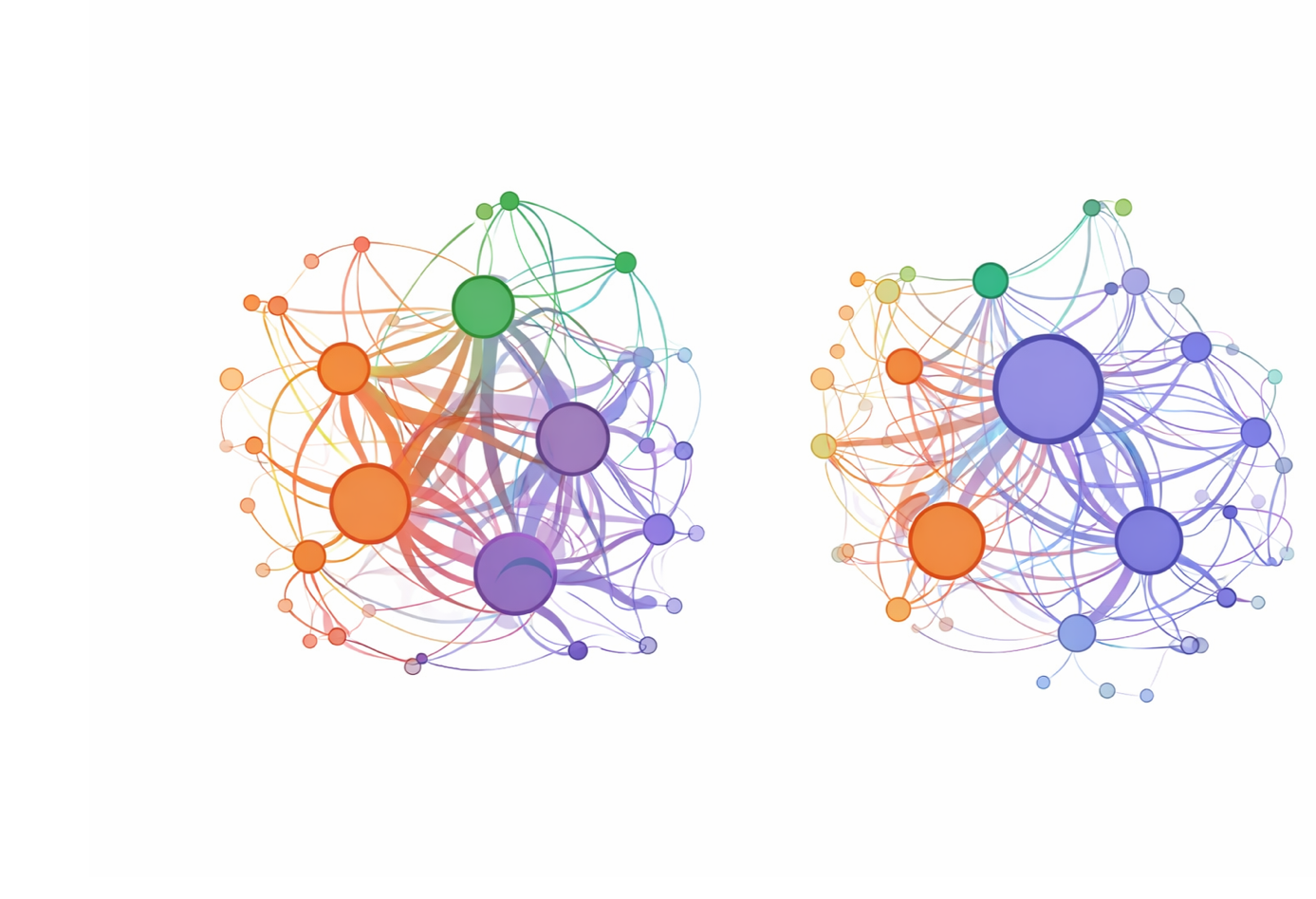
Figure 2 shows a graph that is articulated around 28 nodes and 104 edges. The Betweeness centrality metric recognized the nodes with the most influence within the network: no transparency, corruption, promotion, administrative overhead, and no feedback. Due to the centrality, influence and position they have in the graph, these nodes constitute the central nucleus of social representation. On the other hand, the peripheral system, which is made up of the nodes with the smallest size and with the lowest incidence, is located on the periphery of the network. The nodes of examination, discretionality, accountability and stress stand out.
Using the modularity metric, four communities were identified. The first, referring to the color orange, represents 32% of the connection density. This community is the largest node within the economic stimulus network. The second community, referred to the color purple, has 39% of the density of connections. The node that stands out is the concept of corruption. For its part, the third community, referred to in green, represents 29% of the density of connections. As can be seen, in this one the ascent node stands out.
Figure 1
Social representations of teacher promotion
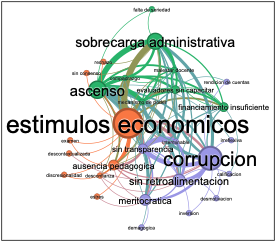
Note: The figure (originally in Spanish) depicts a conceptual network of structural, institutional, and sociocultural factors associated with promotion and evaluation processes in education. Central elements include economic incentives, corruption, promotion, and administrative overload, highlighting their systemic relevance. Related clusters show issues such as lack of transparency, absence of feedback, pedagogical disengagement, insufficient funding, and unqualified evaluators. Peripheral nodes represent contextual dynamics including cronyism, discretionary practices, distrust, stress, and demotivation. The density of connections suggests that promotion systems are perceived as complex governance mechanisms shaped by administrative, economic, and power-related structures rather than solely pedagogical criteria.
Teachers' proposals to improve teacher promotion
Figure 2 shows that the graph is articulated around 33 nodes and 114 edges. With the use of the Betweeness centrality metric, the most outstanding nodes of the network were identified, which constitute the central core of social representation: transparency, professionalization and feedback. It is striking that this graph encodes the node of transparency as the idea with the greatest consensus within the network, a demand in which teachers have persisted in the last decade. On the other hand, we can see how the peripheral system is deployed around the central core through the ideas with less influence within the network, among them are: preparation, favors learning and prestige.
In this order of ideas, through the modularity metric, three communities were detected. The first, referring to the color purple, represents 58% of the density of connections within the network. In this, two of the nodes that constitute the central core of representation stand out: transparency and professionalization. The second community, referred to as orange, has 24% of the connection density. The node that stands out is teacher autonomy. The third community, referred to as green, represents 18% of the network's density. This community is made up of a total of six nodes and the feedback node stands out for its influence.
Figure 2
Teachers' proposal to improve teacher promotion
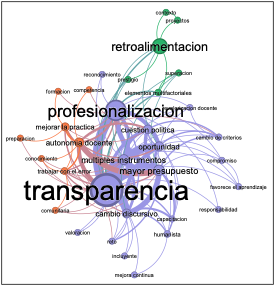
Note: The figure (originally in Spanish) illustrates a conceptual network of proposals articulated by teachers to strengthen promotion and evaluation systems. Central nodes include transparency, professionalization, and feedback, indicating their perceived strategic importance. Interconnected elements highlight the need for multiple evaluation instruments, greater budget allocation, and a discursive shift toward more inclusive, humanistic, and learning-oriented approaches. Related clusters emphasize teacher autonomy, continuous improvement, capacity building, and recognition, alongside calls for policy reform, clearer criteria, and shared responsibility. The density of connections suggests that improvement is conceived as a systemic transformation integrating pedagogical, institutional, and governance dimensions rather than isolated technical adjustments.
Discussion
The social representation of teachers on promotion is linked to economic stimuli, as the idea with the greatest consensus. This idea has historical antecedents that support it. The career system in Mexico has been associated with economic incentive programs since the 1970s. Although it is true that teacher promotion operates in three ways, for the teachers surveyed horizontal promotion is of greater interest. In this sense, the SEP (2024), highlights that 81,493 teachers have benefited, to whom the amount assigned corresponds to an average of between 35 and 41 percent of the salary. However, 205% is the maximum percentage that can be granted on the base salary. This is why the evaluation for horizontal promotion becomes an indispensable mechanism to improve their economic income.
Teachers also associate teacher promotion with corruption schemes. It should be noted that, at the beginning of the government of Andrés Manuel López Obrador, the then Secretary of Public Education, Esteban Moctezuma Barragán, spoke out against the sale of positions and advanced: "We have designed an open and transparent process to guarantee certainty, impartiality and legality in the allocation of vacancies" (SEP, 2019, para. 3). For its part, the government of Dr. Claudia Sheimbaum Pardo, in August 2024, announced: "USICAMM is over, and we are going to build together a new system that considers teachers, without resorting to old practices of corruption" (García, 2024, para. 4).
As part of the institutional framework, the Open and Transparent System for the Allocation of Places (SATAP) was created with the purpose of ensuring that state entities could register vacancies in a timely manner. However, a recent study points out that it is a constant that state entities do not publish calls for entry or promotion to the service, nor vacancies (Compañ, 2024). In addition, it is noted that the USICAMM "largely inherited inefficiency and a marked opacity that gave rise to acts of corruption and discretion in the allocation of positions" (Flores & López, 2025).
Another important aspect is that the teachers believe that the funding granted by the federation for teacher promotion is insufficient. It is worth mentioning that the budget granted to the career system is essential to ensure that the goals established in the LGSCMM are met. Currently, the SEP-USICAMM Call (2025b) includes a legal safe-conduct that allows USICAMM to disregard its responsibility to guarantee the right to economic incentives to those teachers who have obtained favorable results. We refer to the section General considerations, section IX, which reads "the allocation shall be subject to the budgetary provision" (p. 37). This provision leaves teachers without real possibilities of exercising their right.
In this context, it is relevant to know the proposals that teachers made in order to rethink the horizon of teacher promotion. They propose that transparency be privileged in the promotion processes. To do this, it is essential to clearly communicate the objectives, standards and criteria, as well as the results. This helps teachers to position themselves proactively in the face of teacher promotion processes (Ravela et al, 2017). Therein lies one of the challenges for educational authorities, to generate a reliable promotion system.
Teachers also consider that teacher promotion promotes their professionalization. They associate it with training, preparation and education. In the same vein, they also propose that advocacy encourage feedback. Its absence is a cause for concern because it restricts individual and collective dialogue. Moreno (2021) states that feedback is a very important component of formative assessment. For their part, Anijovich and Cappelletti (2020) propose the need to construct dialogic feedback, which goes beyond informing whether the results are good or bad. For this author, it is essential not only to offer answers, but also to offer questions that trigger a deeper reflection on the educational act.
Another proposal that is important to highlight is the use of multiple evaluation instruments. This proposal acquires density and consistency in an educational scenario in which the exam continues to be one of the most widely used instruments in the evaluation of career systems. It should be noted that the exam is one of the multifactorial elements with a high weighting, so the teachers consider it necessary to include other instruments. In this order of ideas, Rosas and Velázquez (2025) review the formative instruments proposed by the Diagnostic, Formative and Comprehensive Assessment Model (MEDFI), in relation to teaching practice, which try to assess the different aspects of teaching from plural perspectives. The instruments that stand out are the portfolio of experiences, reports of experiences and resources to activate reflection.
Conclusions
The purpose of this research was to know and analyze the social representations of teachers about teacher promotion in a context in which the government in power identifies with the left and in which teachers are normatively recognized for their contribution to social transformation. Within this framework, the findings are significant.
The hegemonic idea that organizes social representation is the increase of wages through economic stimuli. This idea is powerful to think about the positive impact that teacher promotion has on the increase in teachers' base salaries. However, the teachers also said that there are problematic aspects. We are referring to administrative overload, insufficient financing and corruption. In this situation, we can affirm that teachers perceive certain similarities and continuities between the teaching promotion of the SPD and the Career System for Teachers.
In this way, teachers also associated teacher promotion with affirmative practices such as promotion, linked to updating and training. On the basis of these ideas, new principles could begin to be proposed to guide this process in the interest of the teachers. If teachers consider that teacher promotion processes are reliable, this could constitute a learning factor.
Consequently, we can argue that the attitude of teachers towards teacher promotion is ambivalent. Social representation is organized around both positive and negative ideas. This shows the need to reformulate the guiding principles that regulate and operate teacher promotion. In such a way that promotion becomes a device that promotes learning, enriches practice and fosters the long-awaited revaluation of the teaching profession. And that, for the time being, it continues to improve the salaries of some teachers while an educational reform is built that dignifies the work of teachers and grants them salaries that allow them to live decently.
Finally, we consider that the proposals made by teachers are intended to vindicate the teaching function through a relevant and necessary career system. In its statements, one can read a concern to reliably regulate the basic principles that guarantee that teachers who opt for promotion, in any of its three paths, do so under equal conditions. Therefore, they propose a transparent, professionalizing evaluation that promotes timely feedback.
References
Aboites, H. (2012). La medida de una nación. Los primeros años de la evaluación en México. Historia de poder y resistencia (1982-2012). CLACSO.
Abric, Jean-Claude (2001). Las representaciones sociales: aspectos teóricos. En J. C. Abric. Prácticas sociales y representaciones. México, Ediciones Coyoacán.
Anijovich, R., & Cappelletti, G. (2020). La retroalimentación formativa: Una oportunidad para mejorar los aprendizajes y la enseñanza. Revista Docencia Universitaria, 21(1), 81–96. https://revistas.uis.edu.co/index.php/revistadocencia/article/view/11327
Bastian, M.; Heymann, S.; Jacomy M. (2009). Gephi: an open source software for exploring and manipulating networks. International AAAI Conference on Weblogs and Social Media, 3(1), 361-362. https://doi.org/10.1609/icwsm.v3i1.13937
Compañ García, J. R. (2024). Sindicalismo magisterial y corporativismo en los procesos de asignación, promoción y dedicación a la función docente. Perfiles educativos, vol. XLVI, núm. 184, 176-192. DOI: https://doi.org/10.22201/iisue.24486167e.2024.184.61344
Congreso de la Unión (2013). “Ley General del Servicio Profesional Docente”, Diario Oficial de la Federación, 11 de septiembre de 2013 (México). https://www.sep.gob.mx/work/models/sep1/Resource/558c2c24-0b12-4676-ad90-8ab78086b184/ley_general_servicio_profesional_docente.pdf
Congreso de la Unión (2019a). “Decreto por el que se reforman, adicionan y derogan diversas disposiciones de los artículos 3o., 31 y 73 de la Constitución Política de los Estados Unidos Mexicanos en materia educativa”, Diario Oficial de la Federación, 15 de mayo de 2019 (México). https://www.dof.gob.mx/nota_detalle.php?codigo=5560457&fecha=15/05/2019#gsc.tab=0
Congreso de la Unión (2019b). “Ley General del Sistema para la Carrera de las Maestras y Maestros”, Diario Oficial de la Federación, 30 de septiembre de 2019.
Cuevas Cajiga, Y., & Moreno Olivos, T. (2016), Políticas de evaluación docente de la OCDE: un acercamiento a la experiencia en la educación básica. Archivos analíticos de Políticas educativas, 24(1), 1-20. https://doi.org/10.14507/epaa.24.2283
Díaz-Barriga, A. (2015). Evaluación formativa y profesión docente. En Guevara G. (Coord.), La evaluación docente en México (pp. 139-176). Fondo de Cultura Económica, Instituto Nacional para la Evaluación de la Educación y la Organización de Estados Iberoamericanos para la Educación, la Ciencia y la Cultura.
Flores Chávez, J. M. y López Guerra, S. (2025, 24 de junio). De la expectativa al fracaso: un diagnóstico crítico de la USICAMM (2019-2025). Profelandia. https://profelandia.com/de-la-expectativa-al-fracaso-un-diagnostico-critico-de-la-usicamm-2019-2025/
García Delgado, I. (2024, 17 de agosto). Qué es la USICAMM y por qué Claudia Sheinbaum quiere eliminar este órgano para asignar plazas a maestros. Infobae. https://www.infobae.com/mexico/2024/08/17/que-es-la-usicamm-y-por-que-claudia-sheinbaum-quiere-eliminar-este-organo-para-asignar-plazas-a-maestros/
Hernández Navarro, L. (2017, 20 de junio). Nochixtlán: un año sin justicia. La jornada. https://www.jornada.com.mx/2017/06/20/opinion/017a2pol
Inclán, C. (2018). Ley General del Servicio Profesional Docente: recorrido normativo y visión meritocrática. En, Cuevas Cajiga, Yazmín (2018). Reforma educativa 2013: evaluación, política y actores (pp. 91-110). NEWTON y UNAM.
Jiménez Fuentes, E. y Fernández Crispín, A. (2019). Representación social de la educadora: aproximación desde el análisis de redes sociales, Educere, 23(75), 465-476.
Jodelet, D. (2011). Aportes del enfoque de las representaciones sociales al campo de la educación. Espacios en blanco - Serie indagaciones, núm. 21, 133-154. https://www.scielo.org.ar/pdf/eb/v21n1/v21n1a06.pdf
Mantilla Gutiérrez, L. (2014). La trascendencia del Banco Mundial en la Ley General del Servicio Profesional Docente. Elementos para el análisis. Diálogos sobre la educación. 9(5). https://doi.org/10.32870/dse.v0i9.295
Mireles Vargas, O. (2011). Representaciones sociales: debates y atributos para el estudio de la educación. Sinéctica, 36, 3. https://sinectica.iteso.mx/index.php/SINECTICA/article/view/121/114
Moliner, Pascal & Lo Monaco, Grégory (2019). Métodos de asociación verbal para las ciencias humanas y sociales. Fundamentos conceptuales y aspectos prácticos. Editorial: Universidad Autónoma Metropolitana y Gedisa Editorial.
Moreno Olivos, T. (2021). La retroalimentación. Un proceso clave para la enseñanza y la evaluación formativa. México: UAM, Unidad Cuajimalpa, División de Ciencias de la Comunicación y Diseño.
Moscovici, Serge (1979). El psicoanálisis, su imagen y su público. Paris: Huemul
Ravela, P., Picaroni, B. y Loureiro, G. (2017). ¿Cómo mejorar la evaluación en el aula? Reflexiones y propuestas de trabajo para docentes. Montevideo: Grupo Almagro Editores.
Redacción. (2015, 27 de noviembre). Federales blindan Oaxaca para evaluación de maestros. Aristegui Noticias. https://aristeguinoticias.com/2711/mexico/federales-blindan-oaxaca-para-evaluacion-de-maestros/
Rivera Ferreiro, L., González Villarreal, R., y Guerra Mendoza, M. (1). Reconfiguración de la profesión docente en México. De la acreditación voluntaria a la evaluación obligatoria (1992-2015). Revista Del IICE, (39), 83-98. https://doi.org/10.34096/riice.n39.3999
Rosas González, S. y Velázquez Albo, M. A. (2025). MEDFI: claves para repensar la evaluación del desempeño docente en educación básica. RECIE. Revista Electrónica Científica De Investigación Educativa, 9. https://doi.org/10.33010/recie.v9i0.2441
SEP (2019). Se acabará con la corrupción y el abuso en la asignación de plazas docentes: Moctezuma Barragán, 03 de octubre, Boletín número 172, Ciudad de México: Secretaría de Educación Pública. https://www.gob.mx/sep/articulos/boletin-no-172-se-acabara-con-la-corrupcion-y-el-abuso-en-la-asignacion-de-plazas-docentes-moctezuma-barragan
SEP (2024, 24 de febrero). Publica SEP convocatorias del proceso de promoción horizontal en Educación Básica 2024. Boletín 34. https://www.gob.mx/sep/articulos/boletin-34-publica-sep-convocatorias-del-proceso-de-promocion-horizontal-en-educacion-basica-2024?idiom=es
SEP-USICAMM (2025a). Acuerdo que contiene las disposiciones, criterios e indicadores para la realización del proceso de promoción a categorías con funciones directivas o de supervisión en educación básica. Ciudad de México: Secretaría de Educación Pública-Unidad del Sistema para la Carrera de las Maestras y Maestros. http://usicamm.sep.gob.mx/usicamm_dsk08/2025-2026/compilacion/EB/Acuerdo_PromocionVertical_EB.pdf
SEP-USICAMM (2025b). Acuerdo que contiene las reglas del Programa de promoción horizontal por niveles con incentivos en educación básica. Ciudad de México: Secretaría de Educación Pública-Unidad del Sistema para la Carrera de las Maestras y Maestros. http://usicamm.sep.gob.mx/usicamm_dsk08/2025-2026/compilacion/EB/acuerdo_prom_horizontal.pdf
SEP-USICAMM (2025c). Acuerdo que contiene las disposiciones, criterios e indicadores para la realización del proceso de promoción a horas adicionales en educación básica. Ciudad de México: Secretaría de Educación Pública-Unidad del Sistema para la Carrera de las Maestras y Maestros. http://usicamm.sep.gob.mx/usicamm_dsk08/2025-2026/compilacion/EB/Acuerdo_PromocionHrsAdc_EB.pdf