Road Safety Education in Citizen Training
(esp) Educación Vial en la Formación Ciudadana
(port) Educação em Segurança Viária na Formação de Cidadãos
Instituto Superior Tecnológico Bolivariano de Tecnología
 https://orcid.org/0009-0002-8678-5533
Tomalá-Tolozano, T. P. (2025). Educación Vial en la Formación Ciudadana. YUYAY: Estrategias, Metodologías & Didácticas Educativas, 4(2), 1–12. https://doi.org/10.59343/yuyay.v4i2.93
Recepción: 06-12-2024 / Aceptación: 18-01-2025 / Publicación: 31-01-2025

Turnitin Similarity Report
Abstract (en)
This research process seeks to respond to how educational curricula, curricula, teacher methodologies and specialized programs for students in technical and professional careers can be integrated in the field of road safety education as a strategy to prevent accidents, accidents and promote a culture of safer urban mobility on the streets of Guayaquil. The documented levels of traffic accidents are taken into consideration, and it is hypothesized that, due to a lack of a road park in the city for citizens, these rates have had periodic growth. The objective of this review is to analyze how the performance of road simulations in suitable spaces allows a standardized evaluation of the knowledge acquired about traffic rules, the correct use of the zebra crossing and from this promote a culture of road learning through experimentation in a controlled and safe space for the benefit of users. the improvement of road knowledge and the reduction of traffic accidents from pedagogical practice for the different educational levels of the Ecuadorian curriculum.
Keywords: Training, education, road safety, learning, curriculum, traffic.
Resumen
Este proceso investigativo busca responder a como se pueden integrar los currículos educativos, planes de estudios, metodologías de los docentes y programas especializados para los estudiantes en las carreras técnicas y profesionales, en el ámbito de la educación vial como una estrategia para prevenir accidentes, siniestros y fomentar una cultura de movilidad urbana más segura en las calles de guayaquil. Se toma en consideración los niveles documentados de siniestros de tránsito y en el que se aborda como hipótesis que, debido a una carencia de un parque vial en la ciudad para la ciudadanía, estos índices han tenido crecimientos periódicos. El objetivo de esta revisión es analizar cómo la realización de las simulaciones viales en espacios idóneos permite una evaluación estandarizada de los conocimientos adquiridos sobre las normas de tránsito, el correcto uso del paso cebra y a partir de ello fomentar una cultura de aprendizaje vial por medio de la experimentar en un espacio controlado y seguro para el beneficio de los usuarios, la mejora del conocimiento vial y la reducción de siniestros de tránsito desde la práctica pedagógica para los diferentes niveles educativos del currículo ecuatoriano.
Palabras claves: Formación, educación, seguridad vial, aprendizaje, currículo, tránsito.
Resumo
Este processo de pesquisa busca responder a como currículos educacionais, currículos, metodologias docentes e programas especializados para estudantes em carreiras técnicas e profissionais podem ser integrados no campo da educação viária como estratégia para prevenir acidentes, acidentes e promover uma cultura de mobilidade urbana mais segura nas ruas de Guayaquil. Os níveis documentados de acidentes de trânsito são levados em consideração e levanta-se a hipótese de que, devido à falta de um parque viário na cidade para os cidadãos, essas taxas têm tido crescimento periódico. O objetivo desta revisão é analisar como a realização de simulações viárias em espaços adequados permite uma avaliação padronizada dos conhecimentos adquiridos sobre as regras de trânsito, o uso correto da faixa de pedestres e a partir disso promover uma cultura de aprendizagem viária por meio da experimentação em um espaço controlado e seguro para o benefício dos usuários. a melhoria do conhecimento viário e a redução de acidentes de trânsito a partir da prática pedagógica para os diferentes níveis educacionais do currículo equatoriano.
Palavras-chave: Formação, educação, segurança viária, aprendizagem, currículo, trânsito.
Author's note:
Concensus (Open AI) was used to generate 10% of the scientific literature content for the review. The author verified the accuracy and originality of the AI-generated content by testing it before submission.
Nota de autor:
Se utilizó Concensus (Open AI) para generar el 10% del contenido de la literatura científica para la revisión. La autoría verificó la exactitud y originalidad del contenido generado por IA sometiéndolo a pruebas antes de su envío.
Nota do autor:
O Concenso (Open AI) foi utilizado para gerar 20% do conteúdo da literatura científica para a revisão. O autor verificou a precisão e a originalidade do conteúdo gerado pela IA testando-o antes do envio.
Introduction
Ecuador's National Transit Agency (ANT) has made available to citizens the Transportation Statistical Report (ESTRA) on traffic accidents that occurred in Ecuador during the fourth quarter of 2023, which reports a total of 20,994 accidents. This represents a decrease of 745 cases compared to 2022, equivalent to a reduction of 3.43%, according to information updated as of February 2024. The report highlights that the main cause of these accidents lies in the incompetence and recklessness of drivers, placing the province of Guayas in first place nationally in terms of injured citizens.
Road safety is presented as a global challenge that requires interdisciplinary solutions. In this context, the research focuses on the role of road safety education as a key strategy to prevent accidents and accidents, promoting a culture of safe mobility on the streets of Guayaquil. Existing gaps in the implementation of road safety education programs are identified and concrete actions are proposed to strengthen the training of citizens, drivers, pedestrians, and transport professionals (ANT, 2023).
Road safety is a global problem that claims thousands of lives every year, which requires researchers and users to reflect deeply on the causes that generate high accident rates. Despite advances in technology and vehicle design, accident numbers are still alarming. In this context, road safety education is presented as a key factor to prevent accidents, promote safe mobility and promote a road culture. However, despite its relevance, road safety education is not always effectively integrated into educational curricula, curricula, teaching methodologies and specialized programs of technical and professional careers. This is particularly concerning in areas such as land transport and logistics, where future drivers and professionals will play a critical role in promoting safe mobility.
Technical and professional careers related to transport, logistics and civil engineering, among others, train specialists who will have a direct impact on road safety. These future engineers, technologists and technicians must receive a solid training in road safety education and vehicular traffic modeling, which allows them to make informed decisions about traffic laws and promote safe practices in their work performance. The integration of road safety education in the curricula of these careers is essential to guarantee a road culture, safer and more efficient mobility, as well as to contribute to the reduction of accident rates.
Currently, when talking about road safety education, it is essential to develop an educational project that involves all the actors of the Urban Mobility Pyramid. This approach seeks to ensure that each group understands its role in mobility, with special emphasis on ensuring road safety for children and young people, with the aim of reducing accident rates. This effort is part of compliance with the Organic Law on Land Transport, Transit and Road Safety (ANT, 2023).
From the above, it is evident that the problem of road safety education is a priority issue that must be addressed throughout the national curriculum. This implies promoting the active participation of institutions and ensuring that teachers include learning in road safety education as a priority, considering institutional, regional, local and community needs.
In line with the 2030 Agenda, specifically Sustainable Development Goal (SDG) 11, it seeks to provide access to safe, affordable, accessible and sustainable transport systems for all. This goal includes improving road safety by expanding public transport and paying special attention to the needs of vulnerable groups, such as women, children, people with disabilities, and older adults (United Nations, 2015). In this framework, Valcárcel (2021) points out that the Road Safety 2030 strategy must adopt tools that allow responding to the evolution of mobility, offering solutions always appropriate to the implications for road safety.
The purpose of this research is to collect, systematize and analyze a wide range of data regarding traffic accidents in Ecuador in the fourth quarter of 2023, to integrate educational curricula, curricula, teacher methodology and the correct specialized program in technical and professional careers. in the field of road safety education as a strategy to prevent accidents, accidents and promote a culture of safe mobility in the streets of Guayaquil.
Background
Initially, the studies focused on Santiago de Chile, ranked 30th, which obtained the highest score in cities in Latin America according to the Urban Mobility Index study, which evaluated 84 large cities in the world on a scale of 0 to 100, the research was oriented to road safety education because it is not a content inserted in the school system and there are few educational institutions, such as schools, that implement this type of program in the curriculum. From the bibliographic review, a study was identified regarding the Chilean legislation, it only prohibits talking on a cell phone when driving, being considered a serious offense, unless hands-free or Bluetooth is used, in addition the study in question indicates that the user will continue to adapt their needs to these new technologies, but must be educated about the proper use of them and the risk caused by distraction when manipulating these mobile devices when manipulating them. go.
Consequently, according to traffic statistics from the Carabineros de Chile, during 2015 there were 22,221 accidents caused by "distracted" drivers, much higher than the 5,180 accidents attributable to alcohol. Talking or tampering with your cell phone while driving is just as dangerous as driving under the influence of alcohol. In this regard, the use of the telephone increases the risk of an accident at the same levels as driving with a blood alcohol level of 1.0 g/l (National Institute of Statistics Chile, 2015) according to Cabrera, Escobedo & Rodríguez (2017) Risk of accident associated with inattentive driving observed on corners with high road accidents in Greater Santiago.
Later in the city of Bogotá, it is ranked 32nd with 46.3 points with the Urban Mobility Index study, therefore the Road Signage Manual was issued: Uniform devices for the regulation of traffic in streets, highways and bicycle routes of Colombia, allows to establish the classification and definition of traffic signs, whose function is to indicate to the road user about the precautions that must be taken into account, the restrictions and releases that are governed in the traffic section. Different studies have shown that signage influences safety and reduces road accidents; Warning signs, for example, can reduce accidents by up to 20% (Tignor, 1999), or the use of traffic lights at intersections and crosswalks could reduce the number of accidents by about 15% at T-intersections and about 30% at crossings (Rune et al. 2013).
For example, at the European level, road safety education is formally taught from educational institutions and driving schools, where all the necessary information is provided to raise awareness from childhood. In addition, this training is also carried out in a non-formal and informal way, involving families and complementing the teaching given in the classrooms. In Europe, state bodies, private institutions and the media contribute to the incorporation of road safety education into the curricula of Primary Education and Compulsory Secondary Education (ESO). In Spain, for example, there are road parks aimed at training responsible pedestrians, which allows the principles of the urban mobility pyramid to be correctly applied (Tuteórica, 2023).
In contrast, due to the absence of an adequate academic curriculum, Ecuador is one of the countries with the highest road accident rates. Therefore, it is urgent to propose a citizen training program from school that allows, in the future, to form responsible, tolerant citizens, with self-control and respect for traffic rules. The correct implementation of the urban mobility pyramid must be the central axis of this training, promoting safer and more sustainable mobility.
In this context, there are training schools for obtaining driver's licenses, both professional and non-professional, where applicants have access to programs designed to train them in road responsibility. These schools offer structured programs to comply with the academic guidelines established by the ANT, ensuring that students acquire the necessary tools to apply them in a practical way in their daily lives. It is important to note that the target audience to access these training courses are people of legal age. These institutions focus on developing teaching methodologies that promote road responsibility and the correct application of traffic rules.
This study explores the importance of learning in the context of victims of traffic accidents, specifically in the period between January and December 2013. According to transportation statistics, 3,615 victims were reported among people between 18 and 29 years old, an alarming figure that highlights the urgency of promoting effective road safety education. The main objective of this research is to analyze the effectiveness of different didactic evaluation strategies within the classroom to improve the teaching of road safety education which, according to Castaño (1995), is defined as any permanent educational action that favors the development of knowledge, skills, behavioral habits, values and positive attitudes towards traffic, in order to improve road safety and reduce the number of accidents and their consequences. This approach underlines the importance of integrating responsible values and behaviors in citizens from an early age.
The implementation of a road park in the city of Guayaquil would represent a key educational resource for citizens. This space would allow road simulations to be carried out where participants could practice and evaluate traffic rules, acquire basic knowledge in automotive mechanics, apply PAS (Protect, Warn and Assist) standards, and promote the correct use of the zebra crossing. In addition, a road park would contribute to creating a culture of road learning through experiences in a controlled environment supervised by assessors appointed by competent bodies. These activities would benefit the community by raising awareness about the importance of road safety and responsible behavior on the roads.
The development of these educational spaces, both virtual and physical, allows students and citizens in general to acquire essential practical skills, promoting safe and sustainable mobility in Guayaquil. With this, a fundamental step is taken towards the construction of a road culture that reduces accident rates and promotes respect for traffic rules.
Development
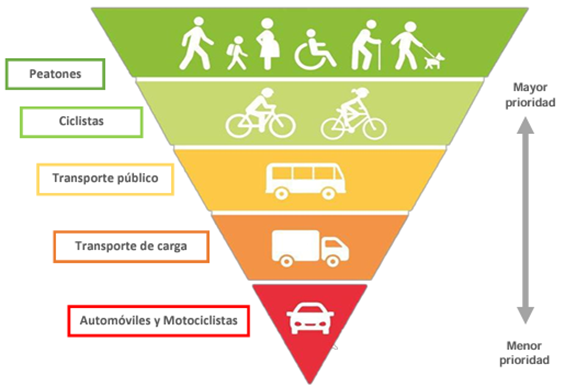
The Urban Mobility Pyramid allows an understanding of the order of priorities for each citizen, with the aim of promoting healthy and sustainable mobility. This tool establishes hierarchies that seek to improve daily mobility habits, promoting equity, social benefit, reduction of environmental impact, and prevention of traffic accidents on the roads (CEPAJ, 2016).
Figure 1
Urban mobility pyramid
Note: Guía global de diseño de calles / Global Designing Cities Initiative, National Association of City Transportation 2016
Pedestrians occupy the first place, as they represent 39% of urban trips. In addition, at some point in the day, we are all pedestrians, which highlights the need to have infrastructure that guarantees their safety (CEPAJ, 2016).
Cyclists, located on the second level, represent an efficient means of transport for short distances. It is economical, does not pollute, takes up less space and is healthy. However, their vulnerability requires measures to guarantee their protection (CEPAJ, 2016).
Public transport takes it to the next level, as it uses less public space than private vehicles and can mobilize a greater number of people. This means of transport is also more economical and favors intermodally with pedestrians (CEPAJ, 2016).
Cargo transport must be regulated so that its activities are carried out at times and places that do not obstruct circulation. It is essential to have adequate space so that these activities do not harm other mobility users (CEPAJ, 2016).
Cars and motorcycles are at the base of the pyramid due to their high consumption of public space and their significant contribution to environmental pollution in cities (CEPAJ, 2016).
That is, due to the need to promote a road culture in Guayaquil citizens, it is essential to train teachers in rules, theory and practice related to road education. This implies reinforcing existing theoretical knowledge and designing content aligned with the real needs of the country. This type of teaching should be considered a priority and included in the curricula. In a context of constant growth of the vehicle fleet and transport in Ecuador, it is essential to promote adequate urban mobility, understanding and attending to the needs of citizens with the aim of saving lives on the roads.
For example, at the European level, road safety education is formally taught from educational institutions and driving schools, where all the necessary information is provided to raise awareness from childhood. In addition, this training is also carried out in a non-formal and informal way, involving families and complementing the teaching given in the classrooms. In Europe, state bodies, private institutions and the media contribute to the incorporation of road safety education into the curricula of Primary Education and Compulsory Secondary Education (ESO). In Spain, for example, there are road parks aimed at training responsible pedestrians, which allows the principles of the urban mobility pyramid to be correctly applied (Tuteórica, 2023).
In contrast, due to the absence of an adequate academic curriculum, Ecuador is one of the countries with the highest road accident rates. Therefore, it is urgent to propose a citizen training program from school that allows, in the future, to form responsible, tolerant citizens, with self-control and respect for traffic rules. The correct implementation of the urban mobility pyramid must be the central axis of this training, promoting safer and more sustainable mobility.
In this context, there are training schools for obtaining driver's licenses, both professional and non-professional, where applicants have access to programs designed to train them in road responsibility. These schools offer structured programs to comply with the academic guidelines established by the ANT, ensuring that students acquire the necessary tools to apply them in a practical way in their daily lives. It is important to note that the target audience to access these training courses are people of legal age. These institutions focus on developing teaching methodologies that promote road responsibility and the correct application of traffic rules.
This study explores the importance of learning in the context of victims of traffic accidents, specifically in the period between January and December 2013. According to transportation statistics, 3,615 victims were reported among people between 18 and 29 years old, an alarming figure that highlights the urgency of promoting effective road safety education. The main objective of this research is to analyze the effectiveness of different didactic evaluation strategies within the classroom to improve the teaching of road safety education which, according to Castaño (1995), is defined as any permanent educational action that favors the development of knowledge, skills, behavioral habits, values and positive attitudes towards traffic, in order to improve road safety and reduce the number of accidents and their consequences. This approach underlines the importance of integrating responsible values and behaviors in citizens from an early age.
On the other hand, Fernández et al., (2017) point out that currently learning in road safety education is motivated by digital media, in contrast to more traditional methods. Web environments amplify communication between teachers and students, offering new dimensions to the teaching-learning process. The integration of digital tools in this context allows for the formation of more conscious citizens, with solid values and committed to safe and sustainable mobility on the streets of Guayaquil. In this way, it contributes to reducing traffic accidents and improving road safety in the community.
Virtual environments have significantly transformed the educational process, creating learning environments that positively impact the development of students' competencies. During the feedback process, it is essential to complement the knowledge acquired at the methodological level and translate it into practice. In this context, Díaz and Soto (2013) define the learning environment as "the organization of space, the arrangement and distribution of teaching resources, the management of time, and the interactions that take place in the classroom" (p. 28). In the field of road education, learning environments must simulate real driving situations, transcending theoretical knowledge to provide practical experiences that allow students to develop skills and make correct decisions when driving a vehicle.
The implementation of a road park in the city of Guayaquil would represent a key educational resource for citizens. This space would allow road simulations to be carried out where participants could practice and evaluate traffic rules, acquire basic knowledge in automotive mechanics, apply PAS (Protect, Warn and Assist) standards, and promote the correct use of the zebra crossing. In addition, a road park would contribute to creating a culture of road learning through experiences in a controlled environment supervised by assessors appointed by competent bodies. These activities would benefit the community by raising awareness about the importance of road safety and responsible behavior on the roads.
The development of these educational spaces, both virtual and physical, allows students and citizens in general to acquire essential practical skills, promoting safe and sustainable mobility in Guayaquil. With this, a fundamental step is taken towards the construction of a road culture that reduces accident rates and promotes respect for traffic rules.
Conclusions
The research proposes the need to integrate road safety education in a transversal way at all educational levels from primary to higher education, which requires a well-structured curriculum, which works on the methodological and practical part, with the purpose of creating citizens with road responsibility, values and awareness about urban mobility and thus reduce road accidents on the streets of Guayaquil.
Therefore, the lack of a road park in Guayaquil has been identified as a necessity, because it is a significant limitation for the practical training of the citizen in road education, the implementation of a safe space allows license applicants to simulate situations behind the wheel, which reinforces practical knowledge, theoretically and in turn develop safe driving skills.
Therefore, road safety education should not only focus on citizens who aspire to obtain a license, but also involve pedestrians, cyclists, drivers, etc. It is necessary to carry out campaigns for society and thus promote a culture of safe mobility that involves all road actors.
References
Bayon, J. (2024). Modelo Praxeológico de Referencia en torno al análisis de una situación vinculada con la Educación Vial. Revista Electrónica de Investigación en Educación en Ciencias, 19(1).
Cedeño Romero, E. L., & Murillo Moreira, J. A. (2019). Entornos virtuales de aprendizaje y su rol innovador en el proceso de enseñanza. Revista de Ciencias Humanísticas y Sociales (rehuso), 4(1), 138-148. Https://doi.org/10.33936/rehuso.v4i1.2156
CEPAJ (2016). Pirámide de movilidad urbana. Centro de Estudios de Políticas Ambientales y Jurídicas.
Codina, A. D., Arjona, V. B., Melgar, P. J., Garzón, P. C., Rodríguez, F. R., Serrano, J. S., & Knox, E. (2023). Adaptación al cambio climático, promoción de la salud y sostenibilidad: la pirámide de movilidad saludable y sostenible. Revista de Salud Ambiental, 23(2), 154-161.
Fernández Escobar, J. E., Ávila Portuondo, A. M., & Milanés Gómez, R. (2017). La educación vial asistida por tecnología 3D: un modelo de su enseñanza-aprendizaje. Revista Universidad y Sociedad, 9(3), 130-134.
Instituto Nacional de Estadística y Censo (2024 Estadísticas de Transporte 2023 (ESTRA). Revisado el 20 de noviembre, 2024, de https://www.ecuadorencifras.gob.ec/documentos/web-inec/Estadisticas_Economicas/Estadistica%20de%20Transporte/2023/iv_trimestre/2023_RESULTADOS_SINIESTROS_IVT.pdf
Jariot-García, M., Rodríguez-Parrón, M., Tello-Sánchez, J., & Montané-Capdevila, J. (2024). Actitudes del profesorado de formación vial en formación para educar personas conductoras con riesgo cero. RELIEVE. Revista Electrónica de Investigación y Evaluación Educativa, 30(1). Https://doi.org/10.30827/relieve.v30i1.26683
Naciones Unidas. (2015). Transformar nuestro mundo: la Agenda 2030 para el Desarrollo Sostenible. Recuperado de https://www.un.org/sustainabledevelopment/es/
Tello Sánchez, J. R. (2023). Impacto del modelo de cambio de actitudes en el proceso de capacitación del profesorado de formación vial.
Tuteórica. (2023). La educación vial en Europa y su impacto en la movilidad urbana. Https://www.tuteorica.com/educacionvial
Valcárcel, J. (2021) Estrategia de seguridad vial 2030. Dirección General de Tránsito (ed) Observatorio Nacional de Seguridad Vial https://seguridadvial2030.dgt.es/export/sites/sv2030/.galleries/descargas/Estrategia_de_Seguridad_Vial_2030_Resumen.pdf
García, A., & Jackson, J. (2024). Herramientas tecnológicas para la enseñanza aprendizaje de la educación vial en estudiantes de conducción (Master's thesis, Quito: Universidad Tecnològica Indoamèrica). https://repositorio.uti.edu.ec/bitstream/123456789/6557/1/ARCE%20GARCIA%20JUAN%20JACKSON.pdf