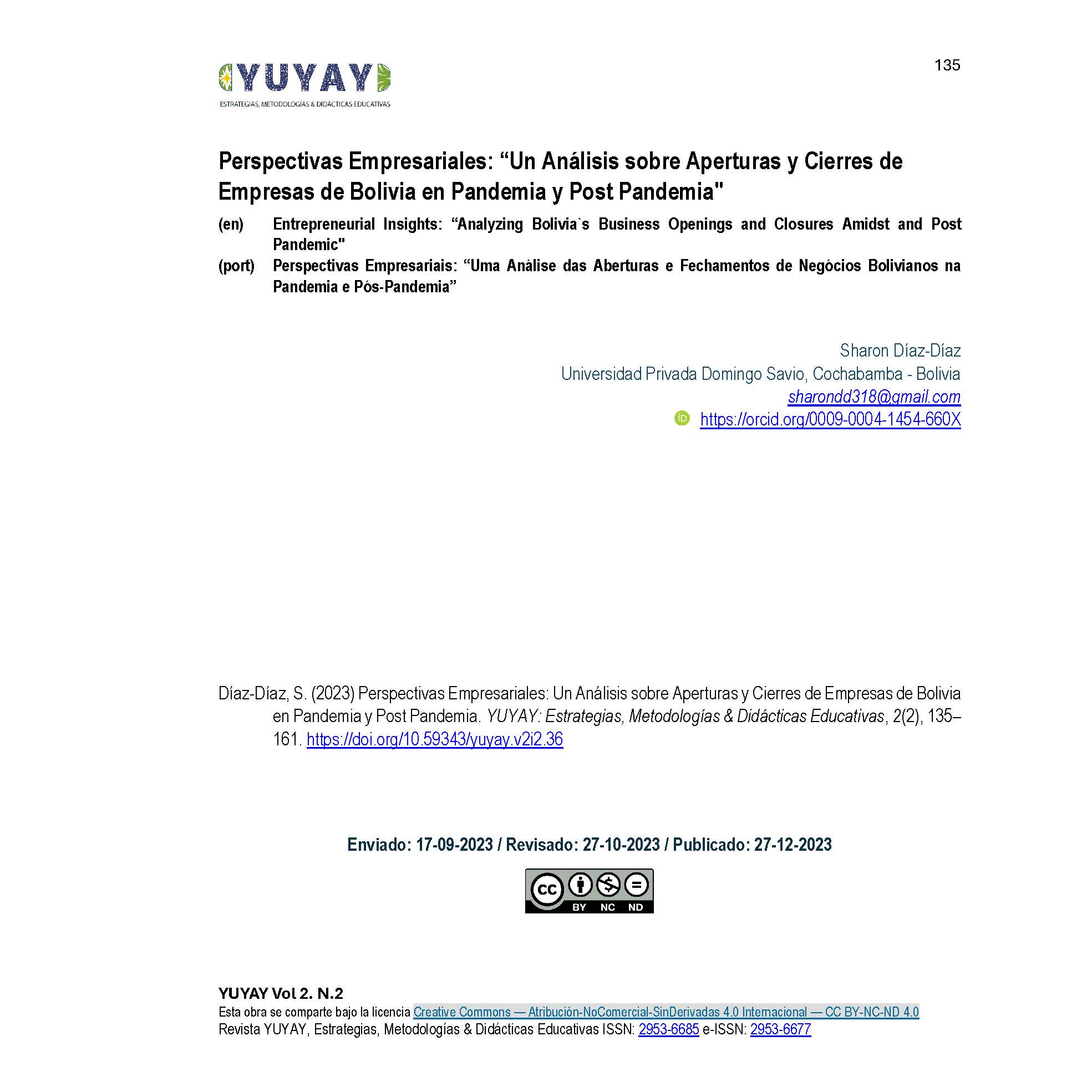
Entrepreneurial Insights
Analyzing Bolivia`s Business Openings and Closures Amidst and Post Pandemic
DOI:
https://doi.org/10.59343/yuyay.v2i2.36Keywords:
New businesses; business closures; business sectors; Bolivia and entrepreneurship; pandemic.Abstract
The main purpose of this paper consists in providing an analysis about the openings and closures business during and after the pandemic period in Bolivia. It covers the period from 2020 to the early months of 2023. The main methodology applied is statistical data collection followed by data analysis within Bolivia and the included countries, forming the core of the research. In addition, in order to explore the local situation, this research expands its focus to a comparison with the neighboring countries by calculating the total businesses in proportion to the population of each country, this comparative perspective is established updated until 2022. The countries considered in this comparison include Argentina, Chile, Peru, Paraguay, and Ecuador.
The findings suggest that Bolivia experienced a promising post-pandemic recovery, as the results revealing a downward trend among businesses that closed. The research also showed that Peru stands suggestively above this group while Argentina has a notable total number businesses in its rank, although in proportion to its population it has a lower percentage and Bolivia is still in a lower position in this group.
Downloads
References
Instituto Peruano de Economía. (s.f.). Instituto Peruano de Economía. Obtenido de https://www.ipe.org.pe/
Ayoroa, T. Z. (2021). RELACIÓN ENTRE EL PIB, LA ELECTRICIDAD Y LA ECONOMÍA SOMBRA EN BOLIVIA. Investigación & Desarrollo, 21(2). doi:https://doi.org/10.23881/idupbo.021.2-2e DOI: https://doi.org/10.23881/idupbo.021.2-2e
Banco Central de Bolivia. (2020). Obtenido de https://www.bcb.gob.bo/
Banco Mundial. (2020). Obtenido de https://www.bancomundial.org/es/home
Banco Mundial. (2023). Obtenido de https://www.worldbank.org/en/country/bolivia/overview
Barrera Insúa, F. N. (2022). La pandemia y el empleo registrado privado en Argentina: un análisis de la desigualdad salarial en clave regional y sectorial. SEDICI. doi:https://doi.org/10.24215/23468904e132 DOI: https://doi.org/10.24215/23468904e132
BCN. (s.f.). Biblioteca del Congreso Nacional de Chile. Obtenido de https://www.bcn.cl/siit/reportesdistritales/pdf_distrito.html?anno_r=2022&distrito=10
Biblioteca del Ministerio de Producción de Argentina. (2023). Obtenido de https://biblioteca.produccion.gob.ar/document/download/535
BID. (2021). Banco Interamericano de Desarrollo. Obtenido de https://publications.iadb.org/es/informe-anual-del-banco-interamericano-de-desarrollo-2021-resena-del-ano
Carmona(UNGS/CONICET), R. (2023). Impactos sobre el mercado de trabajo y desigualdad en el contexto argentino reciente. BORDES(29), 7-12.
Carmona/UNGS/CONICET/, R. (2023). Impactos sobre el mercado de trabajo y desigualdad en el contexto argentino reciente. BORDES(29), 7-12.
Castro, J. M. (2022). Factores que impulsan el crecimiento empresarial en América Latina. Journal of Business Research. doi:10.1016/j.jbusres.2022.08.014 DOI: https://doi.org/10.1016/j.jbusres.2022.08.014
CEPAL. (2020). Estudio Económico de América Latina y el Caribe . Obtenido de https://www.cepal.org/es/publicaciones/46070-estudio-economico-america-latina-caribe-2020-principales-condicionantes
Collazos, C. C. (2021). Reinvención de la mujer emprendedora: una reflexión desde su autonomía económica en Bolivia. Revista Investigación y Negocios, 14(23). doi:https://doi.org/10.38147/invneg.v14i23.132 DOI: https://doi.org/10.38147/invneg.v14i23.132
Copa, A. O. (2022). Estudios sociales de digitalización en Bolivia, 2000-2020. Temas Sociales, 12, 13. doi:https://doi.org/10.53287/eyzg3294yj93f DOI: https://doi.org/10.53287/eyzg3294yj93f
Creswell, J. W. (2014). Research design: Qualitative, quantitative, and mixed methods approaches. Thousand Oaks.
Foronda-Alcaraz, C. F. (2016). Estimación y Características de la duración del desempleo en Bolivia. (O.-l. I. 2518-4431, Ed.) INVESTIGACIÓN & DESARROLLO, 2(15). Obtenido de http://www.scielo.org.bo/scielo.php?script=sci_arttext&pid=S2518-44312015000200003 DOI: https://doi.org/10.23881/idupbo.015.2-2e
Gomez, R. M., De la Fuente Hernandez, M., Herrera Montalvo, L., & Hidalgo Miranda, A. (2021). Challenges of diagnostic genomics in Latin America. Current Opinion in Genetics & Development, 66, 101-109. doi:https://doi.org/10.1016/j.gde.2020.12.010. DOI: https://doi.org/10.1016/j.gde.2020.12.010
Gonzales-Rocha, B. C.-T. (2020). Análisis de las causas del cumplimiento y evasión tributaria: Evidencia de Bolivia. Revista Perspectivas, 121. Obtenido de http://www.scielo.org.bo/scielo.php?pid=S1994-37332020000200006&script=sci_arttext
INDEC. (s.f.). Instituto Nacional de Estadística y Censos. Obtenido de https://www.indec.gob.ar/
INE . (s.f.). Intituto Nacional de Estadística Paraguay. Obtenido de https://www.ine.gov.py/news/news-contenido.php?cod-news=989
INE. (s.f.). Instituto Nacional de Estadística de Bolivia. Obtenido de https://www.ine.gob.bo/index.php/la-economia-de-bolivia-crecio-428-entre-enero-y-septiembre-de-2022/: https://www.ine.gob.bo/
INE. (s.f.). Instituto Nacional de Estadísticas de Chile. Obtenido de https://www.ine.cl/
INEC. (s.f.). Instituto Nacional de Estadística y Censos Ecuador. Obtenido de https://www.ine.gov.py/news/news-contenido.php?cod-news=989
INEI. (s.f.). Instituto Nacional de Estadística e Informática de Perú. Obtenido de https://www.inei.gob.pe/
Jemio, L. C. (2021). El impacto de la pandemia en la economía boliviana. Revista de Análisis Económico. doi:10.29394/RIA.2021.18.2.5
Juan Pablo Bonilla, M. A. (2023). "The Business Environment in Latin America: A Perspective from the Private Sector". Latin American Business Review, 14.
Landa, F., & Quezada, M. (2022). De FUNDEMPRESA al SEPREC: Una transición que podría ocasionar multas a las Sociedades Anónimas. Obtenido de https://emba.com.bo/fundempresa-seprec/
Manuel Olave, R. N. (2020). "Bolivia: Una nueva mirada al rol de los recursos naturales en el crecimiento económico". Latin American Research Review, 55(1), 15. Obtenido de https://www.cambridge.org/core/services/aop-cambridge-core/content/view/F3CD22772A153D6AE36B6577A35EA32C/S0023879100005914a.pdf/div-class-title-bolivia-una-nueva-mirada-al-rol-de-los-recursos-naturales-en-el-crecimiento-economico-div.pdf DOI: https://doi.org/10.25222/larr.176
Medinaceli Monrroy, S. M. (2021). Breve análisis y prospectiva de la industria del gas natural boliviano: 1980-2021. Revista Latinoamericana de Desarrollo Económico, 2, 3, 4. Obtenido de http://www.scielo.org.bo/scielo.php?pid=S2074-47062021000200169&script=sci_arttext DOI: https://doi.org/10.35319/lajed.202136455
Mesa, F. B., León Castro, E., & Fernández Samacá, D. (2023). Intención emprendedora y educación superior: Un enfoque bibliométrico. Revista CEA, 9. doi:https://doi.org/10.22430/24223182.2465 DOI: https://doi.org/10.22430/24223182.2465
MIC. (s.f.). Ministerio de Industria y Comercio de Paraguay. Obtenido de https://www.mic.gov.py/
Ministerio de Desarrollo Productivo de Argentina. (s.f.). Obtenido de https://www.produccion.gob.ar
Ministerio de Desarrollo Productivo y Economía Plural. (2020). Obtenido de https://produccion.gob.bo/
Ministerio de Desarrollo Productivo y Economía Plural. (2020). Acuerdo entre Yacimientos de Litio Bolivianos (YLB) y la empresa alemana Acisa. La Paz, Bolivia.
Ministerio de Desarrollo Productivo y Economía Plural de Bolivia. (2022). Ministerio de Desarrollo Productivo y Economía Plural de Bolivia. Obtenido de https://produccion.gob.bo/
Ministerio de Desarrollo Rural y Tierras. (2020). Obtenido de https://www.economiayfinanzas.gob.bo/
Ministerio de Economía y Finanzas Públicas. (2020). Obtenido de https://www.economiayfinanzas.gob.bo/
Ministerio de Economía, Fomento y Turismo de Chile. (s.f.). Obtenido de https://www.economia.gob.cl/
Ministerio de la Producción de Perú. (s.f.). Obtenido de https://www.produce.gob.pe/
Naciones Unidas. (2021). América Latina y el Caribe después de COVID-19: Repensando el desarrollo. Santiago, Chile.
Neuman, W. L. (2014). Social research methods: Qualitative and quantitative approaches. En W. L. Neuman. Boston.
OCDE/CAF/CEPAL. (2018). Repensando las instituciones para el desarrollo. Perspectivas económicas de América Latina 2018. doi:https://doi.org/10.1787/leo-2018-es DOI: https://doi.org/10.1787/leo-2018-es
Organización Mundial del Comercio. (s.f.). Obtenido de https://www.wto.org/english/thewto_e/countries_e/peru_e.htm
Prego, F. D. (2021). La política industrial del MAS (2006-2019). Iberoamerican Journal of Development Studies, 10, 332-355.
Rodríguez, F. J. (2021). El impacto de la pandemia en el entorno empresarial en América Latina. Revista de Economía Mundial. doi:10.32796/rem2021.155.02
Scholvin, S. (2021). Oportunidades y trampas de las redes globales de producción: un análisis del sector petrolero en Bolivia. Investigaciones Geográficas, 61, 4–15. doi:https://doi.org/10.5354/0719-5370.2021.60741 DOI: https://doi.org/10.5354/0719-5370.2021.60741
SEPREC/SIIP. (2023). Servicio Plurinacional de Registro de Comercio. Obtenido de Sistema integrado de información : https://siip.produccion.gob.bo/index.php
SRI. (s.f.). Servicio de Rentas Internas del Ecuador. Obtenido de https://www.sri.gob.ec/
Stumpo/Dini/(coords), M. y. (2020). Mipymes en América Latina: un frágil desempeño y nuevos desafíos para las políticas de fomento. Comisión Económica para América Latina y el Caribe (CEPAL). Obtenido de https://repositorio.cepal.org/bitstream/handle/11362/44148/1/S1900361_es.pdf
SUBREI. (2022). Subsecretaría de Relaciones económicas Internacionales. Obtenido de https://www.subrei.gob.cl/sala-de-prensa/noticias/detalle-noticias/2022/11/14/exportaciones-de-las-pyme-crecen-43-en-2022
Véliz, J. C. (2021). El impacto de la pandemia en las empresas bolivianas. Revista de Investigación Académica. doi:10.29394/RIA.2021.18.2.5
World Bank Group. (2022). The World Bank. Obtenido de https://www.worldbank.org/en/research?cid=ECR_GA_worldbank_EN_EXTP_search&s_kwcid=AL!18468!3!665400387525!b!!g!!que%20es%20el%20banco%20mundial&gclid=Cj0KCQjw_5unBhCMARIsACZyzS21xmr1skf6kKCqblFSE8Oe0sjAwQQHO9FRsKNYoV5jN0niJEJtu24aAs5nEALw_wcB
Downloads
Published
Issue
Section
Categories
License
Copyright (c) 2023 Sharon Díaz-Díaz

This work is licensed under a Creative Commons Attribution-NonCommercial-NoDerivatives 4.0 International License.
You are free to:
Share — copy and redistribute material in any medium or format.
- Licensor cannot revoke these freedoms if you follow the terms of the license.
Attribution — You must give credit appropriately, provide a link to the license, and indicate if any changes have been made. You may do so in any reasonable way, but not in a manner that suggests that you or your use are supported by the licensor.
NonCommercial — You may not use the material for commercial purposes.
NonDerivatives — If you remix, transform, or create from the material , you may not distribute the modified material.
No additional restrictions — You may not apply legal terms or technological measures that legally restrict others from making any use permitted by the license.