Gamification and arts in the teaching of a foreign language in the 21st century.
(es) La gamificación y el arte en la enseñanza de una lengua extranjera en el siglo XXI.
(fr) La ludification et l'art dans l'enseignement d'une langue étrangère au XXIe siècle
(port) Gamificação e artes no ensino de uma língua estrangeira no século 21.
(it) La ludicizzazione e l'arte nell'insegnamento di una lingua straniera nel XXI secolo
Monserratt Mogrovejo Rosero
Universidad de las Artes - Ecuador
monserratt.mogrovejo@uartes.edu.ec
 https://orcid.org/0009-0006-0373-7907
Mogrovejo, M. (2024). La gamificación y el arte en la enseñanza de una lengua extranjera en el siglo XXI. YUYAY: Estrategias, Metodologías & Didácticas Educativas, 3(1), 1–15. https://doi.org/10.59343/yuyay.v3i1.62
Enviado: 08-01-2024 / Revisado: 27-03-2024 / Publicado: 30-04-2024

C.net Magister
Abstract (en)
This work analyzes the crucial role of technology and innovation in contemporary education, focusing on foreign language teaching. It addresses the pressing need to incorporate technological tools in educational environments to adapt to a globalized and technologically advanced society. The challenges faced by educators in the current era are discussed, highlighting the importance of an adaptive and personalized pedagogical approach. Furthermore, it examines how innovation in education, including digital technology and gamification, can substantially enhance teaching and learning processes. The relevance of personalized learning, the strategic use of digital tools, and the creation of collaborative and flexible educational environments are emphasized. Additionally, the positive impact of gamification on student motivation and engagement, as well as on the development of linguistic and social skills, is underscored.
The role of arts in foreign language teaching is also emphasized, highlighting its ability to enrich the educational experience and promote deeper and more meaningful learning. Various ways in which art can be integrated into the classroom to stimulate creativity, personal expression, and cultural understanding are described. Finally, the future of teaching is reflected upon, exploring the potential of artificial intelligence (AI) to enhance personalized learning and provide intelligent support to students and educators. The possibility of full integration of technology in teaching is raised, although it is acknowledged that its complete impact is yet to be determined.
Keywords: Technological innovations, gamification, foreign languages, sustainable learning.
Resumen
Este trabajo analiza el papel crucial de la tecnología y la innovación en la educación contemporánea centrándose en la enseñanza de idiomas extranjeros. Se aborda la necesidad apremiante de incorporar herramientas tecnológicas en entornos educativos para adaptarse a una sociedad globalizada y tecnológicamente avanzada. Se discuten los desafíos que enfrentan los educadores en la era actual, destacando la importancia de un enfoque pedagógico adaptativo y personalizado. Por otra parte, se analiza cómo la innovación en la educación; incluida la tecnología digital y la gamificación, puede mejorar sustancialmente los procesos de enseñanza y aprendizaje. Se enfatiza la relevancia de la personalización del aprendizaje, el uso estratégico de herramientas digitales y la creación de entornos educativos colaborativos y flexibles. Además, se examina el impacto positivo de la gamificación en la motivación y el compromiso de los estudiantes, así como en el desarrollo de habilidades lingüísticas y sociales.
Se subraya el papel del arte en la enseñanza de idiomas extranjeros, destacando su capacidad para enriquecer la experiencia educativa y promover un aprendizaje más profundo y significativo. Se describen varias formas en que el arte puede integrarse en el aula para estimular la creatividad, la expresión personal y la comprensión cultural. Por último, se reflexiona sobre el futuro de la enseñanza, explorando el potencial de la inteligencia artificial (IA) para mejorar la personalización del aprendizaje y brindar apoyo inteligente a estudiantes y educadores. Se plantea la posibilidad de una integración total de la tecnología en la enseñanza, aunque se reconoce que su impacto completo aún está por determinarse.
Palabras claves: innovaciones tecnológicas, gamificación, lenguas extranjeras, aprendizaje sostenible.
Resumo
Este documento analisa o papel crucial da tecnologia e da inovação na educação contemporânea, com foco no ensino de línguas estrangeiras. Aborda a necessidade de incorporar ferramentas tecnológicas em ambientes educacionais para se adaptar a uma sociedade globalizada e tecnologicamente avançada. Discute os desafios enfrentados pelos educadores na era atual, destacando a importância de uma abordagem pedagógica adaptativa e personalizada. Além disso, considera como a inovação na educação, incluindo a tecnologia digital e a gamificação, pode melhorar substancialmente os processos de ensino e aprendizagem. Enfatiza a relevância da personalização da aprendizagem, o uso estratégico de ferramentas digitais e a criação de ambientes educacionais colaborativos e flexíveis. Também examina o impacto positivo da gamificação na motivação e no engajamento dos estudantes, bem como no desenvolvimento de habilidades linguísticas e sociais.
Também destaca o papel da arte no ensino de línguas estrangeiras, enfatizando sua capacidade de enriquecer a experiência educacional e promover uma aprendizagem mais profunda e significativa. Descreve diversas formas pelas quais a arte pode ser integrada à sala de aula para estimular a criatividade, a expressão pessoal e a compreensão cultural. Por fim, gera uma reflexão sobre o futuro do ensino, explorando o potencial da inteligência artificial (IA) para aprimorar a personalização da aprendizagem e fornecer suporte inteligente a estudantes e educadores. A possibilidade de uma integração total da tecnologia no ensino é questionada, embora se reconheça que seu impacto completo ainda esteja por determinar.
Palavras-chave: Inovações tecnológicas, gamificação, línguas estrangeiras, aprendizagem sustentável.
Contextualization
Technology is present everywhere; the use of technological tools in the teaching-learning process has become a sine qua non[1] condition to dynamize the classroom and ensure sustainable learning, a frequent discussion among educators in the 21st century. We live and operate in a globalized and technified society; therefore, we are committed to integrating multiple innovative resources to achieve the objectives set in the different spheres we navigate. In the workplace, technology has been essential to overcome borders and shorten both distances and language barriers. Academically, technology opens up endless possibilities as a tool for teaching, reviewing content, tutoring, and providing feedback to students.
The education standards in the 21st century, according to the disclosures made by the UN and UNESCO in the plans towards Agenda 2030 (de Santiago, 2020), require teachers to be resilient, responsive -innovative, communicative, inclusive, observant, empathetic, and attentive-and promoters of inclusive innovation. Often, teachers face challenges such as highly heterogeneous classes, students more inclined towards technology, learners with special educational needs (SEN) - whether associated with a disability or not -, and the wide range of post-pandemic study modalities. This has pushed teachers to embrace innovation and foster a learning environment adapted to the individual needs of each student.
In the field of teaching foreign languages, technology is even more relevant as a mediator of knowledge, and its use in various educational products has created a bridge towards democratization. A tangible example of this is the use of Learning Management Systems (LMS), a tool frequently used in educational institutions nowadays. Furthermore, thanks to technology, it has been possible to integrate playful resources or tools that stimulate learners' creativity, such as gamification and the arts. However, to what extent should we include technology and technological innovations in our teaching practice? Can we consider technology as a true ally in the process of teaching a foreign language?
Development
Educational innovation has been vital in adapting teaching processes to current and future demands. Society is rapidly transforming, and education must be able to prepare students to face the challenges that will arise in the future. Moreover, innovation fosters creativity, critical thinking, and student motivation, which are key aspects for meaningful and effective learning. Likewise, the implementation of innovations in education allows for the customization of the teaching process, addressing the individual needs of each student.
With technological advancements and the incorporation of digital tools, more possibilities are opening up to explore and improve the way we teach and learn. For example, the use of virtual platforms, mobile applications, and online resources expand access to information and provide the opportunity to engage in interactive activities. This gives students greater autonomy in their learning process and enables them to acquire fundamental digital skills in today's society.
On the other hand, the integration of collaborative projects and interaction with people from different cultures and countries thanks to global connectivity, promote the development of social and emotional competencies. Therefore, "it is important for educational institutions to design strategies and programs that promote the development of digital competencies among students, integrating the use of ICT (Information and Communication Technologies) across the curriculum" (Olmedo et al., 2021, p. 164).
Flexible and multifunctional environments allow for adaptation to different types of activities and facilitate collaboration and exchange among students. Additionally, the digitization of educational resources and the use of virtual reality (VR) and augmented reality (AR) tools enrich the learning experience, making it more immersive and engaging. In summary, innovation in education is essential to prepare students comprehensively and offer them the best opportunities for their academic and personal development.
With the strategic use of technology and the inexhaustible creativity of educators, it is possible to transform the way teaching and learning are conducted, promoting more meaningful learning adapted to the needs and realities of the 21st century (Seufert et al., 2021). Currently, technological innovations have had a significant impact on education, facilitating access to resources and tools that enrich teaching and learning processes (Szymkowiak et al., 2021). These innovations encompass various areas, such as the use of mobile devices in the classroom, digital learning platforms, virtual and augmented reality, as well as artificial intelligence.
These technologies offer new possibilities to create more dynamic and personalized educational environments, fostering student participation and engagement. Additionally, new trends have emerged in the educational field, such as online learning, gamification, and the use of data and analytics to inform pedagogical decision-making. These trends are transforming the way students learn and professors teach, allowing for the adaptation of the educational process to the individual needs of each student. Similarly, technological innovations are breaking geographical barriers and providing access to education to those who might otherwise not have access. Through online learning platforms and digital resources, anyone with internet access can learn and improve their skills and knowledge, regardless of their location or economic situation.
The use of mobile devices in the classroom has become a common practice in many educational institutions worldwide. These devices, such as smartphones and tablets, provide students with the facility to access online information quickly and easily, allowing them to conduct research and collaborate effectively with their peers on various academic projects. At the same time, through a wide variety of specific educational applications, teachers have the opportunity to create interactive activities and personalized assessments to further enrich the teaching and learning process in the classroom.
These applications enable students to actively engage in their own education, as they can access supplementary study material, take knowledge tests, and participate in practical learning activities. However, despite the evident benefits that mobile devices can bring to the educational environment, it is essential to establish clear and specific guidelines regarding their responsible use. The rules should include aspects such as the allowed time for device usage during classes, the prohibition of access to certain non-educational websites or applications, and the need to maintain an environment of respect and concentration during school activities.
These guidelines play a pivotal role in creating an appropriate learning environment, as they ensure that mobile devices are used effectively and do not become a distraction for students. In this way, educators can make the most of the available technological tools to improve the teaching process and prepare students for the digital world we live in, providing them with the necessary tools to succeed in their studies and future careers (Kipper et al., 2021).
Digital learning platforms have completely revolutionized how students can access a wide variety of educational materials and engage in numerous learning activities. There is no doubt that these platforms are an invaluable tool in the world of education. One of the most prominent features of these platforms is their interactive content. Through videos, exercises, and interactive assessments, students can fully immerse themselves in their learning process. These tools precisely adapt to the individual needs of students, ensuring a personalized and effective educational experience.
Graham and Longchamps (2022) emphasize the following:
It is of paramount importance to include a variety of experiences and learning situations to truly engage students in interacting with teaching materials and acquired concepts through interaction and collaborative participation. This is why sustainable active learning depends on an inclusive, varied, flexible, innovative, and enriching pedagogical approach. (p. 10)
The fourth industrial revolution (4IR), a term coined to describe the technological advancement and its boom in the 21st century, has changed the traditional paradigm of behaviorist education, making it more dynamic, engaging, and immediate, and giving greater prominence to the student.
Haleem et al., (2022) state the following:
Traditional classroom instructions fail to provide an immediate learning environment, quicker assessments, and increased engagement. In contrast, digital learning tools and technology fill this gap. Some of the efficiencies that such technologies provide are simply unparalleled to traditional learning methodologies. With smartphones and other wireless technology devices becoming popular among the general public, it makes sense for schools and educational institutions to make efficient use of them by incorporating technology into the classroom. In fact, the adaptability and non-intrusive nature of current technology make learning more appealing to the next generation (p. 275).
If we focus our analysis on higher education, the classical model limits the interaction among the three main actors in the educational equation: students, professors, and content. It is here that technological innovations in teaching change the landscape; gamification, for example, emerged as a playful tool that allows teaching content and motivates students to participate actively. Graham and Longchamps (2022, as cited in Forbes et al., 2023) assert that "motivation and stimulation are powerful forces."
From the educators' perspective, they have a divided perception; on one hand, they recognize the benefits of gamification as a highly positive strategy to facilitate learning, but at the same time, they emphasize the effort required to prepare gamified lesson sequences (González & Pujolà, 2021).
Gamification refers to the use of game elements and techniques in non-game contexts, such as language teaching. It involves applying game mechanics like challenges, rewards, and competition to motivate and stimulate active student participation. Through gamification, the learning process becomes tremendously fun, exciting, and engaging, thereby facilitating the acquisition of knowledge and skills more effectively and efficiently. However, it is important to emphasize that gamification isn't just about turning educational activities into games; it is about strategically and intentionally using playful elements to enhance and substantially improve student learning. Its impact on the educational landscape has been so significant that more and more institutions and teachers are adopting this innovative and revolutionary methodology for teaching various subjects. Oliva (2017, as cited in Corchuelo-Rodriguez, 2018) agrees with other authors that gamification in the university context presents an opportunity to motivate, improve group dynamics, attention, reflective criticism, and meaningful learning for students.
Applied to foreign languages teaching, gamification brings numerous benefits for learners. Through the playful elements it introduces such as challenges and rewards, it enhances memorization and assimilation of knowledge, fosters communicative skills, and promotes both collaboration and collective effort. Students are motivated to actively participate, take on challenges, and overcome obstacles, experiencing a sense of achievement and satisfaction as they progress through the game. This tool also provides an interactive and enjoyable environment that facilitates the learning process, allowing students to actively experience and practice the foreign language in real situations while fostering friendly competition among them. Zhang and Chen (2021) found that gamification can have positive effects on reducing anxiety in learning a foreign language among Chinese university students, suggesting that this approach can be beneficial for enhancing the learning experience and academic performance in language teaching contexts.
All these activities culminate in an increase in student performance and their individual or collaborative participation in the classroom. Overall, gamification is an effective strategy to make learning a foreign language more dynamic, effective, and long-lasting. By using techniques such as repetition, immediate feedback, and positive reinforcement, the neural connections related to acquiring language skills are strengthened. Students have the opportunity to practice consistently and meaningfully, enabling them to consolidate the concepts and vocabulary acquired. Additionally, when facing challenges and solving problems through gameplay, students develop critical thinking and creativity skills, enhance their attention span, concentration, and boost their ability to retain and apply knowledge in different contexts. Another significant advantage of gamification in foreign language teaching is its ability to personalize learning according to the individual needs and preferences of each student. By adapting games and activities to different levels of language proficiency, students can progress at their own pace and feel appropriately challenged.
On the other hand, it is important to highlight the versatility offered by technology, technological innovations, and their applications, as they allow us to integrate knowledge across disciplines using concepts that align with intrinsic elements of foreign language learning, such as culture and, by extension, art. Learning a language through the arts has a significant impact on achieving sustainable learning, as it creates an enriching and motivating environment that promotes deeper and lasting learning, enhances students' confidence, and fluency in the language. For example, as noted by Rocha Bernal, Valbuena-García, and Castillo (2024), teaching through the arts promotes creativity, personal expression, and the use of the English language.
However, art does not always aim to enhance artistic creation per se but rather enrich students' education through artistic means. Art can often be seen as a "pedagogical value," as expressed by Eraso (2015, as cited in Rocha and Chávez, 2022), which is employed to stimulate the exploration of concepts, achieve goals, carry out projects, and encourage different forms of expression in any educational setting. Through the arts, creativity and innovative thinking are fostered, skills increasingly demanded in today's job market. Additionally, arts education promotes personal expression, allowing students to explore and share their emotions, thoughts, and viewpoints through various artistic forms. It also stimulates critical thinking by inviting students to analyze and reflect on works of art, thereby fostering their analytical and reasoning abilities (Gutierrez-Cassagnne et al., 2023).
Integrating different forms of art into foreign language teaching enriches learning and promotes a comprehensive educational experience, stimulating the creative process, personal expression, and connecting learners with culture, the essence of their people, and thus the target language. To implement art in the classroom, it is necessary to consider the context and level of the students, as well as select appropriate strategies and resources. Art becomes the catalyst that drives and enhances gamification in the educational sphere, adding magic and charm to the learning experience. Through its multiple forms of expression, art allows students to explore new dimensions, connect with their creativity, and enjoy the process of acquiring knowledge in an enriching and stimulating environment. The use of art in foreign language teaching not only improves the experience but also awakens a passion for learning and develops a true connection with the language and its culture. (Hernando, 2023)
For example, music, plays, films, and other artistic expressions allow students to explore the language in a more authentic and meaningful way. These different forms of art offer real and vibrant cultural contexts, facilitating a deeper and more contextualized understanding of the foreign language. Moreover, art also promotes empathy by allowing students to put themselves in the shoes of characters or artists, understanding their perspectives and emotions. This cultural understanding and empathy are essential for effective communication and harmonious coexistence in an increasingly globalized world.
At the University of the Arts (Guayaquil, Ecuador), the Department of Foreign Languages engages in work based on the "actional perspective”[2] integrating art into the language learning process. Our methodology is supported by the concept of Blended-Learning, wherein students reinforce their knowledge and develop skills within the Moodle platform through various interactive activities that merge artistic themes with foreign languages.
Figure 1

Source: Own creation (2024).
Note: Didactization of an authentic document - video from FRANCE 2 broadcast "D'art d'art," about the painting "La Liberté guidant le peuple" by the Romantic painter Eugène Delacroix, uploaded to the Moodle platform using the H5P tool.
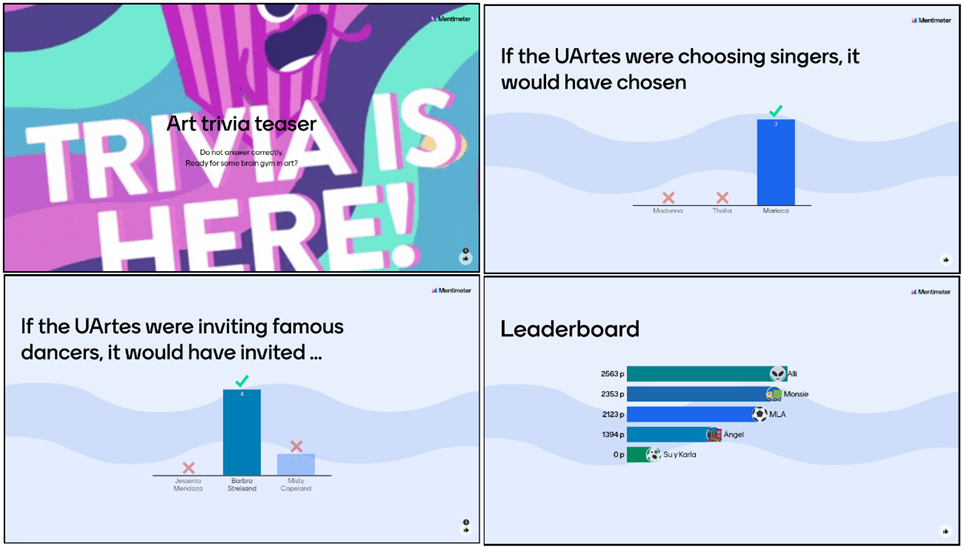
Similarly, within the classroom, teachers incorporate gamification tools to achieve the set objectives in their lessons in a participatory and playful manner. Frequently used applications to reinforce lexical and grammatical content within the teaching-learning process include: Quizziz, Kahoot, Plickers, Socrative, Mentimeter, Blooket, Factile, etc. The use of these playful elements has sparked interest among the student community and has helped foster interactive, communicative, cooperative, and sustainable learning. The acceptance of this methodology has been reflected upon professors’ evaluations, positive feedback from students, and suggestions to include more activities of this nature in both face-to-face and virtual sessions. As Pham and Pham (2022) argue, "teaching and learning become a more collaborative and enjoyable process when game-based components are incorporated. The goal of using the concept of gamification in education is to maximize student motivation and engagement." (p. 263)
Figure 2
Source: Tapia, J. (2024).
Note: Ludic activity to discover the use of the mixed conditional in hypothetical situations. Input created by teacher Joan Tapia Escobar using the app Mentimeter.
Being the first public university in Ecuador devoted to training professionals in different artistic disciplines, we strive to provide a comprehensive and sustainable education to our student body. Therefore, it is essential for us to integrate the use of technological tools and active methodologies, as these allow students to explore and improve their creativity, thus fostering the ability to think innovatively and outside the conventional. Additionally, critical thinking becomes a fundamental pillar, as students learn to analyze information rigorously and question the established norms. Problem-solving becomes an essential skill, as students learn to identify obstacles and find efficient solutions. We are aware that in the current global context, it is crucial for students to acquire and develop 21st-century skills such as digital literacy which will prepare them for success.
Conclusions
In conclusion, technological innovations are revolutionizing education by expanding access to enriching resources and tools, personalizing the learning process, enabling new forms of teaching and learning, and driving educational inclusion by breaking geographic and economic barriers. These technologies continue to evolve and transform the educational world, providing an increasingly tailored learning environment to individual needs and enabling quality education without limits of time or space.
In our teaching practice, within the Department of Foreign Languages at the University of the Arts, both art and gamification have proven to be effective tools in teaching a foreign language to achieve sustainable learning in the 21st century. Gamification motivates and engages students, improves knowledge retention, and develops cognitive and social skills. On the other hand, art stimulates creativity and personal expression, fosters cultural appreciation and empathy, and integrates different art forms into the teaching process. Both methodologies and strategies can be implemented through playful and creative activities, digital platforms, and artistic projects in the foreign language curriculum. Assessment and monitoring of learning, as well as the study of cases and practical experiences, are fundamental to ensure an effective educational process. In summary, combining art and gamification in teaching a foreign language allows for a comprehensive and enriching approach that enhances student learning.
Indeed, in a constantly changing world where today's technology becomes obsolete tomorrow, we wonder if the future of teaching lies in artificial intelligence. Artificial intelligence (AI) has come to transform and revolutionize the educational field in an unprecedented way. It is an essential tool that can provide intelligent and effective support to both students and educators, elevating the quality of teaching to unforeseen levels. AI-based virtual tutoring systems are capable of adapting precisely and surprisingly to the individual needs of each student, thus achieving a much more efficient and personalized teaching process than anyone could have ever predicted. On the other hand, AI-driven educational chatbots have evolved remarkably and can now instantly respond to students' questions with little to no margin of error, providing high-quality real-time assistance that makes students feel like they have an expert by their side at all times. Only time will tell if in ten years, teaching will be completely delivered with, by, and through technology and its innovations.
Referencias
Corchuelo-Rodriguez, C. A. (2018). Gamificación en educación superior: experiencia innovadora para motivar estudiantes y dinamizar contenidos en el aula. Edutec. Revista Electrónica de Tecnología Educativa, 0(63), 29-41 (380).
https://doi.org/10.21556/edutec.2018.63.927
de Santiago, O. (2020). La educación en tiempos de la pandemia de COVID-19. Santiago: CEPAL-UNESCO.
Forbes, D., Gedera, D., Hartnett, M., Datt, A., & Brown, C. (2023). Sustainable Strategies for Teaching and Learning Online. Sustainability 2023, Vol. 15, Page 13118, 15(17), 13118. https://doi.org/10.3390/SU151713118
González, M. V., & Pujolà, J. T. (2021). Del juego a la gamificación: Una exploración de las experiencias lúdicas de profesores de lenguas extranjeras. In Francisco Javier Hinojo Lucena, Salvador Mateo Arias Romero, María Natalia Campos Soto & Santiago Pozo Sánchez (eds.), Innovación e investigación educativa para la formación docente,398–412. Madrid: Dykinson.
https://doi.org/10.2307/j.ctv2gz3t2s.36
Graham, C., & Longchamps, P. (2022). Transformative Education: A Showcase of Sustainable and Integrative Active Learning; Routledge: London,UK.
https://doi.org/10.4324/9781003276203.
Gutierrez-Cassagnne, S., Vallejo-Piza, G., & Almao-Malvacias, V. (2023). El Arte y su Influencia en los Procesos de Aprendizaje de los Estudiantes del Instituto Tecnológico Universitario Euroamericano. 593 Digital Publisher CEIT, 8(6), 131-142.
https://doi.org/10.33386/593dp.2023.6.1624
Haleem, A., Javaid, M., Qadri, M. A., & Suman, R. (2022). Understanding the role of digital technologies in education: A review. Sustainable Operations and Computers, 3, 275–285. https://doi.org/10.1016/J.SUSOC.2022.05.004
Hernando, R. C. (2023). Guernica, arte hecho símbolo. Un breakout educativo digital para el aula de ELE. PARTE 1. CREATIVIDAD Y MOTIVACIÓN. cervantes.es
Kipper, L., Iespen, S., Forno, A., Frozza, R., Bertolin Furstenau, L., Agnes, J., & Cossul, D. (2021). Scientific mapping to identify competencies required by industry 4.0. Technology in Society. 64. 101454.
https://doi.org/10.1016/j.techsoc.2020.101454
Olmedo, E. O., Vázquez-Cano, E., Arias-Sánchez, S., & López-Meneses, E. (2021). Competences in the use of information technologies and communication in university students. Pixel-Bit, Revista de Medios y Educacion, 60, 153–167.
https://doi.org/10.12795/pixelbit.74860
Pham, A. T. V., & Pham, C. M. (2022). Teachers’ perceptions towards using gamification in teaching grammar for non-English majored students. In Proceedings of the 2022 13th International Conference on E-Education, E-Business, E-Management, and E-Learning (IC4E '22) (pp. 261–265). Association for Computing Machinery. https://doi.org/10.1145/3514262.3514295
Rocha Bernal, N., Valbuena-García, L., Castillo, R. (2024). Arts-Based Teaching in E.L.T.: A Review of Concepts and a Proposal of Integration. Zona Próxima, 40, 171-193. https://doi.org/10.14482/zp.40.825.478
Rocha, J. J., & Chávez, G. (2022). El currículo y sus desafíos a nivel metodológico, de la teoría a la praxis y de los contenidos a la centralidad del ser humano. Una propuesta desde las artes. In Marcela Barreiro Moreira, Jefferson Cabrera Amaiquema, Geovanny Chávez Matute, Luis D’aubeterre, Lisbeth Dávila, Johnny Guerra Flores, Elena Gui, Alexander Mansutti-Rodríguez, Juan José Rocha, Rosario Saona, Janina Suárez Pinzón & Jorge Tigrero Vaca. Entre la pedagogía y las artes: Reflexiones sobre la educación en artes, 81-97.
Seufert, S., Guggemos, J., & Sailer, M. (2020). Technology-related knowledge, skills, and attitudes of pre-and in-service teachers: The current situation and emerging trends. https://doi.org/10.1016/j.chb.2020.106552
Szymkowiak, A., Melović, B., Dabić, M., Jeganathan, K., & Kundi, G. S. (2021). Information technology and Gen Z: The role of teachers, the internet, and technology in the education of young people. Technology in Society, 65.
https://doi.org/10.1016/J.TECHSOC.2021.101565
Zhang, L., & Chen, Y. (2021). Examining the Effects of Gamification on Chinese College Students’ Foreign Language Anxiety: A Preliminary Exploration. In Proceedings of the 2021 4th International Conference on Big Data and Education (ICBDE '21) (pp. 1–5). Association for Computing Machinery.
https://doi.org/10.1145/3451400
